West Antarctic ice sheet may not be losing ice as fast as once thought
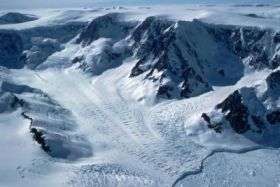
New ground measurements made by the West Antarctic GPS Network (WAGN) project, composed of researchers from The University of Texas at Austin, The Ohio State University, and The University of Memphis, suggest the rate of ice loss of the West Antarctic ice sheet has been slightly overestimated.
"Our work suggests that while West Antarctica is still losing significant amounts of ice, the loss appears to be slightly slower than some recent estimates," said Ian Dalziel, lead principal investigator for WAGN. "So the take home message is that Antarctica is contributing to rising sea levels. It is the rate that is unclear."
In 2006, another team of researchers used data from the Gravity Recovery and Climate Experiment (GRACE) satellites to infer a significant loss of ice mass over West Antarctica from 2002 to 2005. The GRACE satellites do not measure changes in ice loss directly but measure changes in gravity, which can be caused both by ice loss and vertical uplift of the bedrock underlying the ice.
Now, for the first time, researchers have directly measured the vertical motion of the bedrock at sites across West Antarctica using the Global Positioning System (GPS). The results should lead to more accurate estimates of ice mass loss.
Antarctica was once buried under a deeper and more extensive layer of ice during a period known as the Last Glacial Maximum. Starting about 20,000 years ago, the ice began slowly thinning and retreating. As the ice mass decreases, the bedrock immediately below the ice rises, an uplift known as postglacial rebound.
Postglacial rebound causes an increase in the gravitational attraction measured by the GRACE satellites and could explain their inferred measurements of recent, rapid ice loss in West Antarctica. The new GPS measurements show West Antarctica is rebounding more slowly than once thought. This means that the correction to the gravity signal from the rock contribution has been overestimated and the rate of ice loss is slower than previously interpreted.
"The published results are very important because they provide precise, ground-truth GPS observations of the actual rebound of the continent due to the loss of ice mass detected by the GRACE satellite gravity measurements over West Antarctica" said Vladimir Papitashvili, acting director for the Antarctic Earth Sciences Program at the National Science Foundation, which supported the research.
WAGN researchers do not yet know how large the overestimation was. A more definitive correction will be conducted by other researchers who specialize in interpreting GRACE data. Previous estimates of postglacial rebound were made with theoretical models. Assimilation of the direct GPS results into new models will therefore produce significant improvements in estimations of ice mass loss.
The results will appear in "Geodetic Measurements of Vertical Crustal Velocity in West Antarctica and the Implications for Ice Mass Balance" (M. Bevis et al., 2009), published in the electronic journal Geochemistry, Geophysics, Geosystems of the American Geophysical Union and the American Geochemical Society.
A team from The University of Texas at Austin's Jackson School of Geosciences (Ian Dalziel, lead principal investigator), The Ohio State University's School of Earth Sciences (Michael Bevis), and The University of Memphis' Center for Earthquake Research and Information (Robert Smalley, Jr.) performed the WAGN project.
The network consists of 18 GPS stations installed on bedrock outcrops across West Antarctica. Precise, millimeter level, three-dimensional locations of the stations, which are bolted into the bedrock, were determined during measurements made from 2001 to 2003 and from 2004 to 2006, the two measurements being at least three years apart. The difference in the positions during the two time periods indicates the motion of the bedrock.
The WAGN data were supplemented with data from the first year of the Polar Earth Observing Network (POLENET) project, a project to establish a more sophisticated, continuously recording network of GPS and seismic stations, including the already established WAGN sites. POLENET will further improve our understanding of the interaction between the solid earth and ice sheets at both poles. The lead principal investigator of the U.S. Antarctic contribution to POLENET is Terry Wilson of The Ohio State University.
More information: View the paper at: http://www.agu.org/journals/gc/gc0910/2009GC002642/
Source: University of Texas at Austin (news : web)


