Smart rat 'Hobbie-J' produced by over-expressing a gene that helps brain cells communicate
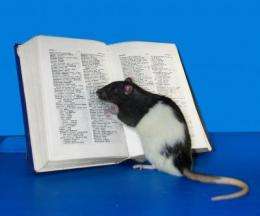
Over-expressing a gene that lets brain cells communicate just a fraction of a second longer makes a smarter rat, report researchers from the Medical College of Georgia and East China Normal University.
Dubbed Hobbie-J after a smart rat that stars in a Chinese cartoon book, the transgenic rat was able to remember novel objects, such as a toy she played with, three times longer than the average Long Evans female rat, which is considered the smartest rat strain. Hobbie-J was much better at more complex tasks as well, such as remembering which path she last traveled to find a chocolate treat.
The report comes about a decade after the scientists first reported in the journal Nature that they had developed "Doogie," a smart mouse that over-expresses the NR2B gene in the hippocampus, a learning and memory center affected in diseases such as Alzheimer's. Memory improvements they found in the new genetically modified Long Evans rat were very similar to Doogie's. Subsequent testing has shown that Doogie maintained superior memory as he aged.
"This adds to the notion that NR2B is a universal switch for memory formation," says Dr. Joe Z. Tsien, co-director of the MCG Brain & Behavior Discovery Institute and co-corresponding author on the paper published Oct. 19 in PLoS ONE. Dr. Xiaohua Cao at East China Normal University also is a co-corresponding author.
The finding also further validates NR2B as a drug target for improving memory in healthy individuals as well as those struggling with Alzheimer's or mild dementia, the scientists says.
NR2B is a subunit of NMBA receptors, which are like small pores on brain cells that let in electrically-charged ions that increase the activity and communication of neurons. Dr. Tsien refers to NR2B as the "juvenile" form of the receptor because its levels decline after puberty and the adult counterpart, NR2A, becomes more prevalent.
While the juvenile form keeps communication between brain cells open maybe just a hundred milliseconds longer, that's enough to significantly enhance learning and memory and why young people tend to do both better, says Dr. Tsien, the Georgia Research Alliance Eminent Scholar in Cognitive and Systems Neurobiology. This trap door configuration that determines not just how much but how fast information flows is unique to NMBA receptors.
Scientists found that Hobbie-J consistently outperformed the normal Long Evans rat even in more complex situations that require association, such as working their way through a water maze after most of the designated directional cues and the landing point were removed. "It's like taking Michael Jordan and making him a super Michael Jordan," Deheng Wang, MCG graduate student and the paper's first author, says of the large black and white rats already recognized for their superior intellect.
But even a super rat has its limits. For example with one test, the rats had to learn to alternate between right and left paths to get a chocolate reward. Both did well when they only had to wait a minute to repeat the task, after three minutes only Hobbie-J could remember and after five minutes, they both forgot. "We can never turn it into a mathematician. They are rats, after all," Dr. Tsien says, noting that when it comes to truly complex thinking and memory, the size of the brain really does matter.
That's one of the reasons scientists pursue this type of research: to see if increased production of NR2B in more complex creatures, such as dogs and perhaps eventually humans, gets the same results. He also is beginning studies to explore whether magnesium - a mineral found in nuts, legumes and green vegetables such as spinach - can more naturally replicate the results researchers have obtained through genetic manipulation. Magnesium ion blocks entry to the NMDA receptor so more magnesium forces the brain cell to increase expression levels of the more efficient NR2B to compensate. This is similar to how statin drugs help reduce cholesterol levels in the blood by inhibiting its synthesis in the liver.
Scientists created Hobbie-J and Doogie by making them over-express CaMKII, an abundant protein that works as a promoter and signaling molecule for the NMDA receptor, something that likely could not be replicated in humans. In October 2008, they reported in Neuron that they could also safely and selectively erase old and new memories alike in mice by over-expressing CaMKII while the memory was being recalled
"We want to make sure this is a real phenomenon," Dr. Tsien says of the apparent connection between higher levels of NR2B and better memory. "You should never assume that discovery you made in a cell line or a mouse can be translated to other species or systems unless you do the experiments." He adds that the failure of new drugs and other disappointments result from the lack of sufficient scientific evidence.
The transgenic rat has other practical value as well. There is substantial scientific and behavior data already available on rats and because rats are larger, it's easier to do memory tests and record signals from their brain. For example they are strong enough to press levers to get a food reward and their size and comfort level with water means they won't just float aimlessly in a water maze as "fluffy" mice tend to do.
More information: Plos ONE paper: http://dx.plos.org/10.1371/journal.pone.0007486
Source: Medical College of Georgia


