Going out on a limb: 'Scaffold' to regenerate lost or damaged bones and tissues
October 19, 2009 Going out on a limb

Enlarge

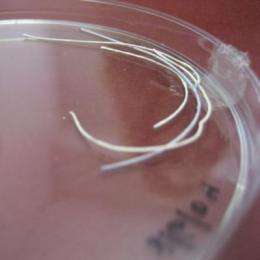
These are composite drug-releasing fibers used as basic elements of scaffolding for tissue and bone regeneration. Credit: AFTAU

Mother Nature has provided the lizard with a unique ability to regrow body tissue that is damaged or torn ― if its tail is pulled off, it grows right back. She has not been quite so generous with human beings. But we might be able to come close, thanks to new research from Tel Aviv University.

Prof. Meital Zilberman of TAU's Department of Biomedical Engineering has developed a new biologically active "scaffold" made from soluble fibers, which may help humans replace lost or missing . With more research, she says, it could also serve as the basic technology for regenerating other types of human tissues, including muscle, arteries, and skin.

"The bioactive agents that spur bone and tissue to regenerate are available to us. The problem is that no technology has been able to effectively deliver them to the tissue surrounding that missing bone," says Prof. Zilberman. Her artificial and flexible scaffolding connects tissues together as it releases growth-stimulating drugs to the place where new bone or tissue is needed ― like the scaffolding that surrounds an existing building when additions to that building are made.

Scientific peer-reviewed research on this scaffold fiber has appeared in a number of journals, including Acta Biomaterialia, and is currently being licensed through Ramot, TAU's technology transfer company.

Active implants

The invention, which does not yet have a name, could be used to restore missing bone in a limb lost in an accident, or repair receded jawbones necessary to secure dental implants, says Prof. Zilberman. The scaffold can be shaped so the bone will grow into the proper form. After a period of time, the fibers can be programmed to dissolve, leaving no trace.

Her technology also has potential uses in cosmetic surgery. Instead of silicon implants to square the chin or raise cheekbones, the technology can be used to "grow your own" cheekbones or puffy lips. But Prof. Zilberman says it's far too early to think of such uses. She first started her work in biomaterials at the UT Southwestern Medical Center at Dallas, Texas, and currently is concentrating on various medical applications. One of them intends to make dental implants more effective. She envisions applying the invention to organ tissue regeneration in the future.

A question of structure

"Our material is very special," Prof. Zilberman explains. "The fibers not only support body parts like bones and arteries. They're also specially developed to release drugs and proteins in a controlled manner. Our special 3-D matrix can hold together drugs that are particularly vulnerable to breaking down easily. The matrix gives the body shape and form, coaxing it to re-grow and strengthen missing parts," she says.

Until now in vitro results on bone have been good, and some basic unpublished results from animal models have shown excellent promise for bone regeneration, says Prof. Zilberman. "It sounds simple, but it's not. It's quite difficult to develop a process for scaffold formation for bone growth. It's a delicate balance to apply only mild conditions that will not destroy the activity of the growth factor molecules."

Currently Prof. Zilberman has developed both a fibrous artificial scaffold and an organic which forms a film. The technology could also be applied to peripheral nerve regeneration. "Our fibers provide all the advantages that clinicians in tissue regeneration are calling for," says Prof. Zilberman. "Being thin, they're ideal when delicate scaffolds are called for. But they can also be the basic building blocks of bones and tissues when bigger structures are needed."

Source: Tel Aviv University (news : web)


print this article email this article download pdf blog this article bookmark this article     Stumble it Digg this share on Facebook retweet share on Reddit add to delicious
Rate this story - 5 /5 (6 votes)

Rank Filter

Move the slider to adjust rank threshold, so that you can hide some of the comments.


Display comments: newest first

  • Birthmark - Oct 20, 2009
    • Rank: not rated yet
    Can they now make teeth and implant them in people's mouths (teeth made from stem cells).
  • cmn - Oct 20, 2009
    • Rank: 5 / 5 (1)
    There's only one "bone" I'm interested in growing. :)
  • DaffyDuck - Oct 20, 2009
    • Rank: 5 / 5 (1)
    "There's only one "bone" I'm interested in growing. :)"

    Middle finger, obviously.

October 19, 2009 all stories

Comments: 3

5 /5 (6 votes)
  • Stumble this up

  • Digg this

  • share this

  • hide
  • Related Stories

  • Bioactive cement scaffold aids bone grafts
    created Apr 17, 2006 | popularity not rated yet | comments 0
  • Carbon Nanotubes Help Fix Bones
    created Mar 14, 2008 | popularity not rated yet | comments 0
  • Engineers create bone that blends into tendons
    created Aug 29, 2008 | popularity not rated yet | comments 0
  • Hydrogels provide scaffolding for growth of bone cells
    created Aug 17, 2008 | popularity not rated yet | comments 0
  • Can a new implant coating technique create a new six million dollar man?
    created Jun 29, 2009 | popularity not rated yet | comments 0


  • hide
  • Relevant PhysicsForums posts

  • Human Leukocyte Antigen (HLA) typing
    created 5 hours ago
  • Breeding program
    created Nov 20, 2009
  • How does a concentration gradient provide energy?
    created Nov 20, 2009
  • Eyesight and Neural Damage from Electronics
    created Nov 19, 2009
  • More from Physics Forums - Biology

Other News

The Monarchs' annual migration ritual has yet to be scientifically explained

Tree-eating bugs threaten Monarch butterfly in Mexico

Biology / Ecology

created 6 hours ago | popularity 4 / 5 (1) | comments 0

The mysterious Monarch butterfly, which migrates en masse annually between Canada and Mexico, is now facing a new peril: another insect thriving in Western Mexican forests.


Extinct goat Myotragus balearicus

Extinct goat was cold-blooded

Biology / Plants & Animals

created Nov 18, 2009 | popularity 4.9 / 5 (33) | comments 10

(PhysOrg.com) -- An extinct goat that lived on a barren Mediterranean island survived for millions of years by reducing in size and by becoming cold-blooded, which has never before been discovered in mammals.


Bigger not necessarily better, when it comes to brains

Bigger not necessarily better, when it comes to brains

Biology / Plants & Animals

created Nov 17, 2009 | popularity 4.5 / 5 (17) | comments 11

(PhysOrg.com) -- Tiny insects could be as intelligent as much bigger animals, despite only having a brain the size of a pinhead, say scientists at Queen Mary, University of London.


Right-handed chimpanzees provide clues to the origin of human language

Biology / Plants & Animals

created Nov 16, 2009 | popularity 3 / 5 (1) | comments 7

Most of the linguistic functions in humans are controlled by the left cerebral hemisphere. A study of captive chimpanzees at the Yerkes National Primate Research Center (Atlanta, Georgia), reported in the January 2010 issue ...


The creature was found at a depth of 161 metres

Japanese researchers film rare baby fish 'fossil'

Biology / Plants & Animals

created Nov 17, 2009 | popularity 4.7 / 5 (7) | comments 4

Japanese marine researchers said Tuesday they had found and successfully filmed a young coelacanth -- a rare type of fish known as "a living fossil" -- in deep water off Indonesia.