Killer algae a key player in mass extinctions
October 19, 2009 algae

Algae, not asteroids, were the key to the end of the dinosaurs, say two Clemson University researchers. Geologist James W. Castle and ecotoxicologist John H. Rodgers have published findings that toxin producing algae were a deadly factor in mass extinctions millions of years ago.

Supervolcanoes and cosmic impacts get all the terrible glory for causing mass extinctions, but a new theory suggests lowly algae may be the killer behind the world's great species annihilations.

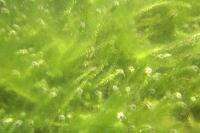
Today, just about anywhere there is water, there can be toxic . The microscopic plants usually exist in small concentrations, but a sudden warming in the water or an injection of dust or sediment from land can trigger a bloom that kills thousands of fish, poisons shellfish, or even humans.

James Castle and John Rodgers of Clemson University think the same thing happened during the five largest mass extinctions in Earth's history. Each time a large die off occurred, they found a spike in the number of fossil algae mats called stromatolites strewn around the planet. Castle will be presenting the research on Monday, 19 October at the annual meeting of the Geological Society of American in Portland, Oregon.

"If you go through theories of mass extinctions, there are always some unanswered questions," Castle said. "For example, an impact - how does that cause species to go extinct? Is it , dust in the atmosphere? It's probably not going to kill off all these species on its own."

But as the nutrient-rich fallout from the disaster lands in the water, it becomes food for algae. They explode in population, releasing chemicals that can act as anything from skin irritants to potent neurotoxins. Plants on land can pick up the compounds in their roots, and pass them on to herbivorous animals.

If the theory is right, it answers a lot of questions about how species died off in the ancient world. It also raises concerns for how today's algae may damage the ecosystem in a warmer world.

"Algae growth is favored by warmer temperatures," Castle said. "You get accelerated metabolism and reproduction of these organisms, and the effect appears to be enhanced for species of toxin-producing cyanobacteria."

He added that toxic algae in the United States appear to be migrating slowly northward through the country's ponds and lakes, and along the coast as temperatures creep upward. Their expanding range portends a host of problems for fish and wildlife, but also for humans, as algae increasingly invade reservoirs and other sources of drinking water.

More information: View abstract at http://gsa.confex.com/gsa/2009AM/finalprogram/abstract_163685.htm

Source: Geological Society of America


print this article email this article download pdf blog this article bookmark this article     Stumble it Digg this share on Facebook retweet share on Reddit add to delicious
Rate this story - 4.4 /5 (17 votes)

Rank Filter

Move the slider to adjust rank threshold, so that you can hide some of the comments.


Display comments: newest first

  • Graeme - Oct 19, 2009
    • Rank: 5 / 5 (2)
    Stromatolites are normally found in hostile conditions, eg high salinity, rather than high fertility water. Places where animals that eat them do not thrive. So their presence may be an indication that mass extinction has already taken place.

    You could expect that where toxic algae dominate over a long period, that some animal that was resistant to the poison could appear and eat them, and do very well.
  • frogz - Oct 19, 2009
    • Rank: 4 / 5 (1)
    eventually, enough scientists will have enough theories about what killed off the dinosaurs, that all we'll need to do is put them all together and call it the day.
  • wiserd - Oct 20, 2009
    • Rank: 5 / 5 (1)
    I've always been a big fan of iron fertilization to help revitalize fish stocks and maybe remove some carbolic acid (dissolved CO2) from the water to alkalinize it a bit. I wonder what it would take to make sure the resulting algae bloom is good algae and not some red tide.

  • Velanarris - Oct 20, 2009
    • Rank: not rated yet
    I've always been a big fan of iron fertilization to help revitalize fish stocks and maybe remove some carbolic acid (dissolved CO2) from the water to alkalinize it a bit. I wonder what it would take to make sure the resulting algae bloom is good algae and not some red tide.


    Iron fertilization would have no effect on Carbonic acid in aqueous solution

October 19, 2009 all stories

Comments: 4

4.4 /5 (17 votes)
  • Stumble this up

  • Digg this

  • share this

  • hide
  • Related Stories

  • Harmful algae taking advantage of global warming
    created Apr 03, 2008 | popularity not rated yet | comments 0
  • Britain cites important algae locations
    created Jan 30, 2008 | popularity not rated yet | comments 0
  • Climate change reduces nutritional value of algae
    created Mar 11, 2009 | popularity not rated yet | comments 0
  • Ultrasound And Algae Team Up To Clean Mercury From Sediments
    created Mar 28, 2006 | popularity not rated yet | comments 0
  • Controlling nitrogen pollution will not stop toxic algae blooms, says research
    created Jul 23, 2008 | popularity not rated yet | comments 0


  • hide
  • Relevant PhysicsForums posts

  • HadleyCru data hacked
    created Nov 20, 2009
  • Younger Dryas Caused by Ice Dam Collapse?
    created Nov 17, 2009
  • Modeling rainfall and flooding
    created Nov 15, 2009
  • Is there any scientific explanation for increasingly violent natural disasters?
    created Nov 14, 2009
  • More from Physics Forums - Earth

Other News

Unseasonably hot and dry weather combined with strong winds to fan scores of blazes in the country's southeastern states

Australia issues 'catastrophic' alerts as fires rage

Space & Earth / Environment

created 5 hours ago | popularity 4 / 5 (1) | comments 0

Australia has issued "catastrophic" alerts after record-breaking temperatures and wild lightning storms sparked more than 100 fires across the country, officials said Saturday.


Atlantis astronauts take 2nd spacewalk of mission (AP)

Atlantis astronauts take 2nd spacewalk of mission

Space & Earth / Space Exploration

created 9 hours ago | popularity 5 / 5 (1) | comments 0

(AP) -- An astronaut anticipating the birth of his daughter at any moment embarked on the first spacewalk of his career Saturday, tackling a load of maintenance work outside the International Space Station.


Commuters wait on the platform shrouded by fog in London

Climate change not man-made, say majority of Britons: poll

Space & Earth / Environment

created Nov 15, 2009 | popularity 3.3 / 5 (15) | comments 45

Less than half of Britons believes that human activity is to blame for global warming, according to a poll carried out for The Times newspaper and published on Saturday.


Mysteriously warm times in Antarctica

Mysteriously warm times in Antarctica

Space & Earth / Earth Sciences

created Nov 18, 2009 | popularity 4.3 / 5 (20) | comments 27

(PhysOrg.com) -- A new study of Antarctica's past climate reveals that temperatures during the warm periods between ice ages (interglacials) may have been higher than previously thought. The latest analysis ...


UN: Fight climate change with free condoms (AP)

UN: Fight climate change with free condoms

Space & Earth / Environment

created Nov 18, 2009 | popularity 3.1 / 5 (11) | comments 22

(AP) -- The battle against global warming could be helped if the world slowed population growth by making free condoms and family planning advice more widely available, the U.N. Population Fund said Wednesday.