3 Questions: Steven Nahn on the elusive Higgs boson
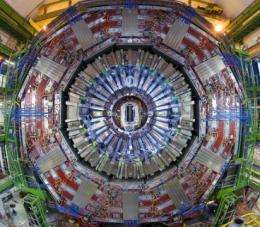
(PhysOrg.com) -- Troubles at the Large Hadron Collider have led some physicists to suggest the Higgs boson is sabotaging its own discovery. Nahn explains why he disagrees.
In September 2008, scientists at CERN sent the first beams of protons running through the Large Hadron Collider (LHC), the world's most powerful particle accelerator. CERN scientists hope to produce the elusive Higgs boson and other novel particles. But the project has seen numerous setbacks. An explosion caused by a failed connection between two magnets last autumn led to a yearlong delay in all operations. And earlier this month, French police arrested a French-Algerian postdoc working at the LHC on charges of terrorism.
Two physicists recently put forth a new theory on why the accelerator has encountered so many delays. Holger Bech Nielsen, of the Niels Bohr Institute in Copenhagen, and Masao Ninomiya of the Yukawa Institute for Theoretical Physics in Kyoto, Japan, suggest that the hypothesized Higgs boson would have such harmful effects that the particle is essentially traveling back through time to stop its own creation.
In this interview, MIT particle physicist Steven Nahn, a leader of the team working on the collider's CMS (compact muon solenoid) detector, says that while there is a long history in physics of "crazy" theories becoming widely accepted, he's not convinced by this one.
Q. Should we take seriously the idea that the Higgs boson is trying to sabotage its own production?
A. The premise is fairly crazy, but many things in physics are constructed that way: Make up a universe where the laws of physics are a bit changed compared to our current understanding, and see where that takes you. That's a common practice amongst the theory crowd. You'd have to check with a historian to be sure, but I can imagine a similar reception to quantum mechanic — but then it explained all sorts of things, like why atoms don't collapse, the Balmer series of quantized radiation from electron transitions, the structure of the periodic table, etc. QM explained certain mysteries already exposed by experiments, and made predictions that could be tested (and were). Similar descriptions apply to both special and general relativity, both of which were probably "crazy" at the time. In special relativity, there is the famous "twin paradox," a prediction that if you take a set of twins, leave one on Earth and send one traveling through space at nearly the speed of light, when the second one returns he will be younger than the one left behind. Sounds "crazy," meaning outside of our normal experience. But in 1972, they put some atomic clocks on planes, flew them around the world, and indeed found that the moving ones were behind relative to ones left on the ground. Experiments like these are essential to have a theory accepted into the canon of physics.
The difference here is that these previous "crazy" ideas gave consequences that were clearly testable and attestable to the new nature of the theory, in an objective manner, and involved the behavior of inanimate objects (i.e., not humans). However, in this case, the consequences seem quite contrived — specifically, setting up the theory such that the Higgs particle thwarts its own discovery at the LHC seems to be creating the means to fit the desired end. Exactly in line with their argument, I could say that Nature abhors the Chicago Cubs, such that the theory which describes the evolution of our universe prescribed Steve Bartman to interfere on Oct. 14, 2003 (en.wikipedia.org/wiki/Steve_Bartman_incident), extending the "bad luck" of the Cubbies. Rather hard to show that this incident is directly attributable to the modification these guys are proposing. On the other hand, if you buy this, we now have a new scapegoat to blame all our misfortunes on: the "imaginary action"!
Then the question, "Why Higgs?" Admittedly, I haven't read the whole series of papers, which means my comments should be taken with a grain of salt, but I did skim, and the authors do make an argument for why a new unknown particle (they use Higgs as their poster boy for unknown theoretical particle) can do this and not the ones we know about, based on the experimental evidence we have on the known particles and the existence of yet another theoretically possible but experimentally undetected (not without trying) phenomenon, a magnetic monopole. But, I think the same argument could have been made in the past regarding any yet-to-be-discovered particle — we don't know its properties, so it could be that it thwarts its own discovery. But (a posteriori) we know that they didn't. Seems a little circular.
Q. Why do physicists want to find the Higgs boson?
A. "Finding the Higgs boson" is really code for understanding why fundamental particles have different masses. We have this wonderfully symmetric structure called the standard model — three "generations" of matter, each with a pair of leptons and a pair of quarks, with each generation looking like a carbon copy of the others. The current leading theory which explains all the interactions of these things does such a good job passing many stringent experimental tests that it is referred to as the "Standard Model." The Standard Model (without the Higgs) requires all these particles to have zero mass, or it fails to be a consistent theory, meaning it will predict outcomes with probability greater than 100 percent at sufficiently high energy — that can't be right! But the big problem is all these symmetries are drastically broken by the mass of these particles. In units of electron volts, the lightest ones weigh less than 0.2, the heaviest 170,000,000,000. And in between there is no pattern. Not only are they not zero, but they are all over the map!
The "Higgs Mechanism" and its associated Higgs boson is just the most economical way of restoring the consistency of the Standard Model while allowing fundamental particles to have non-zero mass. There are other ways of doing it, but this one fits very neatly into the theory. So finding the Higgs boson would allow us to further explore why the fundamental particles have the mass they do. The excitement about the LHC is that in order for the theory to be consistent, the Higgs mass has to lie in a particular range — not too heavy, not too light — and the LHC is the first collider that will have access to the whole range, so we should be able to (eventually) answer this question once and for all.
Q. Barring any further setbacks, when do you expect the Large Hadron Collider to start producing useful data? How long might it take to find evidence of the Higgs boson?
A. From what I have heard just last week, the LHC is still on schedule for circulating beam in the middle of November. But that is just the beginning — then you have to tune the beam and make sure you have it under control, then establish counter-circulating beams, then make sure they collide at the right place, and then ramp up the energy as well. So it can be a long process. Currently, they think it should take about six weeks until we get to "collisions," so maybe by Christmas we'll start getting "real physics" data.
And then, we need to understand our apparatus with this real physics data. We have a bunch of analyses based on simulated data, but it is very difficult to match simulation to actual collisions, so we'll need to use the first batch of data to make sure our strategies based on simulation are in fact optimal for the real deal. We do this by using known physics as benchmarks, the same way you would take an object of known weight to calibrate your bathroom scale.
And then, how long to the Higgs. First, that depends on the mass of the Higgs — in certain mass regions, there are more "false signatures" of the Higgs relative to others, so it takes longer to distinguish the real thing from background. Also, it depends on the machine: For a certain energy, you have a certain probability to make a Higgs — the higher the beam energy, the higher the probability. In addition, the rate at which the machine makes collisions also matters — for a fixed number of Higgses per collision (which is a very tiny number), the more collisions per second, the sooner you get a decent sample to work with.
OK, with all those caveats, we expect to start being able to rule out certain Higgs masses with the data set we will have collected by about one year from now. So don't hold your breath, it will take a few years to have the answer for the whole mass range — this is a marathon, not a sprint, and the path is not perfectly smooth, as we have seen already. But I don't believe physics itself is deliberately setting up roadblocks!
Provided by Massachusetts Institute of Technology (news : web)


