Carbon nanotubes may cheaply harvest sunlight
October 19, 2009 by Sandra Knisely
solar cells

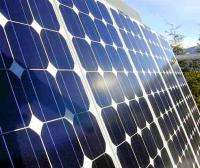
(PhysOrg.com) -- A new alternative energy technology relies on the element most associated with climate change: carbon.

University of Wisconsin-Madison researchers are studying how to create inexpensive, efficient solar cells from carbon nanotubes, which are sheets of carbon rolled into seamless cylinders one nanometer in diameter. Many researchers are studying how to use nanotubes for mechanical and electronics applications, but materials science and engineering assistant professor Michael Arnold is one of the first to apply them to solar energy.

"We are developing new materials and methods to create scalable, inexpensive, stable and efficient photovoltaic solar cell technologies," Arnold says. "Semiconducting carbon nanotubes have remarkable electronic and optical properties that are ideally suited for photovoltaics, so they are an interesting starting point."

Carbon is a promising choice for solar cells because it is an abundant, inexpensive element, and carbon nanotubes have excellent and strong optical absorptivity. Most current solar cells use silicon, which converts 10 to 30 percent of sunlight absorbed into electricity. This is a good rate, but silicon cells are expensive.

"The cost is upfront for silicon cells, and the cost per kilowatt-hour is five times more than you'd pay for coal over 20 years — that's not very motivating for people," says Arnold. With carbon nanotubes, he hopes to achieve efficiency comparable to silicon solar cells for less cost.

Arnold says solar is a valuable energy source since the sun outputs approximately 1,000 watts per square yard. A solar cell that is only 20 percent efficient would generate about 200 watts per square yard on a sunny day, so coating the roof of an average 40-square yard house with solar cells would make a significant dent in the average energy needs of the household. To have an effect on the national electric grid, Arnold envisions expansive fields of solar cells built in desert regions.

"Solar is a viable technology for producing ," Arnold says. "It's just too expensive right now."

To create the new solar cells, Arnold and his students grow nanotube structures and then separate the useful semi-conducting nanotubes from undesirable metallic ones. They also separate the tubes according to diameter, which determines a particular nanotube's bandgap, or wavelength of light the tube can absorb. Certain bandgaps are more suitable than others for absorbing sunlight.

After sorting out the useful nanotubes, the team wraps them in a semi-conducting polymer to make the tubes soluble. They turn the combined nanotubes and polymer into a solution, which can be sprayed in a thin film onto transparent indium-tin-oxide coated glass substrates. The researchers then deposit an electron-accepting semiconductor and a negative electrode on top of the nanotubes to complete the entire cell.

In creating the new , Arnold, who is funded by the National Science Foundation, is attempting to answer a variety of fundamental science and research questions. He is studying how charge is generated in the nanotubes in response to light and how different electron-accepting materials affect the efficiency and speed of the separation of that charge.

"The driving question is, can we understand how to both process the tubes to get the morphology we want, and can we also learn how light creates charges in our carbon nanotube materials and how these charges separate?" he says.

Provided by University of Wisconsin-Madison (news : web)

3.8 /5 (12 votes)  

Filter


Move the slider to adjust rank threshold, so that you can hide some of the comments.


Display comments: newest first

Birger
Oct 20, 2009

Rank: 5 / 5 (1)
" solar cell that is only 20 percent efficient would generate about 200 watts per square yard on a sunny day" -but only if the sun is perpendicular to the solar cell! There are also losses due to cloud, haze etc. I approve of the research, but not on the counterproductive hyperbole.
Rank 3.8 /5 (12 votes)
Related Stories
Relevant PhysicsForums posts
  • polymer nanocomposites
    createdFeb 10, 2012
  • Corrosion Tests on Magnesium
    createdFeb 09, 2012
  • polyethylene copper nanocomposite
    createdFeb 09, 2012
  • Output of xrd analysis
    createdFeb 08, 2012
  • Transport phenomena problem based on problems 18.B11 and 19B.6 from Bird, stewart, lw
    createdFeb 06, 2012
  • Help with material selection - Car Piston
    createdFeb 05, 2012
  • More from Physics Forums - Materials & Chemical Engineering

More news stories

Lab study raises questions over nano-particle impact

Tests involving chickens have raised questions about the impact on health from engineered nano-particles, the ultra-fine grains commonly used in drugs and processed foods, scientists said on Sunday.

Nanotechnology / Bio & Medicine

created 2 hours ago | popularity 5 / 5 (3) | comments 0

New kind of solar cell could capture significantly more energy than current cells

New solar cells could increase the maximum efficiency of solar panels by over 25%, according to scientists from the University of Cambridge.

Nanotechnology / Nanophysics

created Feb 08, 2012 | popularity 4.5 / 5 (13) | comments 14 | with audio podcast

Nanoshell whispering galleries improve thin solar panels

Visitors to Statuary Hall in the U.S. Capitol Building may have experienced a curious acoustic feature that allows a person to whisper softly at one side of the cavernous, half-domed room and for another on ...

Nanotechnology / Nanomaterials

created Feb 07, 2012 | popularity 4.4 / 5 (7) | comments 6 | with audio podcast

'Dark plasmons' transmit energy

Microscopic channels of gold nanoparticles have the ability to transmit electromagnetic energy that starts as light and propagates via "dark plasmons," according to researchers at Rice University.

Nanotechnology / Nanophysics

created Feb 09, 2012 | popularity 4.8 / 5 (10) | comments 1 | with audio podcast

Revealing how a battery material works

Since its discovery 15 years ago, lithium iron phosphate (LiFePO4) has become one of the most promising materials for rechargeable batteries because of its stability, durability, safety and ability to deliver ...

Nanotechnology / Nanomaterials

created Feb 08, 2012 | popularity 5 / 5 (6) | comments 0 | with audio podcast


Scientists discover molecular secrets of 2,000-year-old Chinese herbal remedy

For roughly two thousand years, Chinese herbalists have treated Malaria using a root extract, commonly known as Chang Shan, from a type of hydrangea that grows in Tibet and Nepal. More recent studies suggest that halofuginone, ...

New method to examine batteries -- MRI from the inside

There is an ever-increasing need for advanced batteries for portable electronics, such as phones, cameras, and music players, but also to power electric vehicles and to facilitate the distribution and storage of energy derived ...

Google might launch Drive for cloud storage soon

(PhysOrg.com) -- Google's next big move, according to the Wall Street Journal, is a cloud storage service called Drive. Hardly first to the plate, Google is simply catching up to introducing its cloud reposi ...

A mitosis mystery solved: How chromosomes align perfectly in a dividing cell

Although the process of mitotic cell division has been studied intensely for more than 50 years, Whitehead Institute researchers have only now solved the mystery of how cells correctly align their chromosomes during symmetric ...

Starve a virus, feed a cure? Findings show how some cells protect themselves against HIV

A protein that protects some of our immune cells from the most common and virulent form of HIV works by starving the virus of the molecular building blocks that it needs to replicate, according to research published online ...

Researchers find extensive RNA editing in human transcriptome

In a new study published online in Nature Biotechnology, researchers from BGI, the world's largest genomics organization, reported the evidence of extensive RNA editing in a human cell line by analysis of RNA-seq data, demons ...