Evolution axe goes on display
October 19, 2009
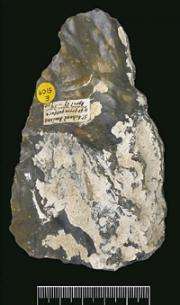
Flint hand axe uncovered in 1859 that helped reveal the ancient age of humankind
(PhysOrg.com) -- A flint hand axe that helped reveal the very ancient age of humankind goes on display at the Natural History Museum October 2009.
The human-made hand axe was discovered in 1859, the same year Charles Darwin published On the Origin of Species, and was the first strong evidence that humans had been living on the planet for much longer than previously thought.
Until the 19th century, most people believed humans had been on Earth for only a few thousands of years. However, this hand axe, probably used by our ancient relatives to cut and prepare meat and skins, was uncovered together with woolly mammoth and rhino remains and showed that humans were living on Earth many thousands of years earlier.
The 2 geologists Joseph Prestwich and John Evans made the discovery and presented the axe at a lecture to the Royal Society.
From then on it began to be more widely accepted that humans had existed on Earth at a much earlier date than previously thought. Since then scientists have gathered extensive evidence for human evolution.
The hand axe is now thought to be about 400,000 years old. Much older stone tools have since been found in Africa by archaeologists. The oldest known artefacts in the world were found in Ethiopia and were made by our very distant ancestors over 2.5 million years ago.
The hand axe was uncovered in 1859 in northern France by workers mining gravel. Crucially, before it was removed from the ground it was photographed.
This meant that scientists could use information such as the position of the item, what other artefacts and fossils were close by, and the type of surrounding rock, to investigate the item scientifically. This was the very first time photography was used to provide precise location evidence for an archaeological discovery.
Joseph Prestwich made many other important geological discoveries, and after his death in 1896 his large collection of fossils and other artefacts was donated to the Natural History Museum.
The axe specimen lay unheralded in the collections for over 100 years and was uncovered again by researchers Robert Kruszynski and Clive Gamble earlier this year, and they published an article about it in the journal Antiquity.
Kruszynski says of their uncovering of the specimen, 'We were able to reconstruct the occasion of the very first endorsement of the great antiquity of human tool-making.'
'The hand axe was donated in 1896 and it is exciting to see it displayed in the Museum for the first time.'
The hand axe display is timely as it coincides with this year’s celebration of Charles Darwin’s 150th anniversary of On the Origin of Species and 200th anniversary of his birth. There are nationwide events taking place as part of a initiative called Darwin200.
The special display called ‘The Axe that revealed the age of mankind’ is in Dinosaur Way in the Blue Zone and is open until December.
-
First evidence of humans in Britain under microscope
Oct 13, 2006 |
not rated yet |
0
-
Fishing boat lands World's oldest underwater human bone
Jul 26, 2009 |
not rated yet |
0
-
Age of earliest human burial in Britain pinpointed
Oct 30, 2007 |
not rated yet |
0
-
Dung beetle named after Darwin
Sep 22, 2009 |
not rated yet |
0
-
Oldest case of impacted wisdom teeth found
Mar 07, 2006 |
not rated yet |
0
-
Engineers build first sub-10-nm carbon nanotube transistor
Feb 01, 2012 |
4.9 / 5 (30) |
30
-
Something old, something new: Evolution and the structural divergence of duplicate genes
Jan 31, 2012 |
4.6 / 5 (7) |
1
-
The hidden nanoworld of ice crystals: Revealing the dynamic behavior of quasi-liquid layers
Jan 30, 2012 |
5 / 5 (3) |
1
-
Stock market network reveals investor clustering
Jan 27, 2012 |
3.9 / 5 (23) |
8
-
Of microchemistry and molecules: Electronic microfluidic device synthesizes biocompatible probes
Jan 26, 2012 |
5 / 5 (1) |
0
-
Pertubance in a model
2 hours ago
-
Cancer drugs and Alzheimer's, Oh my!
10 hours ago
-
Squishing cells
11 hours ago
-
Any books/articles for evolutionary stable strategy models in humans?
22 hours ago
-
Science behind the bore feeling?
Feb 09, 2012
-
Homo Sapien vs. Chimpanzee - Divergence Timeline
Feb 09, 2012
- More from Physics Forums - Biology
More news stories
A frank discussion of the power law and linking correlation to causation
(PhysOrg.com) -- Michael Stumpf a mathematics professor at Imperial College in London, and Mason Porter a lecturer at Oxford have teamed together to write and publish a perspective piece in Science regarding the in ...
Chilean miners' rescue capsule on show in London
The capsule used to rescue Chilean miners trapped underground for two months goes on display Saturday at the Science Museum in London -- the first time it has been seen in Europe.
1 hour ago |
not rated yet |
0
The question of life in the ancient world
Theres a general feeling that we dont get the Greeks ancient or modern. Many, including heads of state like Angela Merkel, visibly shake their head in exasperation, rightly or wrongly, at ...
Other Sciences / Archaeology & Fossils
2 hours ago |
not rated yet |
2
US workers are 'giving away the store,' costing firms billions
Nearly 70 percent of the nation's service employees give away free goods and services from hamburgers to cable TV costing companies billions of dollars a year, according to a groundbreaking study.
Other Sciences / Economics & Business
20 hours ago |
4.5 / 5 (2) |
9
Storm warning: Financial tsunami heading this way
In today's global village, national coffers are more interconnected than ever before. And as the current economic crisis has proven, a downturn in one country can travel in a wave across the globe, like a financial tsunami. ...
Other Sciences / Economics & Business
21 hours ago |
3 / 5 (2) |
7
The power of estrogen -- male snakes attract other males
A new study has shown that boosting the estrogen levels of male garter snakes causes them to secrete the same pheromones that females use to attract suitors, and turned the males into just about the sexiest ...
Experts reveal how plants don't get sunburn
(PhysOrg.com) -- Experts at the University of Glasgow have discovered how plants survive the harmful rays of the sun.
Team isolates nerve cells involved in storing long term memory and gene proteins associated with them
(Medical Xpress) -- A research team in Taiwan has succeeded in isolating two nerve cells in fruit fly brains that are believed to be the major players in allowing for the formation of long term memories. Furthermore, ...
Fool's gold may prove an unlikely alternative to overexploited catalytic materials
Catalytic materials, which lower the energy barriers for chemical reactions, are used in everything from the commercial production of chemicals to catalytic converters in car engines. However, with current catalytic materials ...
SLAC, Stanford team focuses on high-energy electrons to treat cancer
Accelerator physicists at SLAC and cancer specialists from Stanford are working on a new technology that could dramatically reduce the time needed for cancer radiation treatments. The team ran an initial experiment ...
News of plaque-clearing drug tops week of major advances against Alzheimer's disease
In the last eight days, scientists have delivered a powerful one-two punch in the fight to defeat Alzheimer's disease. At the same time, the White House and members of Congress are proposing increases in Alzheimer's research ...