Orionid meteor shower peaks Wednesday
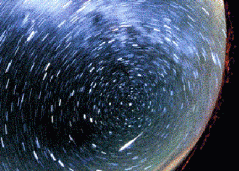
October 19, 2009 meteor shower

Meteor shower. Credit: V. Winter (ICSTARS)

(PhysOrg.com) -- The annual Orionid meteor shower will peak in the hours before dawn on Oct. 21, according to the editors of StarDate magazine, who said the shower could produce up to 20 meteors per hour.

The view should be especially good this year, as the crescent Moon will remain below the horizon, with no chance to overpower the light from meteors streaking across the sky.

High-resolution images and high-definition video are available online at StarDate's Media Center. There, you can also sign up to receive advanced e-mail notices of future skywatching events.

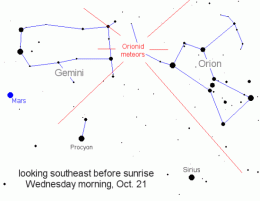
Orionid meteors appear to fall from above the star Betelgeuse, the bright orange star marking the shoulder of the . They are not associated with this star or constellation, but are leftover debris from Halley's . The Orionid meteors recur each year when Earth passes through the comet's debris trail.
Orionid meteor shower peaks Wednesday
Enlarge

Orionid meteors stream from the elbow of Orion the Hunter. Because the shower's radiant point is close to the celestial equator, sky watchers in both hemispheres can enjoy the show.

For your best view, get away from city lights. Look for state or city parks or other safe, dark sites. Lie on a blanket or reclining chair to get a full-sky view. If you can see all of the in the Little Dipper, you have good dark-adapted vision.

Provided by University of Texas at Austin (news : web)


print this article email this article download pdf blog this article bookmark this article     Stumble it Digg this share on Facebook retweet share on Reddit add to delicious
Rate this story - 5 /5 (1 vote)


October 19, 2009 all stories

Comments: 0

5 /5 (1 vote)
  • Stumble this up

  • Digg this

  • share this

  • hide
  • Related Stories

  • Perseid Meteor Shower Peaks Tuesday, Aug. 12
    created Aug 07, 2009 | popularity not rated yet | comments 0
  • Venus, Saturn and Regulus cluster before dawn in October
    created Oct 01, 2007 | popularity not rated yet | comments 0
  • The 2008 Perseid Meteor Shower
    created Jul 22, 2008 | popularity not rated yet | comments 0
  • Mars Joins The Perseid Meteor Shower For A Beautiful Display On August 12th.
    created Jul 26, 2005 | popularity not rated yet | comments 0
  • Perseid Meteor Shower To Peak Aug. 12
    created Aug 07, 2008 | popularity not rated yet | comments 0


  • hide
  • Relevant PhysicsForums posts

  • Question about 2-body gravity
    created Nov 24, 2009
  • life on Mars
    created Nov 24, 2009
  • Semi-major axis from cartesian co-ordinates
    created Nov 23, 2009
  • Primary Mirror grinding
    created Nov 23, 2009
  • More from Physics Forums - General Astronomy

Other News

Small faults in Southeast Spain reduce earthquake risk of larger ones

Small faults in Southeast Spain reduce earthquake risk of larger ones

Space & Earth / Earth Sciences

created 45 minutes ago | popularity not rated yet | comments 0

A team of Spanish scientists, studying recent, active deformations in the Baetic mountain range, have shown that the activity of smaller tectonic structures close to larger faults in the south east of the ...


Cutting greenhouse pollutants could directly save millions of lives worldwide

Space & Earth / Environment

created 16 minutes ago | popularity not rated yet | comments 0

Tackling climate change by reducing carbon dioxide and other greenhouse emissions will have major direct health benefits in addition to reducing the risk of climate change, especially in low-income countries, according to ...


It's not just dirt!

Space & Earth / Environment

created 13 minutes ago | popularity not rated yet | comments 0

Soil is the linchpin of the environment, where atmosphere, biosphere, and hydrosphere meet. Despite that, many students see soil as "just dirt" - a place to grow plants, but nothing more. Soil science educators are challenged ...


First black holes may have incubated in giant, starlike cocoons, says CU-Boulder study

First black holes may have incubated in giant, starlike cocoons

Space & Earth / Astronomy

created 21 hours ago | popularity 4.5 / 5 (11) | comments 15

(PhysOrg.com) -- The first large black holes in the universe likely formed and grew deep inside gigantic, starlike cocoons that smothered their powerful x-ray radiation and prevented surrounding gases from ...


Mars Reconnaissance Orbite

Mars Reconnaissance Orbite Team Plans Uplink of Protective Files

Space & Earth / Space Exploration

created 3 hours ago | popularity 5 / 5 (1) | comments 0

(PhysOrg.com) -- The team operating NASA's Mars Reconnaissance Orbiter plans to uplink protective files to the spacecraft next week as one step toward resuming the orbiter's research and relay activities.