Arctic lake sediments show warming, unique ecological changes in recent decades
October 19, 2009
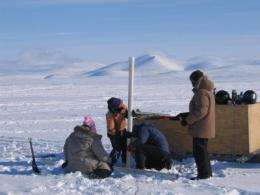
A University of Colorado at Boulder-led analysis of a 200,000 year-old sediment core from a Baffin Island lake indicates warming temperatures in the Arctic due to human activity are overriding a natural cooling trend in the region. Credit: Photo by Jason Briner, University at Buffalo
An analysis of sediment cores indicates that biological and chemical changes occurring at a remote Arctic lake are unprecedented over the past 200,000 years and likely are the result of human-caused climate change, according to a new study led by the University of Colorado at Boulder.
While environmental changes at the lake over the past millennia have been shown to be tightly linked with natural causes of climate change -- like periodic, well-understood wobbles in Earth's orbit -- changes seen in the sediment cores since about 1950 indicate expected climate cooling is being overridden by human activity like greenhouse gas emissions. The research team reconstructed past climate and environmental changes at the lake on Baffin Island using indicators that included algae, fossil insects and geochemistry preserved in sediment cores that extend back 200,000 years.
"The past few decades have been unique in the past 200,000 years in terms of the changes we see in the biology and chemistry recorded in the cores," said lead study author Yarrow Axford of CU-Boulder's Institute of Arctic and Alpine Research. "We see clear evidence for warming in one of the most remote places on Earth at a time when the Arctic should be cooling because of natural processes."
The study was published Oct. 19 in the Proceedings of the National Academy of Sciences. The study included researchers from CU-Boulder, the State University of New York's University at Buffalo, the University of Alberta, the University of Massachusetts and Queen's University in Kingston, Ontario.
The sediment cores were extracted from the bottom of a roughly 100-acre, 30-foot-deep lake near the village of Clyde River on the east coast of Baffin Island, which is several hundred miles west of Greenland. The lake sediment cores go back in time 80,000 years beyond the oldest reliable ice cores from Greenland and capture the environmental conditions of two previous ice ages and three interglacial periods.
The sediment cores showed that several types of mosquito-like midges that flourish in very cold climates have been abundant at the lake for the past several thousand years. But the cold-adapted midge species abruptly began declining in about 1950, matching their lowest abundances of the last 200,000 years. Two of the midge species adapted to the coldest temperatures have completely disappeared from the lake region, said Axford.
In addition, a species of diatom, a lake algae that was relatively rare at the site before the 20th century, has undergone unprecedented increases in recent decades, possibly in response to declining ice cover on the Baffin Island lake.
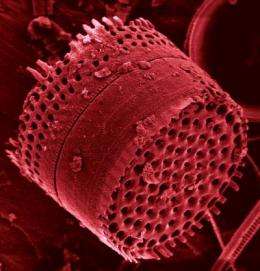
This is a scanning electron micrograph image of an Aulacoseira diatom, preserved in the sediments of Lake CF8 on Baffin Island, Arctic Canada. Credit: Cheryl Wilson and Alexander Wolfe
"Our results show that the human footprint is overpowering long-standing natural processes even in remote Arctic regions," said co-author John Smol of Queen's University. "This historical record shows that we are dramatically affecting the ecosystems on which we depend."The ancient lake sediment cores are the oldest ever recovered from glaciated parts of Canada or Greenland. Massive ice sheets during ice ages generally scour the underlying bedrock and remove previous sediments.
"What is unique about these sediment cores is that even though glaciers covered this lake, for various reasons they did not erode it," said study co-author Jason Briner of the University at Buffalo. The result is that we have a really long sequence of sediment that has survived Arctic glaciations."
Axford emphasized the multiyear research project required expertise from each of the five institutions involved in the PNAS study. "This was a team effort all the way around, and each of the institutions has a unique set of skills that allowed us to carry out this study," she said. "We needed people who understood algae, insects, glaciers and geochemistry, not to mention how to drive snowmobiles and extract the cores."
The study was funded by the National Science Foundation, the Natural Sciences and Engineering Research Council of Canada and the Geological Society of America.
A study published in Science magazine last month that involved CU-Boulder researchers and reconstructed past temperatures in the Arctic using ice cores, tree rings and lake sediments concluded that recent warming around the Arctic is overriding a cooling trend caused by Earth's periodic wobble. Earth is now about 0.6 million miles further from the sun during the Northern Hemisphere summer solstice than it was in 1 B.C. -- a trend that has caused overall cooling in the Arctic until recently.
-
Small Organisms, Great Proxies
Oct 23, 2006 |
not rated yet |
0
-
Deep in arctic mud, geologists find strong evidence of climate change
Jan 18, 2007 |
not rated yet |
0
-
Polar Expedition to Siberian Lake will Yield Details of Past Climate
Nov 16, 2006 |
not rated yet |
0
-
Scientists Return from Expedition to Drill Beneath Frozen Russian Lake
May 28, 2009 |
not rated yet |
0
-
Under a Frozen Lake in Siberia, Geoscientist Drills For Secrets of Earth’s Ancient Climate
Dec 18, 2008 |
not rated yet |
0
-
Engineers build first sub-10-nm carbon nanotube transistor
Feb 01, 2012 |
4.9 / 5 (31) |
30
-
Something old, something new: Evolution and the structural divergence of duplicate genes
Jan 31, 2012 |
4.6 / 5 (7) |
1
-
The hidden nanoworld of ice crystals: Revealing the dynamic behavior of quasi-liquid layers
Jan 30, 2012 |
5 / 5 (3) |
1
-
Stock market network reveals investor clustering
Jan 27, 2012 |
3.9 / 5 (23) |
8
-
Of microchemistry and molecules: Electronic microfluidic device synthesizes biocompatible probes
Jan 26, 2012 |
5 / 5 (1) |
0
-
Discrepancy between oxygen and carbon-dioxide levels
Feb 09, 2012
-
where gems are found in the world
Feb 09, 2012
-
Wind Waves in Reservoir ~ Wind run-up and Wind set-up
Feb 08, 2012
-
Balance of oxygen in the atmosphere
Feb 01, 2012
-
The case for a methanol-based economy
Jan 30, 2012
-
Weather in a rotating cylinder
Jan 25, 2012
- More from Physics Forums - Earth
More news stories
Humans may have helped the decline of African rainforests 3000 years ago
(PhysOrg.com) -- Large areas of rainforests in Central Africa mysteriously disappeared over three thousand years ago, to be replaced by savannas. The prevailing theory has been that the cause was a change ...
Could Venus be shifting gear?
(PhysOrg.com) -- ESAs Venus Express spacecraft has discovered that our cloud-covered neighbour spins a little slower than previously measured. Peering through the dense atmosphere in the infrared, the ...
Space & Earth / Space Exploration
13 hours ago |
5 / 5 (7) |
7
|
NASA sees wide-eyed cyclone Jasmine
Cyclone Jasmine's eye has opened wider on NASA satellite imagery, as it moves through the Southern Pacific Ocean.
Space & Earth / Earth Sciences
5 hours ago |
3.5 / 5 (2) |
1
NASA budget will axe Mars deal with Europe: scientists
US President Barack Obama's budget proposal to be submitted next week for 2013 will cut NASA's budget by 20 percent and eliminate a major partnership with Europe on Mars exploration, scientists said Thursday.
Space & Earth / Space Exploration
16 hours ago |
5 / 5 (2) |
18
Mars Science Laboratory computer issue resolved
(PhysOrg.com) -- Engineers have found the root cause of a computer reset that occurred two months ago on NASA's Mars Science Laboratory and have determined how to correct it.
Space & Earth / Space Exploration
14 hours ago |
4.7 / 5 (6) |
3
|
Google users warned of threat to smartphone wallets
Users of Google smartphone wallets were being warned on Friday that there is a way to crack pass codes intended to thwart thieves from going on illicit shopping sprees.
Anonymous knocks CIA website offline (Update)
The website of the Central Intelligence Agency was inaccessible on Friday after the hacker group Anonymous claimed to have knocked it offline.
Complex wiring of the nervous system may rely on a just a handful of genes and proteins
Researchers at the Salk Institute have discovered a startling feature of early brain development that helps to explain how complex neuron wiring patterns are programmed using just a handful of critical genes. ...
New error-correcting codes guarantee the fastest possible rate of data transmission
Error-correcting codes are one of the triumphs of the digital age. Theyre a way of encoding information so that it can be transmitted across a communication channel such as an optical fiber o ...
The power of estrogen -- male snakes attract other males
A new study has shown that boosting the estrogen levels of male garter snakes causes them to secrete the same pheromones that females use to attract suitors, and turned the males into just about the sexiest ...
New power source discovered
(PhysOrg.com) -- Researchers at the Massachusetts Institute of Technology (MIT) and RMIT University have made a breakthrough in energy storage and power generation.

Oct 19, 2009
Rank: 5 / 5 (1)
1) You notice they talk about the climate since 1950. The Arctic was warmer in the 1930s to 1940s time frame.
2) They talk about a natural cooling trend. We've been on a (generally) warming trend since the end of the last ice age. Unless we passing in to a cooling trend unforeseen by the IPCC climate models, we still have a few more degrees of warming to go before the next ice age.
Oct 20, 2009
Rank: not rated yet
1950? As someone else in another blog noted, this was during the time DDT was being used (and over-used). They also noted that DDT and it's breakdown products are transported from warmer to colder climates.
http://wattsupwit...for-ddt/