
As Greenland melts
October 19, 2009
This is a drill drilling for an ice core sample in Northwest Greenland. The North Greenland Eemian ice-drilling project hopes to reach ice layers just above Greenland's bedrock, where ice as much as 130,000 years old may hold clues to the impact climate change could have in the next few decades. Credit: www.climatecentral.org
Not that long ago - the blink of a geologic eye - global temperatures were so warm that ice on Greenland could have been hard to come by. Today, the largest island in the world is covered with ice 1.6 miles thick. Even so, Greenland has become a hot spot for climate scientists. Why? Because tiny bubbles trapped in the ice layers may help resolve a fundamental question about global warming: how fast and how much will ice sheets melt?
Monday night on The NewsHour with Jim Lehrer (PBS), a report by Climate Central's Dr. Heidi Cullen explores efforts by an international group of scientists looking for answers. Their method: drill down through 130,000 years of accumulated ice to unlock the secrets of climate history from what geologists call the Eemian period. That was the last time the average global temperature was significantly warmer than it is today, and tiny bubbles trapped in the ice preserve key planetary conditions from that time period.
Scientists from 14 nations are participating in the North Greenland Eemian Ice drilling project, or NEEM. Dr. Cullen, Senior Research Scientist for Climate Central (climatecentral.org), a non-profit, non-advocacy group of journalists and scientists dedicated to communicating about climate change, along with a television crew from StormCenter Communications, was invited to report the story. In July she accompanied scientists to North Western Greenland where she observed ice core drilling firsthand.
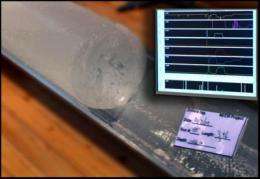
This is an ice core sample from the North Greenland Eemian ice drilling project, where scientists recently completed the first season of drilling. Frozen air bubbles preserve samples of Earth’s ancient atmosphere that can offer clues to Earth’s climate future. The inset shows data analysis readings from another sample. Credit: www.climatecentral.org
"Securing a pristine ice core dating back 130,000 years will provide a snapshot of conditions on Greenland when the average global temperature was 5 to 9 degrees Fahrenheit warmer than today," says Dr. Cullen. "The Eemian provides a very realistic scenario of what we might see in the coming centuries."Climate Central scientists calculate that in 2007, Greenland shed ice at a rate that, melted, equals the equivalent of draining San Francisco Bay - once a week - all year long. Some climate models suggest that if greenhouse emissions are not reduced, Earth's average temperature could approach Eemian era levels when today's children reach their 70's and 80's. Another key question the ice samples may help answer: how long would temperatures have to remain at those levels - or higher - to trigger a major rise in sea level?
Ice cores have been a tool for science since the Cold War, after it was discovered that air bubbles trapped in ice are science rich time capsules. Each layer of ice is a world unto itself. As Jeff Severinghaus, of Scripps Institution of Oceanography, tells Dr. Cullen, "The beautiful thing about an ice core is that it has all of these different indicators: atmospheric composition, mean ocean temperature, dust."
Dr. Cullen also reports that the Greenland project employs a new field technique - cutting a thin slab of the ice core, melting it, and conducting a millimeter-by-millimeter analysis of the drip water. When drilling ended for the 2009 summer season samples from one mile down had been retrieved, dating back over 38,000 years. Scientists hope to reach Eemian ice in the summer of 2011.
None of this is to suggest that a massive, accelerated melting of Greenland is in the offing any time soon - but as the San Francisco Bay analogy highlights -the melting in Greenland demands careful attention be paid.
Source: Climate Central
-
Searching for an interglacial on Greenland
Aug 24, 2009 |
not rated yet |
0
-
International Greenland Ice Coring Effort Sets New Drilling Record in 2009
Aug 26, 2009 |
not rated yet |
0
-
Record warm summers cause extreme ice melt in Greenland
Jan 15, 2008 |
not rated yet |
0
-
Melting glacier worries scientists
Jul 25, 2005 |
not rated yet |
0
-
Greenland and Antarctic ice sheet melting, rate unknown
Feb 16, 2009 |
not rated yet |
0
-
Engineers build first sub-10-nm carbon nanotube transistor
Feb 01, 2012 |
4.9 / 5 (33) |
30
-
Something old, something new: Evolution and the structural divergence of duplicate genes
Jan 31, 2012 |
4.6 / 5 (7) |
1
-
The hidden nanoworld of ice crystals: Revealing the dynamic behavior of quasi-liquid layers
Jan 30, 2012 |
5 / 5 (4) |
1
-
Stock market network reveals investor clustering
Jan 27, 2012 |
3.9 / 5 (23) |
8
-
Of microchemistry and molecules: Electronic microfluidic device synthesizes biocompatible probes
Jan 26, 2012 |
5 / 5 (2) |
0
-
Do some geologists actually act a lot like Randy Marsh?
Feb 11, 2012
-
Discrepancy between oxygen and carbon-dioxide levels
Feb 09, 2012
-
where gems are found in the world
Feb 09, 2012
-
Wind Waves in Reservoir ~ Wind run-up and Wind set-up
Feb 08, 2012
-
Balance of oxygen in the atmosphere
Feb 01, 2012
-
The case for a methanol-based economy
Jan 30, 2012
- More from Physics Forums - Earth
More news stories
Salvage workers begin pumping fuel from Italian shipwreck
Salvage workers Sunday began pumping fuel from the shipwrecked Italian cruise liner Costa Concordia, a day ahead of schedule, officials said.
7 hours ago |
5 / 5 (1) |
0
Latin America mining boom clashes with conservation
Latin America is experiencing a mining boom as prices rise fuelled by a hike in global demand, but the region is also being hit by a wave of violent protests, strikes and rallies by environmentalists.
15 hours ago |
5 / 5 (1) |
1
Political leaders play key role in how worried Americans are by climate change: study
More than extreme weather events and the work of scientists, it is national political leaders who influence how much Americans worry about the threat of climate change, new research finds.
Feb 06, 2012 |
5 / 5 (7) |
73
NASA budget will axe Mars deal with Europe: scientists
US President Barack Obama's budget proposal to be submitted next week for 2013 will cut NASA's budget by 20 percent and eliminate a major partnership with Europe on Mars exploration, scientists said Thursday.
Space & Earth / Space Exploration
Feb 10, 2012 |
5 / 5 (3) |
58
Humans may have helped the decline of African rainforests 3000 years ago
(PhysOrg.com) -- Large areas of rainforests in Central Africa mysteriously disappeared over three thousand years ago, to be replaced by savannas. The prevailing theory has been that the cause was a change ...
Scientists discover molecular secrets of 2,000-year-old Chinese herbal remedy
For roughly two thousand years, Chinese herbalists have treated Malaria using a root extract, commonly known as Chang Shan, from a type of hydrangea that grows in Tibet and Nepal. More recent studies suggest that halofuginone, ...
New method to examine batteries -- MRI from the inside
There is an ever-increasing need for advanced batteries for portable electronics, such as phones, cameras, and music players, but also to power electric vehicles and to facilitate the distribution and storage of energy derived ...
A mitosis mystery solved: How chromosomes align perfectly in a dividing cell
Although the process of mitotic cell division has been studied intensely for more than 50 years, Whitehead Institute researchers have only now solved the mystery of how cells correctly align their chromosomes during symmetric ...
Google might launch Drive for cloud storage soon
(PhysOrg.com) -- Google's next big move, according to the Wall Street Journal, is a cloud storage service called Drive. Hardly first to the plate, Google is simply catching up to introducing its cloud reposi ...
Lab study raises questions over nano-particle impact
Tests involving chickens have raised questions about the impact on health from engineered nano-particles, the ultra-fine grains commonly used in drugs and processed foods, scientists said on Sunday.
Overeating may double risk of memory loss
New research suggests that consuming between 2,100 and 6,000 calories per day may double the risk of memory loss, or mild cognitive impairment (MCI), among people age 70 and older. The study was released today and will be ...

Oct 20, 2009
Rank: 3.7 / 5 (3)
Well we won't have to worry about biased reporting. Dr. Heidi Cullen (of The Weather Channel) has been a strident proponent of AGW for years. Not a iota of doubt exists in any of her public pronouncements.
Oct 20, 2009
Rank: 3 / 5 (2)
You can go back 400 years and see what the landscape looked like when the Earth was 5 degrees F warmer. What's the need to go back 130,000 years?
Nov 12, 2009
Rank: not rated yet
A little research next time, maybe!! And this came from another Physorg article.