Penn State researchers promote pollinator-friendly native gardens
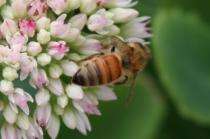
(PhysOrg.com) -- Across the country, pollinators such as honeybees and hummingbirds are declining due to habitat loss, diseases such as Colony Collapse Disorder (CCD), pests and excessive pesticide use. Penn State researchers and educators are hoping to help combat these issues by promoting ways home gardeners can help pollinator populations thrive.
New demonstration gardens featuring native plants have been established recently at Shaver's Creek Environmental Center and the new Arboretum at Penn State. Nancy Ostiguy, associate professor of entomology, and other researchers at Penn State helped design the new gardens.
"The gardens include plants native to Pennsylvania, because they are four times more attractive to pollinators," she said. "We also chose plants that have a variety of flower shapes to attract different types of pollinators, and planted them in clusters of the same type to help pollinators find them."
Pollinators are so important because they are responsible for one out of every three bites of food you eat, said Diana Cox-Foster, Penn State professor of entomology and co-chair of a national working group of CCD researchers.
"Over 80 percent of all flowering plants depend on our pollinators for survival," she said.
Even before the discovery of CCD, pollinators were in decline. According to Cox-Foster, four species of bumble bees are going extinct, and over 50 pollinator species are threatened or endangered. In addition, wild honeybee populations have dropped 25 percent since 1990. "Our pollinators need increased pollen diversity to help bolster their resistance to disease, pesticides and other stresses. Establishing native plant gardens will have a big impact on pollinator health."
In addition to the native plant gardens being established on campus, Penn State Master Gardeners are reaching out to gardeners across the state to help them plant native gardens through a project funded by ice cream manufacturer Haagen Dazs. The program focuses on encouraging homeowner to add plants to the landscape that provide food and shelter for pollinators.
According to Ginger Pryor, extension associate in horticulture and state Master Gardener coordinator, 48 demonstration gardens have been established across the state to educate homeowners so they can have their property certified as pollinator friendly.
"To be certified, homeowners will need implement pollinator friendly practices such as planting native flowering plants, provide nesting sites for pollinators, eliminate pesticides when possible, and provide water," Pryor said.
In addition, Dennis vanEngelsdorp, senior extension associate and State Apiarist for the Pennsylvania Department of Agriculture, also is working with master gardeners at 20 of the demonstration gardens as part of a foraging bee survey. The goal of the project is to estimate the native bee density and diversity by selective trapping.
"The PDA bee inspection program has been doing solitary bee survey intensely for four years and has now identified over 400 species in Pennsylvania," said vanEngelsdorp. "The current effort funded by Haagen Dazs is meant to look at which pollinator plants attract the most and/or greatest variety of bees."
He also is testing different bee monitoring methods and looking to expand the program next year and develop an online bee identification guide.
Also hoping to have an impact on pollinator populations is the Xerces Society for Invertebrate Conservation, which recently received a Natural Resource Conservation Service award to partner with Penn State researchers to develop on-farm pollinator habitats.
"Providing additional forage and refuge through on-farm natural habitat is widely recognized as important for enhancing pollinator health, diversity and abundance," Cox-Foster said.
The Xerces Society will work with Penn State to standardize pollinator seed mixes to ensure that pollinator plantings don't compete with the primary crop. Similarly, these pollinator plantings need to be composed of species that will not become weeds in the primary crop and they should not serve as alternate hosts of crop pests and diseases.
More information: For more information on honey bee research at Penn State, visit www.ento.psu.edu/HoneyBeeResearch.html
Provided by Pennsylvania State University (news : web)


