What does Wall Street's recovery mean to Main Street?
(PhysOrg.com) -- The Dow Jones Industrial Average, among the world?s most closely watched stock indexes, closed above the 10,000-point mark last week for the first time since October 2008, a milestone that made news around the world.
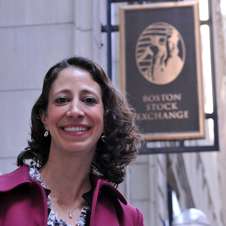
Here, Nicole Boyson, assistant professor of finance and the Reisman Research Professor in the College of Business Administration, talks about what the Dow's resurgence means for the economy and the markets.
Is the Dow’s breaking 10,000 points purely symbolic, or does it have real meaning for the overall economy?
I think it’s a sign the economy is heading in the right direction. Since March 9, 2009, the Dow is up nearly 3,500 points—over 50 percent—and the ride has been a pretty steady path upward, with a short breather in mid-summer.
Even though the U.S. markets have been steadily rising over the past seven months, so has unemployment. We’ve heard from President Obama and others that employment is a lagging indicator. Still, people are mystified that the markets can be rising while the economy only seems to worsen. What’s going on?
The president is correct—employment is a lagging indicator. Though some companies suffer at the first sign of an economic downturn and go out of business, companies that survive a recession often take a bit of time to figure out their strategy going forward. If this strategy involves downsizing production, it often involves downsizing the workforce as well.
Just how much an improvement in employment lags a recovery has varied from recession to recession, although the average for the 1973-1975 and 1981-1982 recessions was about 12 to 18 months. This recession has been particularly hard in that unemployment rates are near 10 percent, a level not seen since 1983, so I suspect it will take quite a while for employment to recover.
What does this milestone mean for the markets? Do you think it will continue to be a volatile market for stocks, or can investors start to believe it is stabilizing?
The VIX, a measure of the volatility of the broad stock market that has been calculated since 1990, hit an all-time high in October 2008. It is now down to about one-third that level, and quite close to its historical average. So, although the stock market should never be considered a low-volatility place to invest, volatility does seem to be returning to more typical levels.
Compared to where the Dow was last March, 10,000 points is a big number. But it’s still closer to the bottom than to last year’s peak of 14,000. Was that peak only possible because of the house of cards that was built on shaky mortgage investments?
Though the relationship between shaky mortgage investments and the value of the Dow is pretty complex, I believe that the willingness of institutions to make risky loans and the willingness of consumers to take on these loans certainly contributed to the high Dow value.
I’m quite sure the Dow will reach 14,000 again, but it’s difficult to say exactly when. Assuming a typical stock market return of, say, 7 percent per year, it would take five or six years to get back to that level. That said, when the economy recovers, we typically see much higher returns during the recovery period, so it could be much quicker than that. Of course, the jury’s still out on whether this recovery is the real deal.
Some economists have been saying the recovery isn’t real and we need another stimulus bill. Is that a good idea, and, if so, what should the target of the bill be?
A 50 percent recovery in the U.S. stock market since its lows and the improvements in many other economic indicators are strong evidence that the federal stimulus package has been helpful thus far.
I believe strongly that it is rather imprudent to attempt to manipulate the economy into a fast recovery. We didn’t get into this mess overnight, and shouldn’t expect to get out overnight.
We also need to be careful with stimulus packages that encourage consumers to borrow or spend beyond prudent levels. After all, consumer debt and imprudent borrowing were a factor in the recent economic downturn.
On the heels of the bank bailouts, the uptick in the stock market has caused many people to feel even more disconnected from, and resentful of, a Wall Street culture that seems uninterested in and immune to Main Street’s pain. Do they have a valid point?
Certainly the Wall Street culture of creating increasingly risky products and earning large bonuses based on the sale of those products contributed to the economic downturn. However, the willingness of many American consumers to take on debt well beyond levels that would be considered prudent to participate in the American dream of home ownership was a large contributing factor as well.
That said, many Americans who did not behave imprudently are still suffering as a result of this bailout, as are former Wall Street employees who were not involved with risky products.
The bailouts appear to be working to a large extent, in that many banks are enjoying healthy balance sheets and paying back government loans at a steady rate. Hence, I think the best approach for consumers is to enjoy the increase in their retirement assets attributable to a rising stock market, and to think twice before borrowing money that may be difficult to pay back.
Provided by Northeastern University (news : web)


