Galileo's Jupiter Journey Began Two Decades Ago
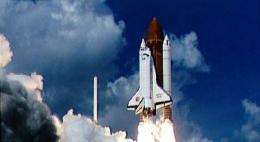
(PhysOrg.com) -- NASA's Galileo spacecraft began what would become a 14-year odyssey of exploration 20 years ago this Sunday, Oct. 18. Galileo was humanity's first emissary to orbit a planet in the outer solar system - Jupiter.
Galileo was launched into space aboard the space shuttle Atlantis on Oct. 18, 1989, from Kennedy Space Center, Florida. The crew of Atlantis deployed Galileo out of the shuttle's cargo bay only hours after launch. Then, a little over seven hours after leaving Earth, Galileo was propelled onto its interplanetary flight path by a two-stage, solid-fuel motor called an Inertial Upper Stage. Although earlier plans called for Galileo to use a more powerful upper stage so that it could fly directly to Jupiter, the final flight took it by other planets first so that it could gain energy from the gravity of each. Galileo flew past Venus on Feb. 10, 1990, and then twice past Earth -- once on Dec. 8, 1990, and again on Dec. 8, 1992.
Even before its arrival at Jupiter in 1995, Galileo was making groundbreaking discoveries. On Oct. 29, 1991, the spacecraft flew past asteroid Gaspra - sending back the first close up images of one of these celestial wanderers. Then on Aug. 28, 1993, Galileo encountered the 15.2-kilometer-wide (9.4-mile) asteroid Ida, where it took the first images of an asteroid and discovered the first asteroid moon, the 1.6-kilometer-wide (1-mile) Dactyl. During the latter part of its interplanetary cruise, Galileo was used to observe the collisions of fragments of Comet Shoemaker-Levy with Jupiter in July 1994.
Galileo arrived at Jupiter on Dec. 7, 1995, entering orbit and dropping a probe into the giant planet's atmosphere. The probe's velocity as it entered Jupiter's atmosphere was a blistering 47.6 kilometers per second (106,500 miles per hour). After the atmospheric drag and a deployed parachute slowed its descent rate, the probe relayed to Galileo the first in-place studies of Jupiter's clouds and winds, furthering scientists' understanding of how the gas giant evolved. The probe also made composition measurements designed to assess the degree of evolution of Jupiter compared to the sun.
While the descent of the probe was a highlight of Galileo's mission, it was hardly the only one. Galileo extensively investigated the geologic diversity of Jupiter's four largest moons: Ganymede, Callisto, Io and Europa. It found that Io's extensive volcanic activity is 100 times greater than that found on Earth. Galileo discovered strong evidence that Jupiter's moon Europa has a melted saltwater ocean under an ice layer on its surface. Scientists estimate such an ocean could be up to 100 kilometers (62 miles) deep underneath its frozen surface and contain about twice as much water as all of Earth's oceans. Data showed moons Ganymede and Callisto may also have a liquid-saltwater layer. The biggest discovery surrounding Ganymede was the presence of a magnetic field. No other moon of any planet is known to have one.
When Galileo turned its instruments towards the giant gas world itself, the spacecraft made the first observations of ammonia clouds in another planet's atmosphere. It also observed numerous thunderstorms on Jupiter many times larger than those on Earth, with lightning strikes up to 1,000 times more powerful than on Earth. It was the first spacecraft to dwell in a giant planet's magnetosphere long enough to identify its global structure and to investigate the dynamics of Jupiter's magnetic field. Galileo determined that Jupiter's ring system is formed by dust kicked up as interplanetary meteoroids smash into the planet's four small inner moons. Galileo data showed that Jupiter's outermost ring is actually two rings, one embedded within the other.
Having traveled approximately 4.6 billion kilometers (about 2.8 billion miles), the hardy spacecraft endured more than four times the cumulative dose of harmful Jovian radiation it was designed to withstand -- and still major systems functioned. But while it was still enjoying relatively good health, the spacecraft's propellant was low. Without propellant, Galileo would not be able to point its antenna toward Earth or adjust its trajectory, so controlling the spacecraft would no longer be possible. Mission managers at NASA and JPL decided to place their resilient Jovian explorer on a collision course with Jupiter to eliminate any chance of an unwanted impact between the spacecraft and Europa. The possibility of life existing on Europa is so compelling and has raised so many unanswered questions that it is prompting plans for future spacecraft to return to the icy moon.
The Galileo spacecraft's 14-year odyssey came to an end on Sunday, Sept. 21, 2003, when the spacecraft passed into Jupiter's shadow, then disintegrated in the planet's dense atmosphere at 11:57 a.m. Pacific Daylight Time. Its entry speed was 48.2 kilometers per second (nearly 108,000 miles per hour). That is the equivalent of traveling from Los Angeles to New York City in 82 seconds.
JPL's Deep Space Network tracking station in Goldstone, Calif., received the last signal at 12:43:14 PDT, 46 minutes after it was sent. The delay is due to the time it takes for the signal to travel to Earth. Hundreds of former Galileo project members and their families were present at JPL for a celebration to bid the spacecraft goodbye.
Galileo project scientist Torrence Johnson said at the time, "We haven't lost a spacecraft, we've gained a steppingstone into the future of space exploration."
Key facts:
• Launch: Oct. 18, 1989, from Kennedy Space Center, Fla., on space shuttle Atlantis on mission STS-34
• Arrival in orbit around Jupiter: Dec. 7, 1995
• VEEGA (Venus-Earth-Earth Gravity Assist) is the acronym mission planners gave for Galileo's flight path through the inner solar system
• Observed impacts of fragments from comet Shoemaker-Levy 9 into Jupiter
• Approximate number of people (from around the world) who worked on the Galileo mission: 800
• More than 100 scientists from United States, Great Britain, Germany, France, Canada and Sweden carried out Galileo's experiments
Provided by JPL/NASA (news : web)


