Volunteers wanted for simulated 520-day Mars mission

October 20, 2009
Volunteers wanted for simulated 520-day Mars mission

Enlarge

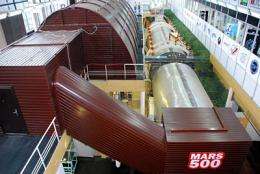
The simulations will take place here on Earth inside a special facility in Moscow. A precursor 105-day study is scheduled to early 2009, possibly followed by another 105-day study, before the full 520-day study begins late 2009. Credits: ESA - S. Corvaja

(PhysOrg.com) -- Starting in 2010, an international crew of six will simulate a 520-day round-trip to Mars, including a 30-day stay on the martian surface. In reality, they will live and work in a sealed facility in Moscow, Russia, to investigate the psychological and medical aspects of a long-duration space mission. ESA is looking for European volunteers to take part.

Starting in 2010, an international crew of six will simulate a 520-day round-trip to Mars, including a 30-day stay on the martian surface. In reality, they will live and work in a sealed facility in Moscow, Russia, to investigate the psychological and medical aspects of a long-duration . ESA is looking for European volunteers to take part.

The ‘mission’ is part of the Mars500 programme being conducted by ESA and Russia’s Institute of Biomedical Problems (IBMP) to study human psychological, medical and physical capabilities and limitations in space through fundamental and operational research. ESA’s Directorate of Human is undertaking Mars500 as part of its European Programme for Life and Physical Sciences (ELIPS) to prepare for future human missions to the Moon and Mars.
Volunteers wanted for simulated 520-day Mars mission
Enlarge

The Mars500 study takes place in a special isolation facility at the Russian Institute of Biomedical Problems in Moscow. The purpose of the Mars500 study is to gather data, knowledge and experience to help prepare for a real mission to Mars one day. The participants are subjects in scientific investigations to assess the effect that isolation has on various psychological and physiological aspects, such as stress, hormone regulation and immunity, sleep quality, mood and the effectiveness of dietary supplements. Credits: ESA

Following on from the successful 105-day precursor study completed in July, ESA is now looking for two candidates and two backups for the full 520-day study, which is due to get underway before mid-2010 after four months of training.

The crew will follow a programme designed to simulate a 250-day journey to , a 30-day surface exploration phase and 240 days travelling back to Earth. For the ‘surface exploration’, half of the crew will move to the facility’s martian simulation module and the hatch to the rest of the facility will be closed.

Candidates should be aged 20-50, motivated, in good health and no taller than 185 cm. They should speak one of the working languages: English and Russian. Candidates must have a background and work experience in medicine, biology, life support systems engineering, computer engineering, electronic engineering or mechanical engineering.
Volunteers wanted for simulated 520-day Mars mission
Enlarge

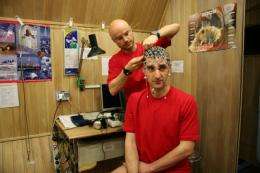
Cyrille Fournier helps Oliver Knickel prepare for a nighttime EEG. Credits: ESA

Selection will be based on education, professional experience, medical fitness and social habits. Following an initial assessment, potential candidates will have to submit results from medical tests and will then be invited for interview, to be screened in a process similar to that used in astronaut selection.

The candidates’ nationality and residence is restricted to ESA Member States participating in ELIPS (Austria, Belgium, Switzerland, Czech Republic, Germany, Denmark, Spain, France, Greece, Italy, Ireland, Norway, The Netherlands, Sweden and Canada).


Join PhysOrg.com on Facebook!
Follow PhysOrg.com on Twitter!
More information: The Call for Candidates and related documents are available on: http://www.esa.int/callmars500

Provided by European Space Agency (news : web)

3.8 /5 (27 votes)  

Filter


Move the slider to adjust rank threshold, so that you can hide some of the comments.


Display comments: newest first

ScottyB
Oct 21, 2009

Rank: not rated yet
Nothing new here.
Doesnt give any dates.
Just a recap of the last experiment as far as i can see.
RAL
Oct 21, 2009

Rank: not rated yet
Why not pair up a man and a woman? That's a long time.
dlynne976
Oct 21, 2009

Rank: 3 / 5 (1)
So will they be allowing filming during this experiment? The reality TV possibilities are endless! But seriously, I think people will want to get to know the individuals who are chosen and know how they're doing. Our astronauts keep in touch with Earth and learn major events while they're in space, as well as hearing from loved ones. Will they be able to stream video or keep in touch with the world (assuming, of course, that there would be some communication delays on a REAL mission to Mars)?
ScottyB
Oct 22, 2009

Rank: not rated yet
They will be able to have some form of contact with teh outside world (even ifi t is just "Mission control" but they will put a delay on it that is equivalent to the delay you woudl expect on a mars mission.
Reseacher
Oct 22, 2009

Rank: not rated yet
There has been a mental break on a Soviet missions, Soyuz-21. The problem that caused it is unknown by NASA and the Russian Space Agency.

Subliminal Distraction was discovered to cause mental breaks for office workers forty years ago. The cubicle was designed to deal with them by 1968.

Unaware of SD and Cubicle Level Protection this simulation will have problems just like the last one did.

If you think you can help reach those in charge read the Astronauts & Insanity page at VisionAndPsychosis.Net and send them an email. The address on the ESA contact page is Sander.Verkerk AT esa.int. Eliminate the spaces.
Rank 3.8 /5 (27 votes)
Related Stories
Relevant PhysicsForums posts

More news stories

Scientists chart high-precision map of Milky Way's magnetic fields

(PhysOrg.com) -- Scientists at the Naval Research Laboratory (NRL) are part of an international team that has pooled their radio observations into a database, producing the highest precision map to date of ...

Space & Earth / Astronomy

created 11 hours ago | popularity 4.7 / 5 (6) | comments 10 | with audio podcast

Coral growth in Western Australia found to be thriving in warmer water

(PhysOrg.com) -- As most people are well aware, global warming isn’t just about the atmosphere, it’s about rising ocean temperatures as well. And like increases in the atmosphere, scientists aren’t ...

Space & Earth / Environment

created 13 hours ago | popularity 5 / 5 (1) | comments 7 | with audio podcast report

Surface of Mars an unlikely place for life after 600 million year drought, say scientists

Mars may have been arid for more than 600 million years, making it too hostile for any life to survive on the planet's surface, according to researchers who have been carrying out the painstaking task of analysing ...

Space & Earth / Space Exploration

created 11 hours ago | popularity 4.2 / 5 (9) | comments 2 | with audio podcast

Global extinction: Gradual doom is just as bad as abrupt

A painstakingly detailed investigation shows that mass extinctions need not be sudden events. The deadliest mass extinction of all took a long time to kill 90 percent of Earth's marine life, and it killed ...

Space & Earth / Earth Sciences

created 11 hours ago | popularity 3.9 / 5 (16) | comments 0 | with audio podcast

Mission to land on a comet

Europe’s Rosetta spacecraft is en route to intercept a comet– and to make history. In 2014, Rosetta will enter orbit around comet 67P/Churyumov-Gerasimenkoand land a probe on it, two firsts.

Space & Earth / Space Exploration

created 13 hours ago | popularity 5 / 5 (2) | comments 1 | with audio podcast


Amazon fungi found that eat polyurethane, even without oxygen

(PhysOrg.com) -- Until now polyurethane has been considered non-biodegradable, but a group of students from Yale University in the US has found fungi that will not only eat and digest it, they will do so even in the absence ...

Whole exome sequencing identifies cause of metabolic disease

Sequencing a patient's entire genome to discover the source of his or her disease is not routine – yet. But geneticists are getting close.

Hearing metaphors activates brain regions involved in sensory experience

When a friend tells you she had a rough day, do you feel sandpaper under your fingers? The brain may be replaying sensory experiences to help understand common metaphors, new research suggests.

Renowned physicist invents microscope that can peer at living brain cells

(PhysOrg.com) -- Ever since scientists began studying the brain, they’ve wanted to get a better look at what was going on. Researchers have poked and prodded and looked at dead cells under electron microscopes, ...

New kind of high-temperature photonic crystal could someday power everything from smartphones to spacecraft

A team of MIT researchers has developed a way of making a high-temperature version of a kind of materials called photonic crystals, using metals such as tungsten or tantalum. The new materials — which ...

Hackers intercept FBI, Scotland Yard call (Update)

(AP) -- Trading jokes and swapping leads, investigators from the FBI and Scotland Yard spent the conference call strategizing about how to bring down the hacking collective known as Anonymous, responsible ...