Last visit home for ESA's comet chaser Rosetta
October 20, 2009
Last visit home for ESA's comet chaser Rosetta

Enlarge

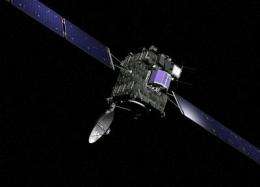
This is Rosetta, ESA's comet chaser. Credit: ESA (image by AOES Medialab)

ESA's Rosetta comet chaser will swing by Earth on 13 November to pick up orbital energy and begin the final leg of its 10-year journey to the outer Solar System. Several observations of the Earth-Moon system are planned before the spacecraft heads out to study comet 67/P Churyumov-Gerasimenko.

This will be the third Earth swingby, the last of Rosetta's four planetary gravity assists. Closest approach to Earth is expected at 08:45 CET. The swingby will provide exactly the boost needs to continue into the . The craft is scheduled for a close encounter with asteroid 21 Lutetia in July next year.

Rosetta is expected to arrive at its final destination in May 2014. There, it will release the Philae lander for in-situ studies on the surface. The spacecraft will then escort the on its journey toward the Sun, studying it closely for up to two years.

As it closes in on Earth next month, Rosetta will have travelled almost 4500 million km since launch. It will speed past at 13.3 km/s, passing above the Indian Ocean at 109°E, 8°S, just south of the Indonesian island of Java. The gravity-assist will increase the spacecraft's speed by 3.6 km/s with respect to the Sun.

Instruments in action

While the swingby is critical for achieving the velocity required to reach its ultimate destination, the close encounter will also be used to study the Earth-Moon system from Rosetta's unique perspective.

Several instruments that usually hibernate during the long trek will be turned on in the week before the swingby.

Follow the swingby live

The Rosetta Blog will be updated regularly for this final planetary swingby. Follow crucial events live via the blog and the dedicated ESA Rosetta mission website.

Critical swingby events

Closest approach is scheduled for 08:45 CET on 13 November, but mission operators will perform a number of critical actions before and after the swingby to ensure that Rosetta is on the right trajectory.

One of the most important will be a trajectory correction manoeuvre (TCM), scheduled for 22 October at 13:30 CET. Results of this manoeuvre will be analysed to determine whether additional TCMs are required to achieve the correct approach trajectory.

Source: European Space Agency (news : web)


Rank 5 /5 (6 votes)
Related Stories
Relevant PhysicsForums posts
  • Never ending outer space.....
    created15 hours ago
  • Neutron Star fragments?
    created17 hours ago
  • stationary or not?
    created21 hours ago
  • Scale of the Universe
    createdFeb 10, 2012
  • Titan's lack of impact craters
    createdFeb 09, 2012
  • Real pictures of black hole eating a star?
    createdFeb 08, 2012
  • More from Physics Forums - General Astronomy

More news stories

Salvage workers begin pumping fuel from Italian shipwreck

Salvage workers Sunday began pumping fuel from the shipwrecked Italian cruise liner Costa Concordia, a day ahead of schedule, officials said.

Space & Earth / Environment

created 32 minutes ago | popularity not rated yet | comments 0

Latin America mining boom clashes with conservation

Latin America is experiencing a mining boom as prices rise fuelled by a hike in global demand, but the region is also being hit by a wave of violent protests, strikes and rallies by environmentalists.

Space & Earth / Environment

created 8 hours ago | popularity 5 / 5 (1) | comments 0

Political leaders play key role in how worried Americans are by climate change: study

More than extreme weather events and the work of scientists, it is national political leaders who influence how much Americans worry about the threat of climate change, new research finds.

Space & Earth / Environment

created Feb 06, 2012 | popularity 5 / 5 (6) | comments 73

NASA budget will axe Mars deal with Europe: scientists

US President Barack Obama's budget proposal to be submitted next week for 2013 will cut NASA's budget by 20 percent and eliminate a major partnership with Europe on Mars exploration, scientists said Thursday.

Space & Earth / Space Exploration

created Feb 10, 2012 | popularity 5 / 5 (3) | comments 55

Humans may have helped the decline of African rainforests 3000 years ago

(PhysOrg.com) -- Large areas of rainforests in Central Africa mysteriously disappeared over three thousand years ago, to be replaced by savannas. The prevailing theory has been that the cause was a change ...

Space & Earth / Environment

created Feb 10, 2012 | popularity 4.1 / 5 (14) | comments 20 | with audio podcast report


Scientists discover molecular secrets of 2,000-year-old Chinese herbal remedy

For roughly two thousand years, Chinese herbalists have treated Malaria using a root extract, commonly known as Chang Shan, from a type of hydrangea that grows in Tibet and Nepal. More recent studies suggest that halofuginone, ...

New method to examine batteries -- MRI from the inside

There is an ever-increasing need for advanced batteries for portable electronics, such as phones, cameras, and music players, but also to power electric vehicles and to facilitate the distribution and storage of energy derived ...

A mitosis mystery solved: How chromosomes align perfectly in a dividing cell

Although the process of mitotic cell division has been studied intensely for more than 50 years, Whitehead Institute researchers have only now solved the mystery of how cells correctly align their chromosomes during symmetric ...

Starve a virus, feed a cure? Findings show how some cells protect themselves against HIV

A protein that protects some of our immune cells from the most common and virulent form of HIV works by starving the virus of the molecular building blocks that it needs to replicate, according to research published online ...

Researchers find extensive RNA editing in human transcriptome

In a new study published online in Nature Biotechnology, researchers from BGI, the world's largest genomics organization, reported the evidence of extensive RNA editing in a human cell line by analysis of RNA-seq data, demons ...

The proteins ensuring genome protection

Researchers from the University of Geneva (UNIGE), Switzerland, have discovered the crucial role of two proteins in developing a cell 'anti-enzyme shield'. This protection system, which operates at the level of molecular ...