Internet advertising appears to begin its comeback
(AP) -- After bogging down in the recession, Internet advertising is regaining the momentum that has made it the decade's most disruptive marketing machine.
The signs of an online revival are emerging even while advertising in print and broadcasts remain in a slump that has triggered mass layoffs, pay cuts and other upheaval.
Internet advertising was just about the only bright spot in the third-quarter reports of two major newspaper publishers, Gannett Co. and McClatchy Co. Meanwhile the companies still are dealing with steep declines in print ads - an imbalance most analysts predict will take years to address.
The harsh reality is that much of the advertising in long-established media, particularly in the classified sections of newspapers, will never rebound to pre-recession levels, said Lauren Rich Fine, a longtime media analyst who is now a professor at Kent State University.
That grim outlook contrasts with the fact that advertisers are increasingly allocating more of their budgets to the Web. That's where their customers are spending more of their free time. On top of that, Internet ad rates are less expensive, and the returns on online ad investments are easier to quantify.
Even when they buy time in other media, advertisers are realizing they need to be promoting their wares on the Internet too.
"You can draw a straight line from the time when people hear an ad on the radio or television to when they search for that company on the Internet," said David Karnstedt, chief executive of Efficient Frontier, which helps manage ad campaigns on search engines.
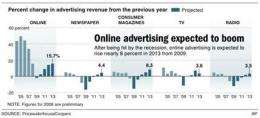
These trends will give Internet advertising 19 percent, or nearly $87 billion, of the worldwide ad market in 2013, up from just 4 percent, or about $18 billion, in 2004, according to PricewaterhouseCoopers and Wilkofsky Gruen Associates.
That would make the Internet the third-largest marketing medium. Television is expected to remain on top, with $168 billion, or 36 percent of the global ad market, down from 35 percent in 2004. Newspapers would still be No. 2, but their $92 billion in advertising revenue is projected to account for 20 percent of the global ad market, down from 28 percent in 2004.
For now, though, some types of Internet advertising - real estate, travel and help-wanted, in particular - remain in the funk they fell into in the first half of the year, when U.S. ad revenue on the Web fell 5 percent. (That was still far better than the 12 percent to 29 percent declines suffered by U.S. newspapers, radio stations and television broadcasters.)
David Hallerman, a senior analyst at eMarketer, thinks it's too early to conclude the entire Internet advertising market is on the upswing. "It's more like the patient had a 105-degree temperature and now it's down to 100 degrees," he said.
EMarketer expects Internet ad sales in the U.S. to fall by nearly 3 percent in the second half of this year, slightly less than in the first half. The research firm expects a 6 percent increase next year followed by a 7 percent gain in 2011.
The most compelling evidence for an online recovery is being made by Google Inc., whose search engine powers an online network that has grown from $411 million in worldwide ad revenue in 2002 to more than $22 billion annually now. The company's ad revenue rose 8 percent in the third quarter, the fastest pace so far this year, and Google's executives indicated they are gearing up for even more rapid growth in the months ahead.
Google could be an anomaly because its specialty - selling ads tied to online search requests - tends to be the last thing cut from marketing budgets and the first thing to attract more money in the early stages of a recovery.
The reason: Search requests have proven to be a highly effective way to identify consumers shopping for a specific product or service. And the ads typically cost advertisers only when the links are clicked on.
For instance, a Google ad tied to a search request containing the word "shoes" currently costs about $6.80 per click, while an ad generated by a request with the term "car parts" costs just 48 cents per click. Buying ads in major newspapers or on TV can easily cost thousands of dollars with no assurance the investment will deliver customers.
Besides the Internet's lower prices, the Web's tracking technologies make it easy to measure whether a search ad campaign is yielding adequate sales to justify the expense. If their online spending isn't paying off, advertisers typically can pull the plug more quickly than in print and broadcast, which often require financial commitments that last several months.
The greater flexibility online makes it easier to gauge the mood of consumers by buying Internet search ads before ramping up spending in other areas, Fine said.
"I think a lot of (advertisers) are experimenting right now, hoping they can stimulate a little more demand," she said. "Some of this could be wishful thinking."
It might take longer to see an ad rebound at Yahoo Inc., which runs the Internet's second-most widely used search engine. Yahoo's forte is "display advertising" - online billboards and other more visual forms of marketing.
Companies still seem reluctant to spend on those more elaborate campaigns, partly because they tend to be more expensive and not as well-aimed as search ads. The reticence is the main reason Yahoo reported its third-consecutive quarterly decline in ad sales Tuesday. Yahoo's ad revenue fell 12 percent after declining 13 percent in the first half of the year.
Even so, Yahoo isn't being hit as badly as newspaper publishers; McClatchy's print advertising, for instance, plunged 32 percent in the third quarter. Its online ad sales, on the other hand, increased 3 percent.
©2009 The Associated Press. All rights reserved. This material may not be published, broadcast, rewritten or redistributed.


