TRMM sees some heavy rains in Neki as it heads toward Johnston Island
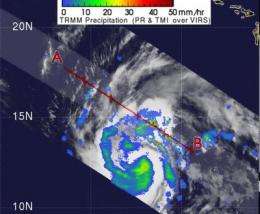
October 20, 2009 NASA's TRMM sees some heavy rains in Neki as it heads toward Johnston Island

Enlarge

TRMM's analysis of rainfall within Neki showed areas of heavy rainfall. The yellow and green areas indicate moderate rainfall between .78 to 1.57 inches per hour. Red areas are heavy rainfall at almost 2 inches per hour. Credit: NASA/SSAI, Hal Pierce

NASA's Tropical Rainfall Measuring Mission, or TRMM satellite has been flying over Tropical Storm Neki in the Central Pacific Ocean and providing scientists with an idea of how much rainfall Johnston Island can expect from it.

A Watch is already in effect for Johnston Island. That means hurricane conditions are possible within the next 48 hours. A Hurricane Warning may be issued later today, meaning hurricane conditions are happening.

Johnston Island is the main island in the Johnston Atoll, a 50-square-mile atoll in the North Pacific Ocean. It's located 750 nautical miles west of Hawaii. The Atoll consists of four islands: Johnston, Sand, North Island and East Island.

The Tropical Rainfall Measuring Mission () satellite, managed by NASA and the Japanese Space Agency (JAXA) passed over Tropical Storm Neki on October 20 at 1043 UTC (6:43 a.m. EDT/12:43a.m. HST) and captured a look at Neki's rainfall. TRMM found that there were some areas of heavy rainfall in the northeast quadrant of the storm. rates were around 2 inches per hour in that part of Neki.

Rain rates are created from different instruments aboard TRMM. The rain rates in the center of TRMM images are derived from the TRMM Precipitation Radar, the only spaceborne radar of its kind, while those in the outer portion are from the TRMM Microwave Imager. The rain rates are then overlaid on infrared data from the TRMM Visible Infrared Scanner to create the entire image. The images are created at NASA's Goddard Space Flight Center, in Greenbelt, Md.

TRMM also has the ability to analyze how high the thunderstorms are in , and this morning's image indicated there were some "hot towers," that is, towering thunderstorms that are almost 15 kilometers (about 9 miles) high. That's an indication that the storm is strengthening.

At 2 a.m. HST (8 a.m. EDT) on October 20, Tropical Storm Neki's had increased from 40 mph to 50 mph, and it is expected to continue intensifying. Neki was located about 515 miles east-southeast of Johnston Island, and 640 miles south-southeast of Honolulu, Hawaii. It was near 13.0 North and 162.8 West. Neki is moving northwest near 18 mph and will continue in that direction for the next two days, although it is forecast to slow down. Estimated minimum central pressure is 1005 millibars.

Neki will continue to strengthen as it moves northwest and could pass Johnston Island as a hurricane. Neki is headed for a landfall over the tiny island by Thursday, October 22.

Source: JPL/NASA (news : web)


print this article email this article download pdf blog this article bookmark this article     Stumble it Digg this share on Facebook retweet share on Reddit add to delicious
Rate this story - not rated yet


October 20, 2009 all stories

Comments: 0

not rated yet
  • Stumble this up

  • Digg this

  • share this

  • hide
  • Related Stories


  • hide
  • Relevant PhysicsForums posts

  • The IPCC and the term "most"
    created Nov 23, 2009
  • Is global warming a fact?
    created Nov 23, 2009
  • Random variability of wind patterns
    created Nov 23, 2009
  • Record precipitation in the UK
    created Nov 22, 2009
  • More from Physics Forums - Earth

Other News

Ships warned about icebergs headed for New Zealand (AP)

Ships warned about icebergs headed for New Zealand

Space & Earth / Earth Sciences

created 14 minutes ago | popularity not rated yet | comments 0

(AP) -- Ships are on alert and maritime authorities are monitoring the movements of hundreds of menacing icebergs drifting toward New Zealand in the southern Pacific Ocean, officials said.


Cutting greenhouse pollutants could directly save millions of lives worldwide

Space & Earth / Environment

created 1hour ago | popularity 1 / 5 (2) | comments 0

Tackling climate change by reducing carbon dioxide and other greenhouse emissions will have major direct health benefits in addition to reducing the risk of climate change, especially in low-income countries, according to ...


Small faults in Southeast Spain reduce earthquake risk of larger ones

Small faults in Southeast Spain reduce earthquake risk of larger ones

Space & Earth / Earth Sciences

created 1hour ago | popularity not rated yet | comments 0

A team of Spanish scientists, studying recent, active deformations in the Baetic mountain range, have shown that the activity of smaller tectonic structures close to larger faults in the south east of the ...


It's not just dirt!

Space & Earth / Environment

created 1hour ago | popularity 5 / 5 (1) | comments 0

Soil is the linchpin of the environment, where atmosphere, biosphere, and hydrosphere meet. Despite that, many students see soil as "just dirt" - a place to grow plants, but nothing more. Soil science educators are challenged ...


Mars Reconnaissance Orbite

Mars Reconnaissance Orbite Team Plans Uplink of Protective Files

Space & Earth / Space Exploration

created 4 hours ago | popularity 5 / 5 (1) | comments 0

(PhysOrg.com) -- The team operating NASA's Mars Reconnaissance Orbiter plans to uplink protective files to the spacecraft next week as one step toward resuming the orbiter's research and relay activities.