Social memory in Drosophila
October 20, 2009 Social memory in Drosophila

Enlarge

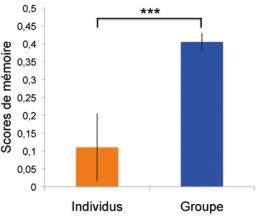
Measure of olfactory memory 48 hours after conditioning in Drosophila individuals (on the left) and Drosophila in a group (on the right). The difference between the two groups is statistically highly significant (***). Memory retrieval is highly facilitated by social interactions. ©T.Preat/CNRS-ESPCI ParisTech

Positive social interactions exist within Drosophila: when in a group, Drosophila flies have better memory than when they are isolated. Thomas Preat's team at the Laboratoire de Neurobiologie (CNRS, France) has recently highlighted this phenomenon through olfactory memory tests.

This work, published in the journal Current Biology on 13 October 2009, has paved the way for new research avenues for understanding the role of social environment on memory modulation and decision making.

In a large number of animal species, individuals draw advantages from social life by observing their congeners. In particular, they are capable of adapting their behavior when faced with diverse situations, such as seeking food or defending themselves against predators. Thomas Preat's team at the Laboratoire de Neurobiologie (CNRS) has studied the behavior of using olfactory memory tests to investigate the potential effects of interactions between individuals.

During their experiments, the neurobiologists exposed a group of Drosophila flies, homogenous from a genetic viewpoint, to an odor associated with weak electric shocks. After this conditioning, the scientists conducted olfactory memory tests on the flies, either individually or in groups. Memory was evaluated through the ability of the flies to avoid the odor associated previously with an unpleasant stimulus, for example 24 or 48 hours after conditioning.

This study has shown that Drosophila flies demonstrate poorer memory when they are tested individually than when tested in a group. However, individual flies have poorer memory not because they do not remember but because they have difficulty in extracting the information. In addition, a fly conditioned beforehand does not simply have to be placed in a group for its memory to be improved. The group must itself have been conditioned to be able to produce the interactions that lie behind this memory facilitation.

The hypothesis that has been put forward is that, during the test (in other words in the presence of the odor that represents a potential danger), the conditioned flies give off an alarm signal that arouses the attention of surrounding flies and enhances their memory retrieval. In rats, several nerve centers such as amygdala or certain stress hormones such as adrenaline play the role of modulators in such retrieval. This work, carried out on Drosophila, has opened new avenues of research on memory modulation and decision making as a function of the perception of the , emotions or stress.

More information: Chabaud, M.-A., Isabel, G., Kaiser, L. and Preat, T. (2009). “Social facilitation of long-lasting retrieval in Drosophila”. , 19(19): 1654-1659.

Provided by CNRS


print this article email this article download pdf blog this article bookmark this article     Stumble it Digg this share on Facebook retweet share on Reddit add to delicious
Rate this story - 5 /5 (1 vote)


October 20, 2009 all stories

Comments: 0

5 /5 (1 vote)
  • Stumble this up

  • Digg this

  • share this

  • hide
  • Related Stories

  • Tracing the formation of long-term memory
    created Dec 06, 2006 | popularity not rated yet | comments 0
  • Even fruit flies have an orientation memory: Recall tested in a virtual space
    created Jul 10, 2008 | popularity not rated yet | comments 0
  • Long-term memory controls discovered
    created Jan 13, 2006 | popularity not rated yet | comments 0
  • A fly's tiny brain may hold huge human benefits
    created Mar 24, 2008 | popularity not rated yet | comments 0
  • Scientists identify a mechanism that helps fruit flies lock-in memories
    created Mar 29, 2008 | popularity not rated yet | comments 0


  • hide
  • Relevant PhysicsForums posts

  • Super quick question about Starling forces?
    created 20 hours ago
  • Questions about diffusion
    created Nov 22, 2009
  • Human Leukocyte Antigen (HLA) typing
    created Nov 21, 2009
  • Breeding program
    created Nov 20, 2009
  • More from Physics Forums - Biology

Other News

Beyond sunlight: Explorers census 17,650 ocean species between edge of darkness and black abyss

Beyond sunlight: Explorers census 17,650 ocean species between edge of darkness and black abyss (w/ Video)

Biology / Plants & Animals

created 14 hours ago | popularity 5 / 5 (7) | comments 0

Census of Marine Life scientists have inventoried an astonishing abundance, diversity and distribution of deep sea species that have never known sunlight - creatures that somehow manage a living in a frigid ...


Rare Charles Darwin book found on toilet bookshelf (AP)

Rare Charles Darwin book found on toilet bookshelf

Biology / Other

created 13 hours ago | popularity 4.5 / 5 (2) | comments 1

(AP) -- An auction house says it is selling a rare first edition of Charles Darwin's "On the Origin of Species" found in a family's guest lavatory in southern England.


Bigger not necessarily better, when it comes to brains

Bigger not necessarily better, when it comes to brains

Biology / Plants & Animals

created Nov 17, 2009 | popularity 4.5 / 5 (19) | comments 11

(PhysOrg.com) -- Tiny insects could be as intelligent as much bigger animals, despite only having a brain the size of a pinhead, say scientists at Queen Mary, University of London.


Extinct goat Myotragus balearicus

Extinct goat was cold-blooded

Biology / Plants & Animals

created Nov 18, 2009 | popularity 4.9 / 5 (34) | comments 10

(PhysOrg.com) -- An extinct goat that lived on a barren Mediterranean island survived for millions of years by reducing in size and by becoming cold-blooded, which has never before been discovered in mammals.


Right-handed chimpanzees provide clues to the origin of human language

Biology / Plants & Animals

created Nov 16, 2009 | popularity 2.5 / 5 (2) | comments 7

Most of the linguistic functions in humans are controlled by the left cerebral hemisphere. A study of captive chimpanzees at the Yerkes National Primate Research Center (Atlanta, Georgia), reported in the January 2010 issue ...