Presidential election outcome changed voters' testosterone
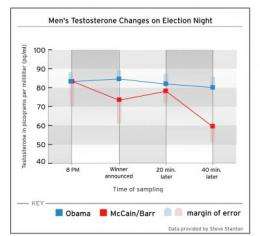
(PhysOrg.com) -- Young men who voted for Republican John McCain or Libertarian candidate Robert Barr in the 2008 presidential election suffered an immediate drop in testosterone when the election results were announced, according to a study by researchers at Duke University and the University of Michigan.
In contrast, men who voted for the winner, Democrat Barack Obama, had stable testosterone levels immediately after the outcome.
Female study participants showed no significant change in their testosterone levels before and after the returns came in.
The men who participated in the study would normally show a slight night-time drop in testosterone levels anyway. But on this night, they showed a dramatic divergence: The Obama voters' levels didn't fall as they should, and the McCain and Barr voters lost more than would have been expected.
"This is a pretty powerful result," said Duke neuroscientist Kevin LaBar. "Voters are physiologically affected by having their candidate win or lose an election."
In a post-election questionnaire, the McCain and Barr backers were feeling significantly more unhappy, submissive, unpleasant and controlled than the Obama voters.
The findings mirror what other studies have found in men who participate directly in an interpersonal contest -- the winner gets a boost of testosterone, while the loser's testosterone drops. Testosterone is a steroid hormone manufactured by the testes that is linked to aggression, risk-taking and responses to threats. Women have it too but in much lesser amounts and originating from different sources (their ovaries and adrenal glands), which makes them less likely to experience rapid testosterone changes following victory or defeat.
Researchers in Durham and Ann Arbor had 183 men and women chew a piece of gum and then spit into a sample tube at 8 p.m. as the polls closed on Nov. 4, 2008. When the election results were announced at about 11:30 p.m., the subjects provided a second sample, and then two more at 20-minute intervals. Those spit samples were then analyzed for concentrations of testosterone and some related stress hormones.
It would appear that even vicarious participation in such a "macro-scale dominance competition" is enough to change hormone levels, said Duke post-doctoral researcher Steven Stanton, who is the first author on a paper appearing in PLOS One on Wednesday.
"Voters participate in elections both directly by casting their ballots, and vicariously because they don't personally win or lose the election," Stanton said. "This makes democratic political elections highly unique dominance contests."
Stanton said the scientific consensus suggests the testosterone response to fighting and competition in males affects their future behavior in a beneficial way. The loser chills out a bit so he doesn't continue to press his case and perhaps become injured. In contrast, the winner may be motivated to pursue further gains in social status. "The research on this extends beyond humans and other primates," Stanton said.
The study also looked at levels of cortisol in the spit samples, a stress hormone behind the "fight or flight" response, and will discuss those findings in a forthcoming paper.
The college-aged men involved in this study would generally have more testosterone than older men, so perhaps the study provided a better opportunity to see the dominance response at work, LaBar said. "It would be interesting to see how this shakes out in older men."
Hormonal shifts from vicarious competition are also likely to occur around hotly contested collegiate football and basketball contests, the researchers note.
To find out, they're going to be repeating this kind of study on Duke and University of North Carolina basketball fans during one of their games this winter. "They'll spit before the game and spit after the game, and we'll just see," LaBar said.
"What a perfect place to study this," said Stanton.
Source: Duke University (news : web)


