Synthetic Cells Shed Biological Insights While Delivering Battery Power
October 20, 2009
Synthetic Cells Shed Biological Insights While Delivering Battery Power

Enlarge

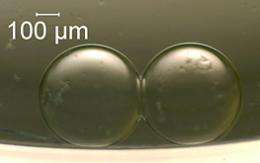
Image of two artificial cells that can act as a tiny battery. Each cell has a droplet of a water-based solution containing a salt—potassium and chloride ions—enclosed within a lipid wall. If the solutions in the two cells start with different salt concentrations, then poking thin metal electrodes into the droplets creates a small electric battery. Credit: NIST

(PhysOrg.com) -- Trying to understand the complex workings of a biological cell by teasing out the function of every molecule within it is a daunting task. But by making synthetic cells that include just a few chemical processes, researchers can study cellular machinery one manageable piece at a time.

A new paper from researchers at Yale University and the National Institute of Standards and Technology describes a highly simplified model cell that not only sheds light on the way certain real cells generate electric voltages, but also acts as a tiny battery that could offer a practical alternative to conventional solid-state energy-generating devices.

Each synthetic cell built by NIST engineer David LaVan and his colleagues has a droplet of a water-based solution containing a salt—potassium and chloride ions -- enclosed within a wall made of a lipid, a molecule with one end that is attracted to while the other end repels them. When two of these "cells" come into contact, the water-repelling lipid ends that form their outsides touch, creating a stable double bilayer that separates the two cells' interiors, just as actual cell membranes do.

If the researchers only did that much, nothing interesting would happen, but they also inserted into the bilayer a modified form of a protein, alpha-hemolysin, made by the . These embedded proteins create pores that act as channels for ions, mimicking the pores in a biological cell. "This preferentially allows either positive or negative ions to pass through the bilayer and creates a voltage across it," LaVan says. "We can harness this voltage to generate electric current."

If the solutions in the two cells start with different salt concentrations, then poking thin metal electrodes into the droplets creates a small battery: electrons will flow through a circuit connected to the electrodes, counterbalancing the ion flow through the channels. As this happens, the ion concentrations in the droplets eventually equalize as the system discharges its electric potential.

Building synthetic versions of complex real cells—such as those that enable an electric eel to zap its prey -- is far too difficult a task for now, says LaVan. So the researchers instead created this far simpler system whose performance they could understand in terms a handful of basic properties, including the size of the droplets, the concentration of the aqueous solutions, and the number of ion channels in the barrier between the two cells.

A tiny battery with two droplets, each containing just 200 nanoliters of solution, could deliver electricity for almost 10 minutes. A bigger system, with a total volume of almost 11 microliters, lasted more than four hours. In terms of the energy it can deliver for a given volume, the biological battery is only about one-twentieth as effective as a conventional lead-acid . But in its ability to convert chemical into electrical energy, the synthetic cell has an efficiency of about 10 per cent, which compares well with solid-state devices that generate electricity from heat, light, or mechanical stress—so that synthetic cells may one day take their place in the nanotechnology toolbox.

More information: J. Xu, F.J. Sigworth, and D.A. LaVan. Synthetic Protocells to Mimic and Test Cell Function. Advanced Materials, published online Oct. 1, 2009; DOI: 10.1002/adma.200901945

Provided by National Institute of Standards and Technology (news : web)


Rank 5 /5 (1 vote)
Related Stories
Relevant PhysicsForums posts
  • How to determine zinc in a plant.
    createdFeb 11, 2012
  • Stoichiometry
    createdFeb 10, 2012
  • Boiling and melting point of impure substances
    createdFeb 10, 2012
  • Safe nitrogen compound to decompose a 500 deg C in a furnace?
    createdFeb 09, 2012
  • [ask]electron inside drinking water
    createdFeb 08, 2012
  • How to avoid formation of Lithium Chromate ???
    createdFeb 08, 2012
  • More from Physics Forums - Chemistry

More news stories

Scientists discover molecular secrets of 2,000-year-old Chinese herbal remedy

For roughly two thousand years, Chinese herbalists have treated Malaria using a root extract, commonly known as Chang Shan, from a type of hydrangea that grows in Tibet and Nepal. More recent studies suggest that halofuginone, ...

Chemistry / Biochemistry

created 12 hours ago | popularity 4.5 / 5 (19) | comments 16 | with audio podcast

New method to examine batteries -- MRI from the inside

There is an ever-increasing need for advanced batteries for portable electronics, such as phones, cameras, and music players, but also to power electric vehicles and to facilitate the distribution and storage of energy derived ...

Chemistry / Analytical Chemistry

created 12 hours ago | popularity 5 / 5 (7) | comments 0 | with audio podcast

Hydrogen from acidic water: Researchers develop potential low cost alternative to platinum for splitting water

A technique for creating a new molecule that structurally and chemically replicates the active part of the widely used industrial catalyst molybdenite has been developed by researchers with the Lawrence Berkeley ...

Chemistry / Materials Science

created Feb 09, 2012 | popularity 4.8 / 5 (16) | comments 21 | with audio podcast

Fool's gold may prove an unlikely alternative to overexploited catalytic materials

Catalytic materials, which lower the energy barriers for chemical reactions, are used in everything from the commercial production of chemicals to catalytic converters in car engines. However, with current catalytic materials ...

Chemistry / Materials Science

created Feb 10, 2012 | popularity 4.4 / 5 (8) | comments 9 | with audio podcast

Research provides octagonal window of opportunity for carbon capture

(PhysOrg.com) -- Filtering carbon dioxide, a greenhouse gas, from factory smokestacks is a necessary, but expensive part of many manufacturing processes. However, a collaborative research team from the National ...

Chemistry / Materials Science

created Feb 08, 2012 | popularity 5 / 5 (2) | comments 6 | with audio podcast


A mitosis mystery solved: How chromosomes align perfectly in a dividing cell

Although the process of mitotic cell division has been studied intensely for more than 50 years, Whitehead Institute researchers have only now solved the mystery of how cells correctly align their chromosomes during symmetric ...

Google might launch Drive for cloud storage soon

(PhysOrg.com) -- Google's next big move, according to the Wall Street Journal, is a cloud storage service called Drive. Hardly first to the plate, Google is simply catching up to introducing its cloud reposi ...

Lab study raises questions over nano-particle impact

Tests involving chickens have raised questions about the impact on health from engineered nano-particles, the ultra-fine grains commonly used in drugs and processed foods, scientists said on Sunday.

Starve a virus, feed a cure? Findings show how some cells protect themselves against HIV

A protein that protects some of our immune cells from the most common and virulent form of HIV works by starving the virus of the molecular building blocks that it needs to replicate, according to research published online ...

Researchers find extensive RNA editing in human transcriptome

In a new study published online in Nature Biotechnology, researchers from BGI, the world's largest genomics organization, reported the evidence of extensive RNA editing in a human cell line by analysis of RNA-seq data, demons ...

The proteins ensuring genome protection

Researchers from the University of Geneva (UNIGE), Switzerland, have discovered the crucial role of two proteins in developing a cell 'anti-enzyme shield'. This protection system, which operates at the level of molecular ...