Biochemical 'On-Switch' Could Solve Protein Purification Challenge
October 20, 2009
Biochemical 'On-Switch' Could Solve Protein Purification Challenge

Enlarge

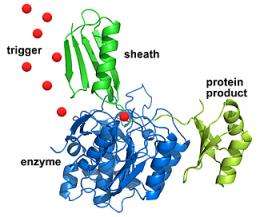
The sheath (in green at top), with the desired protein linked to it (in yellow at right), first sticks to the engineered enzyme (in blue atbottom left) - allowing impurities and other proteins to be washed away. Then an infusion of triggering molecules (red dots) causes the enzyme to cut away the desired protein (at the point where the sheath and protein connect), which can be collected in a pure state. The sheath can then be washed away and the process repeated. Credit: NIST

(PhysOrg.com) -- Drugs based on engineered proteins represent a new frontier for pharmaceutical makers. Even after they discover a protein that may form the basis of the next wonder drug, however, they have to confront a long-standing problem: how to produce large quantities of the protein in a highly pure state. Now, a multi-institutional research team including a biochemist at the National Institute of Standards and Technology may have found a new solution in an enzymatic "food processor" they can activate at will.

The team has found an efficient method of harvesting purified molecules by altering an that use to break down their food. In its natural form, this enzyme would be of little use to drug developers, but the team has modified it so that it can be activated at the desired moment. By creating essentially an "on-switch" for the enzyme's activity, the team has found a way to separate a single, desired protein from the mixture of thousands generated by a living cell, which remains biotechnology's natural protein factory of choice.

Bacteria use the enzyme, called subtilisin, as a sort of food processor: After producing it internally, they release the enzyme into the soil, where it uses a minuscule "blade" to chop up proteins into digestible pieces. Because it could damage the bacterium's interior, the blade has a protective sheath that only comes off once the enzyme has exited the cell.

"The enzyme and sheath are strongly attracted to each other. The enzyme's first act is to cut the sheath away," says NIST's Travis Gallagher. "The method takes advantage of their attraction in order to isolate the protein we want."

The team first creates many "sheathless" copies of the enzyme, which are modified to function only in the presence of a triggering molecule such as fluoride. The modified enzymes are bound to the surface of a strainer. Then the team uses engineered cells to generate mass quantities of a potentially therapeutic protein, each copy of which has a subtilisin sheath attached to it. After harvesting these proteins along with the thousands of others that grow in the cellular interior, they filter the mixture through the strainer, where the protein-sheath pairs are caught and stuck fast to the subtilisin while the rest of the mixture drains away.

At this point, the team flicks their switch. They add a bit of fluoride and the enzyme snips the bond between sheath and protein, releasing the desired protein free of almost all impurities. "The technique can conceivably be used to obtain any protein you like, and the process is repeatable, as the sheaths can be removed for another round of purification," Gallagher says. "For most proteins, the method can achieve greater than 95 percent purity at a single step."

The research team also includes members from Potomac Affinity Proteins, LLC (PAP) and the University of Maryland Biotechnology Institute (UMBI). UMBI holds the patent, which has been licensed to PAP. The research was supported by grants from the National Institutes of Health and the Bill and Melinda Gates Foundation.

More information: T. Gallagher, B. Ruan, M. London, M. Bryan and P.N. Bryan. Structure of a switchable subtilisin complexed with substrate and with the activator azide. .

Provided by National Institute of Standards and Technology (news : web)


Rank not rated yet
Related Stories
Relevant PhysicsForums posts
  • How to determine zinc in a plant.
    createdFeb 11, 2012
  • Stoichiometry
    createdFeb 10, 2012
  • Boiling and melting point of impure substances
    createdFeb 10, 2012
  • Safe nitrogen compound to decompose a 500 deg C in a furnace?
    createdFeb 09, 2012
  • [ask]electron inside drinking water
    createdFeb 08, 2012
  • How to avoid formation of Lithium Chromate ???
    createdFeb 08, 2012
  • More from Physics Forums - Chemistry

More news stories

Hydrogen from acidic water: Researchers develop potential low cost alternative to platinum for splitting water

A technique for creating a new molecule that structurally and chemically replicates the active part of the widely used industrial catalyst molybdenite has been developed by researchers with the Lawrence Berkeley ...

Chemistry / Materials Science

created Feb 09, 2012 | popularity 4.8 / 5 (15) | comments 21 | with audio podcast

Fool's gold may prove an unlikely alternative to overexploited catalytic materials

Catalytic materials, which lower the energy barriers for chemical reactions, are used in everything from the commercial production of chemicals to catalytic converters in car engines. However, with current catalytic materials ...

Chemistry / Materials Science

created Feb 10, 2012 | popularity 4.4 / 5 (8) | comments 8 | with audio podcast

Research provides octagonal window of opportunity for carbon capture

(PhysOrg.com) -- Filtering carbon dioxide, a greenhouse gas, from factory smokestacks is a necessary, but expensive part of many manufacturing processes. However, a collaborative research team from the National ...

Chemistry / Materials Science

created Feb 08, 2012 | popularity 5 / 5 (1) | comments 5 | with audio podcast

Flexible paper robots

(PhysOrg.com) -- These inexpensive robots can stretch, bend and twist under control, and lift objects up to 120 times their own weight. Being soft, they can apply gentle and even pressure, and adapt to varied ...

Chemistry / Materials Science

created Feb 09, 2012 | popularity 5 / 5 (5) | comments 4 | with audio podcast

New form of hafnium oxide developed

(PhysOrg.com) -- A novel material developed by researchers at the University of Cambridge is opening up new possibilities for next generation electronic and optoelectronic devices, and paving the way for further ...

Chemistry / Materials Science

created Feb 07, 2012 | popularity 4.6 / 5 (5) | comments 4 | with audio podcast


Injured boomers beware: Know when to see doctor

(AP) -- It happened to nurse Jane Byron years after an in-line skating fall, business owner Haralee Weintraub while doing "men's" push-ups, and avid cyclist Gene Wilberg while lifting a heavy box.

Google might launch Drive for cloud storage soon

(PhysOrg.com) -- Google's next big move, according to the Wall Street Journal, is a cloud storage service called Drive. Hardly first to the plate, Google is simply catching up to introducing its cloud reposi ...

Latin America mining boom clashes with conservation

Latin America is experiencing a mining boom as prices rise fuelled by a hike in global demand, but the region is also being hit by a wave of violent protests, strikes and rallies by environmentalists.

Love a click away in Indonesia's Twitter Republic

He was a geeky kid from Yogyakarta, she a glamorous city girl in Jakarta. In a country with one of the world's most vibrant social networking scenes they fell in love on Twitter.

Europeans protest controversial Internet pact

Tens of thousands of people marched in protests in more than a dozen European cities Saturday against a controversial anti-online piracy pact that critics say could curtail Internet freedom.

Walney offshore wind farm is world's biggest (for now)

(PhysOrg.com) -- The Walney wind farm on the Irish Sea--characterized by high tides, waves and windy weather--officially opened this week. The farm is treated in the press as a very big deal as the Walney ...