Sugar cereals are 'Smart Choices'? FDA not so sure
October 21, 2009 By MATTHEW PERRONE , AP Business Writer
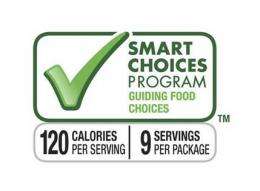
FILE - In this 2008 file image provided by the Keystone Center, a sample of a label that appears on foods that meet certain nutritional requirements within their categories is shown. U.S. manufacturers, including Kraft Foods and General Mills, rolled out their so-called Smart Choices program last year, amid growing concern about obesity rates. The green labels appear on the front of boxed foods that meet certain standards for calories per serving and number of servings.(AP Photo/ Keystone Center)
(AP) -- Ever wondered how that "Smart Choices" sticker wound up on the front of Froot Loops or Cocoa Puffs?
Well, federal health officials are having similar thoughts, and they're warning food manufacturers.
The Food and Drug Administration said Tuesday that nutritional logos from food manufacturers may be misleading consumers about the actual health benefits of cereal, crackers and other processed foods. The agency sent a letter to companies saying it will begin cracking down on inaccurate food labeling. The FDA did not name specific products or give a timeline for enforcement.
U.S. manufacturers, including Kellogg, Kraft Foods and General Mills, rolled out their so-called Smart Choices program last year, amid growing concern about obesity rates. The green labels appear on the front of foods that meet certain standards for calories per serving and fat content.
But consumer advocates complain about lax standards for the program, with logos appearing on everything from frozen sweets to sugary cereals.
"There are products that have gotten the Smart Choices check mark that are almost 50 percent sugar," FDA Commissioner Margaret Hamburg said during a call with reporters.
The agency is developing proposed nutritional standards that would have to be met before manufacturers place such claims on their packages, Hamburg said. She added that she hoped industry would cooperate with the FDA to develop standardized "labeling that all Americans can trust and use to build better diets."
Mike Hughes, chair of the Smart Choices Program, said in a statement that Smart Choices is based on the U.S. Dietary Guidelines for Americans.
"We believe in the science behind the Smart Choices Program," he said. "We also look forward to the opportunity to participate in FDA's initiatives on front-of-package labeling."
There are more than a half-dozen labels crowding grocery packages, including the American Heart Association's heart-shaped logo, Giant Food Store's Healthy Ideas box and Supervalu's Nutritional IQ logo.
"There's a growing proliferation of forms and symbols, check marks, numerical ratings, stars, heart icons and the like," said Hamburg. "There's truly a cacophony of approaches, not unlike the tower of Babel."
The FDA plans to research whether one particular approach would make it easier for consumers to select healthy foods. Hamburg pointed to the success of the U.K.'s traffic light system, which uses red, yellow and green lights to highlight nutritional quality.
The Grocery Manufacturers Association said its members will work with the FDA to provide useful nutritional information to consumers. The Washington-based group - which includes Kraft, Nestle USA and most other large food processors - said companies already have reformulated 10,000 products to make them healthier.
Such changes includes ConAgra's move to reduce sodium in its soup, hot dogs and other products by 20 percent, and General Mills adding fiber to its cereals.
©2009 The Associated Press. All rights reserved. This material may not be published, broadcast, rewritten or redistributed.
-
Smart Choices Program helps shoppers identify food and beverage choices
Aug 05, 2009 |
not rated yet |
0
-
England says stop supersizing
Mar 28, 2007 |
not rated yet |
0
-
Report: 'Healthy' food not so healthy
Jan 09, 2008 |
not rated yet |
0
-
FDA takes issue with Cheerios health claims
May 12, 2009 |
not rated yet |
0
-
Full disclosure: People will make healthier choices if restaurants provide nutritional data
Mar 31, 2009 |
not rated yet |
0
-
Engineers build first sub-10-nm carbon nanotube transistor
Feb 01, 2012 |
4.9 / 5 (33) |
30
-
Something old, something new: Evolution and the structural divergence of duplicate genes
Jan 31, 2012 |
4.6 / 5 (7) |
1
-
The hidden nanoworld of ice crystals: Revealing the dynamic behavior of quasi-liquid layers
Jan 30, 2012 |
5 / 5 (4) |
1
-
Stock market network reveals investor clustering
Jan 27, 2012 |
3.9 / 5 (23) |
8
-
Of microchemistry and molecules: Electronic microfluidic device synthesizes biocompatible probes
Jan 26, 2012 |
5 / 5 (2) |
0
-
Classical and Quantum Mechanics via Lie algebras
Apr 15, 2011
- More from Physics Forums - Independent Research
More news stories
Starve a virus, feed a cure? Findings show how some cells protect themselves against HIV
A protein that protects some of our immune cells from the most common and virulent form of HIV works by starving the virus of the molecular building blocks that it needs to replicate, according to research published online ...
8 hours ago |
5 / 5 (2) |
0
|
Overeating may double risk of memory loss
New research suggests that consuming between 2,100 and 6,000 calories per day may double the risk of memory loss, or mild cognitive impairment (MCI), among people age 70 and older. The study was released today and will be ...
Medicine & Health / Neuroscience
5 hours ago |
5 / 5 (2) |
0
|
Injured boomers beware: Know when to see doctor
(AP) -- It happened to nurse Jane Byron years after an in-line skating fall, business owner Haralee Weintraub while doing "men's" push-ups, and avid cyclist Gene Wilberg while lifting a heavy box.
10 hours ago |
5 / 5 (1) |
0
Declining health-care productivity in England: Who says so?
Reports that the National Health Service in England has been declining in productivity in the last decade appear to have been accepted as fact. However, a Viewpoint published Online First by The Lancet disputes this. The Vi ...
3 hours ago |
not rated yet |
0
FDA-approved drug rapidly clears amyloid from the brain, reverses Alzheimer's symptoms in mice
Neuroscientists at Case Western Reserve University School of Medicine have made a dramatic breakthrough in their efforts to find a cure for Alzheimer's disease. The researchers' findings, published in the journal Science, show t ...
Medicine & Health / Neuroscience
Feb 09, 2012 |
4.9 / 5 (58) |
17
|
Scientists discover molecular secrets of 2,000-year-old Chinese herbal remedy
For roughly two thousand years, Chinese herbalists have treated Malaria using a root extract, commonly known as Chang Shan, from a type of hydrangea that grows in Tibet and Nepal. More recent studies suggest that halofuginone, ...
New method to examine batteries -- MRI from the inside
There is an ever-increasing need for advanced batteries for portable electronics, such as phones, cameras, and music players, but also to power electric vehicles and to facilitate the distribution and storage of energy derived ...
Google might launch Drive for cloud storage soon
(PhysOrg.com) -- Google's next big move, according to the Wall Street Journal, is a cloud storage service called Drive. Hardly first to the plate, Google is simply catching up to introducing its cloud reposi ...
A mitosis mystery solved: How chromosomes align perfectly in a dividing cell
Although the process of mitotic cell division has been studied intensely for more than 50 years, Whitehead Institute researchers have only now solved the mystery of how cells correctly align their chromosomes during symmetric ...
Lab study raises questions over nano-particle impact
Tests involving chickens have raised questions about the impact on health from engineered nano-particles, the ultra-fine grains commonly used in drugs and processed foods, scientists said on Sunday.
Researchers find extensive RNA editing in human transcriptome
In a new study published online in Nature Biotechnology, researchers from BGI, the world's largest genomics organization, reported the evidence of extensive RNA editing in a human cell line by analysis of RNA-seq data, demons ...
Oct 21, 2009
Rank: not rated yet
Oct 21, 2009
Rank: not rated yet
Kudos for the FDA.
Oct 21, 2009
Rank: not rated yet
Oct 21, 2009
Rank: not rated yet
You'd be a lot better off trusting business before Government. Business just wants your wallet (and there is no profit is killing off your customers), while (the current) Government wants nothing less than your wallet AND complete control of your life.
Oct 21, 2009
Rank: 1 / 5 (1)
Oct 21, 2009
Rank: not rated yet