It takes two to tutor a sparrow
October 21, 2009 by Joel Schwarz It takes 2 to tutor a sparrow

Enlarge

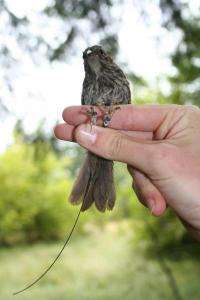
A juvenile song sparrow shows off a radio antenna that enables researchers to track it as they study how the birds learn to sing. Credit: University of Washington

(PhysOrg.com) -- It may take a village to raise a child, and apparently it takes at least two adult birds to teach a young song sparrow how and what to sing.

In the first study conducted in the field to examine how juvenile song birds learn their repertoire, University of Washington researchers have learned that eavesdropping on the singing conversations between two adult sparrows appears to be a key event in song learning. The results are being published Oct. 21 in the online edition of the .

Scientists study how song birds acquire their songs because the process has parallels with human language learning. In each case eavesdropping seems to play a role.

The researchers used radio telemetry to track the young song sparrows (Melospiza melodia) and monitor responses to recorded bird songs played over two speakers. Only male birds were studied because female sparrows generally do not sing.

"We measured how close the juveniles came to the speakers, how long it took for them to approach and their overall movements. They generally moved closer, faster and farther when they heard recordings of two adult male sparrows interacting than when they heard recordings of a solo sparrow singing," said Christopher Templeton, a UW biology doctoral student and lead author of the study.

The research stems from an earlier UW laboratory study that showed young sparrows acquire more of their songs when they eavesdrop on two birds than when they interact with a tutor. That research was headed by Michael Beecher, a UW psychology and biology professor, who is a co-author of the new paper.

For the field study, the researchers radio tagged 11 male sparrows in Seattle's undeveloped Discovery Park. These birds were about two months old and had not yet begun to sing. The park has a year-round resident population of approximately l50 breeding pairs.

To test a young bird's reactions, it was first located by its radio signal and then the speakers were placed about 50 yards from the animal's location. Finally the bird was exposed to five minutes of pre-recorded song, either from pairs of song sparrows, a sparrow and a chickadee (effectively a solo sparrow) or a pair of chickadees (the control condition). All of the sparrow recordings were from birds that were no longer alive, so that the songs the young birds heard were not familiar. Chickadees commonly live in the same habitat as song sparrows, so sparrows are familiar with their songs.

That the juvenile birds approached the simulated interaction of two song sparrows but largely ignored the solo singing of a song sparrow lends support to the social eavesdropping hypothesis proposed by Beecher. This theory says young birds learn to sing by eavesdropping on singing between adult birds, rather than listening to a single bird or directly interacting with an adult.

"They seem to be learning how to sing and interact by eavesdropping on interactions. This way they can learn shared songs, which will be important for their future success. Having shared song is the basis of song communications," said Templeton.

"By listening to two birds, the juvenile can also learn how the songs are used, something he can't learn by listening to a single bird. The young bird could do this by directly interacting with a mature adult bird, but that is risky because he might be chased away or beaten up."

Source: University of Washington (news : web)


Rate this story - 4.5 /5 (2 votes)

Rank Filter

Move the slider to adjust rank threshold, so that you can hide some of the comments.


Display comments: newest first

  • teledyn - Oct 21, 2009
    • Rank: not rated yet
    is this true also for European or African swallows? :)
  • nkalanaga - Oct 21, 2009
    • Rank: not rated yet
    I don't know, but it would seem likely for any social songbird. Human infants also learn better from conversations than from one person talking alone.

October 21, 2009 all stories

Comments: 2

4.5 /5 (2 votes)

  • hide
  • Related Stories

  • Eavesdropping comes naturally to young song sparrows
    created May 29, 2007 | popularity not rated yet | comments 0
  • Steroids, not songs, spur growth of brain regions in sparrows
    created Jul 23, 2007 | popularity not rated yet | comments 0
  • Bird songs change with environment
    created May 20, 2009 | popularity not rated yet | comments 0
  • Researcher 'sings' for a living to decode the meaning of bird songs
    created Dec 18, 2008 | popularity not rated yet | comments 0
  • Songbirds' Brains Provide Clues to Human Speech
    created Jan 16, 2008 | popularity not rated yet | comments 0


  • hide
  • Relevant PhysicsForums posts

  • Do we lose weight by respiration ? (Losing carbons)
    created 2 hours ago
  • Sleeping habits and the risk of cancer
    created Feb 08, 2010
  • Pressure in chambers of the heart
    created Feb 07, 2010
  • Primordial soup canned?
    created Feb 07, 2010
  • More from Physics Forums - Biology

Other News

Scientists crash test DNA's replication machinery

Biology / Cell & Microbiology

created 44 minutes ago | popularity 5 / 5 (1) | comments 0 | with audio podcast

(PhysOrg.com) -- Important molecular machines routinely crash into one another while plying their trades on DNA. New research shows that the enzymes that copy DNA before cell division, called replisomes, are the kings of ...


Benefits of badger culling not long lasting for reducing cattle TB, says study

Benefits of badger culling not long lasting for reducing cattle TB, says study

Biology / Ecology

created 1hour ago | popularity not rated yet | comments 0

(PhysOrg.com) -- Badger culling is unlikely to be a cost-effective way of helping control cattle TB in Britain, according to research published today in PLoS ONE.


giant oarfish

Bizarre giant oarfish filmed (w/ Video)

Biology / Plants & Animals

created 2 hours ago | popularity 3.5 / 5 (2) | comments 0 | with audio podcast report

(PhysOrg.com) -- A rare giant oarfish, probably the largest bony fish in the ocean, has been filmed off the Gulf of Mexico. This is possibly the first time the fish has been observed in its natural environment.


Scientists release Key Largo wood rats in first test of restocking experiment

Biology / Ecology

created 1hour ago | popularity not rated yet | comments 0

The seven pioneers spent the week preparing for their upcoming ordeal in North Key Largo, sampling berries and other local fare, redecorating homes with sticks, leaves and whatever else they got their little paws on, and ...


Great tits: birds with character

Great tits: birds with character

Biology / Plants & Animals

created 15 hours ago | popularity 5 / 5 (3) | comments 3 | with audio podcast

(PhysOrg.com) -- In humans and animals alike, individuals differ in sets of traits that we usually refer to as personality. An important part of the individual difference in personality is due to variation ...