Gyrowheel to keep new bike riders upright (w/ Video)
October 21, 2009 by Lin Edwards
(PhysOrg.com) -- A new device called the Gyrowheel could soon revolutionize the way children learn to ride bicycles, and they will be able to learn on their own, without training wheels, and in as little as half an hour.
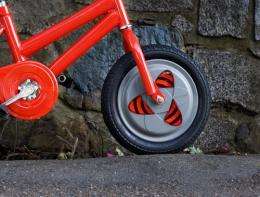
The Gyrowheel has a fast spinning disk inside that can spin for up to three hours on a full charge of its built-in rechargeable NiMH battery. The spinning disk is completely enclosed for safety. The Gyrowheel replaces the front wheel of the child's bike, and the spinning disk inside keeps the bike upright and stable, even when a wobbling child is aboard.
The Gyrowheel has three speeds, with the highest speed being the most stable. At this speed the wheel is able to resist knocks and shoves even when it is stationary, and without a bicycle attached can travel upright, letting itself down gently when it stops. The gyroscope gives the bicycle high stability even at very slow speeds.
As the novice rider gathers more confidence, the speed can be decreased, until the child is riding unaided. The Gyrowheel has been tested on over a hundred children, and all learned to ride very quickly without needing training wheels.
Daniella Reichstetter, the CEO of Gyrobike, the Gyrowheel's developer, explained that the old system of training wheels did nothing more than stop the child falling over, and could start the novice off with bad habits and riding techniques that had to be unlearned when the training wheels were removed.
The wheel was originally intended to teach someone how to ride a unicycle, but Reichstetter and her team soon realized the device could be used equally well on a young child's bicycle to help them learn more safely and quickly.
The Gyrowheel took two years to develop and test, and Reichstetter said it was difficult to get a disk that could spin fast enough to create sufficient gyroscopic precession to stabilize the bicycle at the low speeds at which a learner tends to ride.
The Gyrowheel was demonstrated at the Interbike International Trade Expo in Las Vegas in September. It will fit on any standard 12 inch child's bicycle, and a 16 inch version is expected later. The Gyrowheel will be available from the Gyrobike website in plenty of time for Christmas, and will be available elsewhere during 2010. The price for the 12 inch is expected to be around $100.
Other products that may be developed using the gyroscope technology include bicycles for the senior citizen cyclist who may benefit from the extra stability.
More information: Official website: http://www.thegyrobike.com/
© 2009 PhysOrg.com


This is training wheels that are internal -- just because you cannot see the training wheels does not mean you know how to ride a bike.
I've thought about this kind of thing for a while. I do have a unicycle and first thought about it for the sake of unicycling and did make the extension to regular bikes. Oh well!
Like RayCherry said, surely many other people, myself included, have thought of this and made nothing of it.
El Nose, the fact that it doesn't provide complete stability tells me it will still help learn and isn't a direct analog to training wheels. You stay upright on a bike BECAUSE of the gyroscopic effect of the wheels. This is simply increasing the gyroscopic effect, giving the bike more stability (but not complete stability like training wheels), meaning a rider still has to learn how to stabilize - they just have more time to do it now than they did before, to start.
The falling over is what is slowed because of the angular momentum of the wheel. The whole idea is that instead of just flopping over, the bike slowly tilts (and turns) giving the rider enough time to self-right.
I don't see how anyone would flip over handlebars because of the tilt and turn of the bike/handlebars.
Stability can be a bad thing. Modern motorbikes are often made to be maneuverable. Even large touring motorcycles have to be easily maneuverable.
A high angular momentum means that it would be harder to turn and tilt. This basically means that it's harder to get it to do what you want. Sure, it'll stay upright, but if you're going fast and need to turn quickly to avoid crashing into something, with the added stability you're out of luck - you simply can't turn the wheel enough and tilt enough to turn.
Putting this on airplanes makes no sense. Airplanes are already stable (in most modes) by virtue of their design. Not to mention, the spinning of the engines does add some stability by a similar effect.
I don't know what you're talking about with respect to fault sensitive devices such as springs, levers weights and hydraulics on airplanes or balloons.