Pavlopetri -- the world's oldest known submerged town
October 21, 2009 Pavlopetri -- the world's oldest known submerged town

Enlarge

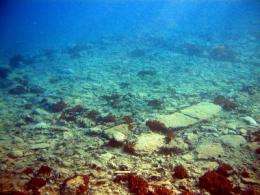
This image shows large square building foundations at Pavlopetri. Credit: Jon Henderson

The world's oldest known submerged town has been revealed through the discovery of late Neolithic pottery. The finds were made during an archaeological survey of Pavlopetri, off the southern Laconia coast of Greece.

Marine geo-archaeologist Dr Nic Flemming of the National Oceanography Centre, Southampton said: "The discovery of Neolithic pottery is incredible! It means that we are looking at a port city which may be 5000-6000 years old, with trade goods and wrecks nearby showing some of the very earliest days of seafaring trade in the Mediterranean."

The project is being carried out by a multidisciplinary team, including Dr Flemming, led by Mr Elias Spondylis, Ephorate of Underwater Antiquities of the Hellenic Ministry of Culture in Greece and Dr Jon Henderson, an underwater archaeologist from the Department of Archaeology at The University of Nottingham.

The underwater city was discovered in 1967 by Flemming, then at the National Institute of Oceanography. He worked out that it was Bronze Age, about 2000 BC, and arranged the permit for a team from Cambridge University to map it properly in 1968, which they did using just snorkels and tape measures. The results were published by The British School at Athens in 1969, but no further work has been done over the last 40 years. The site was so remote that its isolation protected it from human interference, while a submerged ridge of rock protected it from erosion.
Pavlopetri -- the world's oldest known submerged town
Enlarge

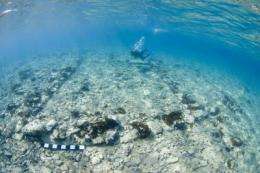
Nic Flemming -- The curvature of the sea surface and the nearby walls is of course caused by the "fish-eye" lens. There is an obvious wall across the foreground, slightly curved, and two huge wall foundations stretching away parallel towards the diver. There are other walls branching off into the gloom to left and right. Although there are some square or flattened paving stones in the town, almost all the walls are made out of uncut stones like dry-stone sheep walls on Exmoor. They were probably packed with clay to make them stronger, as we know that some of the houses were at least two stories high later in the Bronze Age, from the paintings at Santorini. The diver is Kirsten Flemming, who was the architect-diver for the project. Credit: Pavlopetri Expedition

Now in his 70s, Flemming has joined forces with archaeologists from the University of Nottingham and the Ephorate of Underwater Antiquities of the Hellenic Ministry of Culture as part of a five-year collaborative study of the site. The survey methods include laser range-finding on the surface and high-frequency sector-scanning sonar underwater. Their initial findings, and especially the discovery of Neolithic ceramics, mean that the submerged city was occupied at least 5,000 years ago, 1,200 years earlier than previously believed, and perhaps based on a primitive settlement much earlier still. The findings have been made public by the Greek government.

"What we've got here is something which is two or even three thousand years older than most of the submerged cities which have been studied," said Flemming: "And it is uniquely complete. We have almost the complete town plan, the main streets and all of the domestic buildings. We can study how it was used as a port, where ships came in and how trade was managed."

The total town area is about 100,000 square metres, about half of which has so far been mapped. Much is still covered by sand. The team has already found a new area of ruins, measuring about 100 by 100 metres.

Flemming is running the studies of sea-level change and tectonics at the site, while colleague Dr Neil Wells of the University of Southampton's School of Ocean and Earth Science at the National Oceanography Centre and one of his students have already modelled winds and waves to work out aspects of coastal sand transport and erosion.
Pavlopetri -- the world's oldest known submerged town
Enlarge

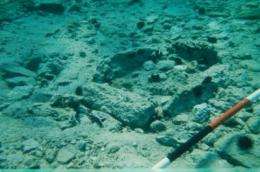
This is a rectangular cist grave made by four stones standing on edge. The markings on the range pole are in 25cm bands. Credit: Nic Flemming

There is a lot more work to do in analysing the sand movements over the site, plotting various findings of submerged 'beachrock' which can be dated showing earlier shorelines now hundreds of metres offshore, and modelling the process of inundation itself.

The Hellenic Centre for Marine Research plans to provide a geophysics research boat in 2010 to measure the sub-bottom profiles to get sediment thickness in key areas around the submerged city, and confirm the position of the shoreline at different dates.

The permit runs for another four years.

Source: National Oceanography Centre, Southampton


print this article email this article download pdf blog this article bookmark this article     Stumble it Digg this share on Facebook retweet share on Reddit add to delicious
Rate this story - 4.6 /5 (9 votes)

Rank Filter

Move the slider to adjust rank threshold, so that you can hide some of the comments.


Display comments: newest first

  • Shootist - Oct 21, 2009
    • Rank: not rated yet
    Oldest sunken city? Dang 'ol global warming.
  • Arkaleus - Oct 21, 2009
    • Rank: 5 / 5 (1)
    Does the IPCC have a working plan to address the issue of ocean level variation? After all, with their deep understanding of climate and exactly what mixture of gasses causes each and every weather condition, they should be able to devise a tax to prevent any change in sea level from here to eternity.

    Or does what I said make absolutely no sense?

    If the climate changes naturally, wouldn't trying to prevent it from changing be *unnatural*? What exactly is normal climate on earth? Isn't the whole premise of "Climate change" hype that early 20th century earth climate is the normal baseline climate for earth? Could it be that 20th century earth climate was unique or was in a transition state between even longer periods of activity?
  • OdinsAcolyte - Oct 21, 2009
    • Rank: 5 / 5 (1)
    Arkaleus, you are speaking to ears that cannot hear
    and minds that do not care. What they want to preserve is their 'now' no matter that it is not the perpetual now or even the best or the average 'now'. What it is about is dictating to others what to do because they are so much more intelligent than the vulgate and what they think must be best for the rest. The fact that they are most likely wrong never enters their minds. We must 'teach' them.
  • GrayMouser - Oct 21, 2009
    • Rank: not rated yet
    What they want to preserve is their 'now' no matter that it is not the perpetual now or even the best or the average 'now'.

    Your being too kind. The alternative explanations are:
    1) Somebody is going make lots of money flogging this. At least until the economy fails.
    2) Somebody gets to tell other people how to live (even if they themselves don't live that way.) That has got to be an enormous ego boost. Beyond a Nobel Peace Prize for doing nothing.
  • Sean_W - Oct 22, 2009
    • Rank: not rated yet
    Cool to have such a large site from that age. Here's hoping for lots of artifact finds.

October 21, 2009 all stories

Comments: 5

4.6 /5 (9 votes)
  • Stumble this up

  • Digg this

  • share this

  • hide
  • Related Stories

  • World's oldest submerged town dates back 5,000 years (w/ Video)
    created Oct 16, 2009 | popularity not rated yet | comments 0
  • Race to preserve the world's oldest submerged town
    created May 11, 2009 | popularity not rated yet | comments 0
  • FSU classics professor exploring a 'lost' city of the Mycenaeans
    created Mar 11, 2008 | popularity not rated yet | comments 0
  • 5 ancient Roman shipwrecks found off Italy coast
    created Jul 25, 2009 | popularity not rated yet | comments 0
  • Underwater exploration seeks evidence of early Americans
    created Jul 09, 2009 | popularity not rated yet | comments 0


  • hide
  • Relevant PhysicsForums posts

  • Human Leukocyte Antigen (HLA) typing
    created 5 hours ago
  • Breeding program
    created Nov 20, 2009
  • How does a concentration gradient provide energy?
    created Nov 20, 2009
  • Eyesight and Neural Damage from Electronics
    created Nov 19, 2009
  • Quick question about the Golgi Apparatus?
    created Nov 19, 2009
  • The beginning of humans
    created Nov 18, 2009
  • More from Physics Forums - Biology

Other News

Museum: Galileo's fingers, tooth are found (AP)

Museum: Galileo's fingers, tooth are found

Other Sciences / Archaeology & Fossils

created 16 hours ago | popularity not rated yet | comments 5

(AP) -- Two fingers and a tooth removed from Galileo Galilei's corpse in a Florentine basilica in the 18th century and given up for lost have been found again and will soon be put on display, an Italian museum ...


Measure to change U. of Neb. stem-cell rule fails (AP)

Measure to change U. of Neb. stem-cell rule fails (Update 2)

Other Sciences / Other

created 16 hours ago | popularity 5 / 5 (1) | comments 0

(AP) -- The University of Nebraska's governing board on Friday voted not to place tighter restrictions on embryonic stem cell research than those outlined under federal guidelines, which were expanded after ...


Researcher: Faint writing seen on Shroud of Turin (AP)

Researcher: Faint writing seen on Shroud of Turin (Update)

Other Sciences / Archaeology & Fossils

created Nov 20, 2009 | popularity 1.9 / 5 (23) | comments 23

(AP) -- A Vatican researcher has rekindled the age-old debate over the Shroud of Turin, saying that faint writing on the linen proves it was the burial cloth of Jesus. Experts say the historian may be reading ...


Three of a kind

Three of a kind: Revealing language’s universal essence

Other Sciences / Social Sciences

created Nov 20, 2009 | popularity 3.8 / 5 (10) | comments 6

(PhysOrg.com) -- On the surface, English, Japanese, and Kinande, a member of the Bantu family of languages spoken in the Democratic Republic of Congo, have little in common. It is not just that the vocabularies ...


Maya

New insights into the life of the Maya

Other Sciences / Archaeology & Fossils

created Nov 16, 2009 | popularity 4.6 / 5 (15) | comments 7

(PhysOrg.com) -- Ancient artifacts are almost always concerned with rich and powerful religious and political leaders, but new excavations of an ancient Maya site have unearthed a pyramid decorated with murals ...