Final look at ESA's SMOS and Proba-2 satellites
October 21, 2009
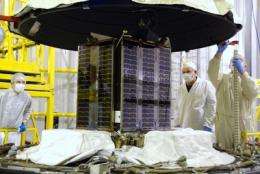
Proba-2 being covered by the SMOS launch adapter before both satellites were encapsulated within the Rockot fairing. Credits: ESA
As preparations for the launch of SMOS and Proba-2 continue on schedule, the engineers and technicians at the Russian launch site say goodbye as both satellites are encapsulated within the half-shells of the Rockot fairing.
Volker Liebig, ESA's Director of Earth Observation Programmes, said, "Today, with the encapsulation of the SMOS satellite in the launcher fairing, we have made an important step towards the launch of this key environmental mission, which will investigate two parameters of the complex climate system. I am looking forward to the launch in a few days!"
The small Proba-2 satellite had already been mated to the Breeze-KM, which is the upper stage of the Russian Rockot, and sealed from view by the SMOS launch adapter above. In launch configuration, Proba-2 sits underneath the SMOS satellite, for injection into orbit after SMOS.
Proba-2 is the second in ESA's Project for Onboard Autonomy series. Although it is less than a cubic metre, incorporates a total of 17 technology developments and four scientific experiments that focus on solar and space weather.
This video is not supported by your browser at this time.
SMOS will provide global maps of soil moisture and ocean salinity, which are two key variables linked to Earth's water cycle. The maps of ocean salinity will further our knowledge of ocean circulation patterns and their role in the climate system. Credits: ESA - AOES Medialab
Michel Courtois, ESA's Director of Technical and Quality Managment, said, "The encapsulation of the Proba-2 satellite was an emotional moment for the project team in Plesetsk. After five years of hard work, our satellite is one step closer to launch, ready to show the importance of in-orbit demonstration of new technologies."The Proba-2 technology demonstrator is taking advantage of the launch of the 'Soil Moisture and Ocean Salinity' (SMOS) mission, which will make advances in our understanding of Earth's water cycle.
By employing novel technology in space, SMOS will provide the data to produce global maps of soil moisture at least every three days and global maps of sea-surface salinity averaged over 30 days. Through this regular and consistent mapping, the mission will improve our understanding of the role these two key variables play in regulating the water cycle.
Information from SMOS will also improve weather and climate models, and have practical applications in areas such as agriculture and resource management. The data on sea-surface salinity will further our knowledge of ocean circulation patterns and the role they play in the climate system.
Both Proba-2 and SMOS have been at the Plesetsk Cosmodrome in northern Russia since September, initially taking turns in the cleanroom for the early part of the launch campaign. Over the last week or so, the teams have been working in parallel to mate the satellites to the upper stage of the launcher and now encapsulate them within the fairing. This proved quite emotional for the teams, as both missions have been a number of years in the making.
Now protecting both satellites from the rigors of launch, the half-shells will not open until three minutes after launch, which is scheduled for 2 November at 02: 50 CET (01:50 UT). The next important step in the preparation schedule will be to roll out the 'upper composite' to the launch pad on 26 October, for mating with the rest of the rocket.
-
SMOS and Proba-2 launch rescheduled for November (w/Video)
Jun 22, 2009 |
not rated yet |
0
-
SMOS arrives safely at Russian launch site
Sep 18, 2009 |
not rated yet |
0
-
SMOS ready to ship to launch site
May 28, 2009 |
not rated yet |
0
-
SMOS water mission on track for launch
Feb 12, 2009 |
not rated yet |
0
-
Proba-2 satellite flies into its Russian launch site
Sep 07, 2009 |
not rated yet |
0
-
Engineers build first sub-10-nm carbon nanotube transistor
Feb 01, 2012 |
4.9 / 5 (33) |
30
-
Something old, something new: Evolution and the structural divergence of duplicate genes
Jan 31, 2012 |
4.6 / 5 (7) |
1
-
The hidden nanoworld of ice crystals: Revealing the dynamic behavior of quasi-liquid layers
Jan 30, 2012 |
5 / 5 (4) |
1
-
Stock market network reveals investor clustering
Jan 27, 2012 |
3.9 / 5 (23) |
8
-
Of microchemistry and molecules: Electronic microfluidic device synthesizes biocompatible probes
Jan 26, 2012 |
5 / 5 (2) |
0
-
Never ending outer space.....
19 hours ago
-
Neutron Star fragments?
21 hours ago
-
stationary or not?
Feb 11, 2012
-
Scale of the Universe
Feb 10, 2012
-
Titan's lack of impact craters
Feb 09, 2012
-
Real pictures of black hole eating a star?
Feb 08, 2012
- More from Physics Forums - General Astronomy
More news stories
Latin America mining boom clashes with conservation
Latin America is experiencing a mining boom as prices rise fuelled by a hike in global demand, but the region is also being hit by a wave of violent protests, strikes and rallies by environmentalists.
12 hours ago |
5 / 5 (1) |
1
Salvage workers begin pumping fuel from Italian shipwreck
Salvage workers Sunday began pumping fuel from the shipwrecked Italian cruise liner Costa Concordia, a day ahead of schedule, officials said.
4 hours ago |
not rated yet |
0
Political leaders play key role in how worried Americans are by climate change: study
More than extreme weather events and the work of scientists, it is national political leaders who influence how much Americans worry about the threat of climate change, new research finds.
Feb 06, 2012 |
5 / 5 (6) |
73
NASA budget will axe Mars deal with Europe: scientists
US President Barack Obama's budget proposal to be submitted next week for 2013 will cut NASA's budget by 20 percent and eliminate a major partnership with Europe on Mars exploration, scientists said Thursday.
Space & Earth / Space Exploration
Feb 10, 2012 |
5 / 5 (3) |
58
Humans may have helped the decline of African rainforests 3000 years ago
(PhysOrg.com) -- Large areas of rainforests in Central Africa mysteriously disappeared over three thousand years ago, to be replaced by savannas. The prevailing theory has been that the cause was a change ...
Overeating may double risk of memory loss
New research suggests that consuming between 2,100 and 6,000 calories per day may double the risk of memory loss, or mild cognitive impairment (MCI), among people age 70 and older. The study was released today and will be ...
Google might launch Drive for cloud storage soon
(PhysOrg.com) -- Google's next big move, according to the Wall Street Journal, is a cloud storage service called Drive. Hardly first to the plate, Google is simply catching up to introducing its cloud reposi ...
Scientists discover molecular secrets of 2,000-year-old Chinese herbal remedy
For roughly two thousand years, Chinese herbalists have treated Malaria using a root extract, commonly known as Chang Shan, from a type of hydrangea that grows in Tibet and Nepal. More recent studies suggest that halofuginone, ...
New method to examine batteries -- MRI from the inside
There is an ever-increasing need for advanced batteries for portable electronics, such as phones, cameras, and music players, but also to power electric vehicles and to facilitate the distribution and storage of energy derived ...
Lab study raises questions over nano-particle impact
Tests involving chickens have raised questions about the impact on health from engineered nano-particles, the ultra-fine grains commonly used in drugs and processed foods, scientists said on Sunday.
Injured boomers beware: Know when to see doctor
(AP) -- It happened to nurse Jane Byron years after an in-line skating fall, business owner Haralee Weintraub while doing "men's" push-ups, and avid cyclist Gene Wilberg while lifting a heavy box.