Scientists bend nanowires into 2-D and 3-D structures
October 21, 2009 BY STEVE BRADT
Scientists bend nanowires into 2-D and 3-D structures

Enlarge

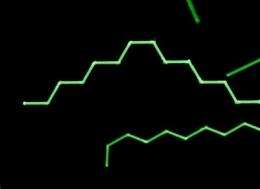
This is a false-color scanning electron microscope image of the zigzag nanowires in which the straight sections are separated by triangular joints and specific device functions are precisely localized at the kinked junctions in the nanowires. Credit: Bozhi Tian, Lieber Group, Harvard University

(PhysOrg.com) -- Taking nanomaterials to a new level of structural complexity, scientists have determined how to introduce kinks into arrow-straight nanowires, transforming them into zigzagging two- and three-dimensional structures with correspondingly advanced functions.

The work is described this week in the journal by Harvard University researchers led by Bozhi Tian and Charles M. Lieber.

Among other possible applications, the authors say, the new technology could foster a new nanoscale approach to detecting electrical currents in cells and tissues.

"We are very excited about the prospects this research opens up for nanotechnology," says Lieber, Mark Hyman, Jr. Professor of Chemistry in Harvard's Faculty of Arts and Sciences. "For example, our nanostructures make possible integration of active devices in nanoelectronic and photonic circuits, as well as totally new approaches for extra- and intracellular biological sensors. This latter area is one where we already have exciting new results, and one we believe can change the way much electrical recording in biology and medicine is carried out."

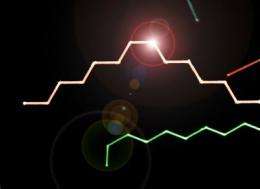
Lieber and Tian's approach involves the controlled introduction of triangular "stereocenters" -- essentially, fixed 120º joints -- into nanowires, structures that have previously been rigidly linear. These stereocenters, analogous to the chemical hubs found in many complex organic molecules, introduce kinks into 1-D nanostructures, transforming them into more complex forms.
Scientists bend nanowires into 2-D and 3-D structures
Enlarge

This is a false-color scanning electron microscope image of the zigzag nanowires in which the straight sections are separated by triangular joints and specific device functions are precisely localized at the kinked junctions in the nanowires. Credit: Bozhi Tian, Lieber Group, Harvard University

The researchers were able to introduce stereocenters as nanowires self-assembled. They halted growth of the 1-D nanostructures for 15 seconds by removing key gaseous reactants from the chemical brew in which the process was taking place, replacing these reactants after joints had been introduced into the nanostructures. This approach resulted in a 40 percent yield of bent nanowires, which can then be purified to achieve higher yields.

"The stereocenters appear as 'kinks,' and the distance between kinks is completely controlled," says Tian, a research assistant in Harvard's Department of Chemistry and Chemical Biology. "Moreover, we demonstrated the generality of our approach through synthesis of 2-D silicon, germanium, and cadmium sulfide nanowire structures."

The research by Lieber and Tian is the latest in a years-long effort by scientists to control the composition and structure of during synthesis. Despite advances in these areas, the ability to control the design and growth of self-assembling nanostructures has been limited.

Lieber and Tian's work takes the formation of 2-D nanostructures a step further by enabling the introduction of electronic devices at the stereocenters.

"An important concept that emerged from these studies is that of introducing functionality at defined nanoscale points for the first time -- in other words, nanodevices that can 'self-label,'" Lieber says. "We illustrated this novel capability by the insertion of p-n diodes and field-effect transistors precisely at the stereocenters."

Such self-labeled structures could open up the possibility of introducing nanoelectronics, photodetectors, or biological sensors into complex nanoscale structures.

Source: Harvard University (news : web)

4.4 /5 (8 votes)  

Rank 4.4 /5 (8 votes)
Related Stories
Relevant PhysicsForums posts
  • How to magnetize water using super magnet?
    created1 hour ago
  • Anti-Gravity Q
    created2 hours ago
  • Help my dad and I settle a argument
    created3 hours ago
  • Is 'straightness' relative to earths curviture?
    created3 hours ago
  • Integrating a squared velocity
    created3 hours ago
  • Acceleration and Normal Force
    created6 hours ago
  • More from Physics Forums - General Physics

More news stories

New kind of solar cell could capture significantly more energy than current cells

New solar cells could increase the maximum efficiency of solar panels by over 25%, according to scientists from the University of Cambridge.

Nanotechnology / Nanophysics

created 11 hours ago | popularity 4.8 / 5 (5) | comments 12 | with audio podcast

Revealing how a battery material works

Since its discovery 15 years ago, lithium iron phosphate (LiFePO4) has become one of the most promising materials for rechargeable batteries because of its stability, durability, safety and ability to deliver ...

Nanotechnology / Nanomaterials

created 16 hours ago | popularity 5 / 5 (5) | comments 0 | with audio podcast

'Shish kebab' structure provides improved form of 'buckypaper'

Scientists are reporting development of a new form of buckypaper, which eliminates a major drawback of these sheets of carbon nanotubes -- 50,000 times thinner than a human hair, 10 times lighter than steel, ...

Nanotechnology / Nanomaterials

created 9 hours ago | popularity not rated yet | comments 0 | with audio podcast

Will bubble-powered microrockets zoom through the human stomach?

Scientists have developed a new kind of tiny motor — which they term a "microrocket" — that can propel itself through acidic environments, such as the human stomach, without any external energy source, ...

Nanotechnology / Nanomaterials

created 10 hours ago | popularity not rated yet | comments 0

Nanoshell whispering galleries improve thin solar panels

Visitors to Statuary Hall in the U.S. Capitol Building may have experienced a curious acoustic feature that allows a person to whisper softly at one side of the cavernous, half-domed room and for another on ...

Nanotechnology / Nanomaterials

created Feb 07, 2012 | popularity 4.2 / 5 (5) | comments 6 | with audio podcast


Astronomy team discovers nearby dwarf galaxy

(PhysOrg.com) -- A team led by UCLA research astronomer Michael Rich has used a unique telescope to discover a previously unknown companion to the nearby galaxy NGC 4449, which is some 12.5 million light years ...

Amasia: As next supercontinent forms, Arctic Ocean, Caribbean will vanish first

(PhysOrg.com) -- Geologists at Yale University have proposed a new theory to describe the formation of supercontinents, the epic process by which Earth’s major continental blocks combine into a single ...

Why are there so few fish in the Earth's oceans?

(PhysOrg.com) -- A Stony Brook University researcher has found that, contrary to popular belief, there are not plenty of fish in the sea.

Scientists strengthen memory by stimulating key site in brain

Ever gone to the movies and forgotten where you parked the car? New UCLA research may one day help you improve your memory.

Transparent iron? For the first time, an experiment shows that atomic nuclei can become transparent

At the high-brilliance synchrotron light source PETRA III, a team of DESY scientists headed by Dr. Ralf Röhlsberger has succeeded in making atomic nuclei transparent with the help of X-ray light. At the ...

Physicists build highly efficient 'no-waste' laser

A team of University of California, San Diego researchers has built the smallest room-temperature nanolaser to date, as well as an even more startling device: a highly efficient, "thresholdless" laser that ...