Alzheimer's lesions found in the retina
October 21, 2009 Alzheimer's lesions found in the retina

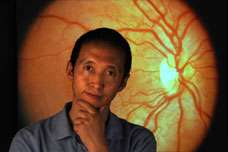
UCI neuroscientist Zhiqun Tan lead research that found the retinas of mice may mirror the brain ravaged by Alzheimer's disease. Photo by Daniel A. Anderson

(PhysOrg.com) -- The eyes may be the windows to the soul, but new research indicates they also may mirror a brain ravaged by Alzheimer's disease.

UC Irvine neuroscientists have found that retinas in mice genetically altered to have Alzheimer's undergo changes similar to those that occur in the brain - most notably the accumulation of amyloid plaque lesions.

In addition, the scientists discovered that when Alzheimer's therapies are tested in such mice, retinal changes that result might predict how the treatments will work in humans better than changes in mouse brain tissue.

These findings are key to developing retinal imaging technology that may help diagnose and treat people with Alzheimer's, which afflicts 5.3 million people in the U.S. and is the leading cause of elderly . Brain imaging techniques are being tested, but retinal imaging could be less invasive, less expensive and easier to perform.

"It's important to discover the pathological changes before an Alzheimer's patient dies," said Zhiqun Tan, a UCI neuroscientist leading the research. "Brain tissue isn't transparent, but retinas are. I hope in the future we'll be able to diagnose the disease and track its progress by looking into the eyes."

For a study appearing in the November issue of the , Tan and colleagues analyzed the retinas of Alzheimer's mice that had been treated with immunotherapy.

Vaccinated mice performed better on learning and tests than untreated mice, and their brains had fewer plaque lesions. Similarly, retinas in the treated mice had fewer lesions than in untreated mice. However, the treated mice's retinas had worse inflammation and vascular changes associated with Alzheimer's than did their brains.

When immunotherapy was tested in humans, inflammation of occurred similar to that observed in the mice retinas. "This tells us the may be more sensitive at reflecting changes in the human brain," Tan said.

UCI researchers, including Dr. Steven Schreiber, neurology professor and interim chair, are working on retinal imaging technology for Alzheimer's patients.

"New ways to view various body parts with high resolution are being invented at a rapid pace," Schreiber said. "I expect the imaging field will continue improving as we progress in developing our retinal technique."

Source: University of California - Irvine


print this article email this article download pdf blog this article bookmark this article     Stumble it Digg this share on Facebook retweet share on Reddit add to delicious
Rate this story - not rated yet


October 21, 2009 all stories

Comments: 0

not rated yet
  • Stumble this up

  • Digg this

  • share this

  • hide
  • Related Stories

  • Drug rescues memory lost to Alzheimer's disease
    created Jul 14, 2009 | popularity not rated yet | comments 0
  • Vitamin B3 reduces Alzheimer's symptoms, lesions
    created Nov 04, 2008 | popularity not rated yet | comments 0
  • Anti-inflammatory drug blocks brain plaques
    created Jun 24, 2008 | popularity not rated yet | comments 0
  • Alzheimer's vaccine clears plaque but has little effect on learning and memory impairment
    created Apr 04, 2008 | popularity not rated yet | comments 0
  • Vaccine slows progression of skeletal muscle disorder
    created May 13, 2009 | popularity not rated yet | comments 0


  • hide
  • Relevant PhysicsForums posts

  • The obesity epidemy
    created 1hour ago
  • 23 Years in a Vegetative State....or not?
    created 6 hours ago
  • Has the H1N1 vaccine been scientifically proven to work?
    created Nov 24, 2009
  • nesfatin
    created Nov 22, 2009
  • More from Physics Forums - Medical Sciences

Other News

The tall and short of diseases

Medicine & Health / Health

created 14 minutes ago | popularity not rated yet | comments 0

(PhysOrg.com) -- Research shows that being taller means a fatter pay check and an increased risk of some cancers.


Scale of justice

fMRI scans used in murder trial sentencing

Medicine & Health / Other

created 1hour ago | popularity not rated yet | comments 0

(PhysOrg.com) -- Functional Magnetic Resonance Imaging (fMRI) scans have been used, possibly for the first time, in the sentencing phase of a murder trial in Chicago in the US.


Researchers identify proteins in lung cancer cells that may provide potential drug targets

Medicine & Health / Cancer

created 2 hours ago | popularity not rated yet | comments 0

Researchers from Boston University School of Medicine (BUSM) and the Boston University Biomedical Engineering Department have identified a number of proteins whose activation allows them to distinguish between cancer and ...


Most radiation oncologists utilize advanced medical imaging techniques, study suggests

Medicine & Health / Cancer

created 2 hours ago | popularity not rated yet | comments 0

A recent study shows that 95 percent of radiation oncologists use advanced imaging techniques such as positron emission tomography (FDG-PET), magnetic resonance imaging (MRI), and 4-dimensional computed tomography (4DCT) ...


Drug users know their stuff

Drug users know their stuff

Medicine & Health / Psychology & Psychiatry

created 11 hours ago | popularity 5 / 5 (2) | comments 1

Drug users are well informed about the harms associated with the drugs they use, and perceive alcohol and tobacco to be amongst the most dangerous substances, according to a survey by UCL (University College ...