The first men and women from the Canary Islands were Berbers
A team of Spanish and Portuguese researchers has carried out molecular genetic analysis of the Y chromosome (transmitted only by males) of the aboriginal population of the Canary Islands to determine their origin and the extent to which they have survived in the current population. The results suggest a North African origin for these paternal lineages which, unlike maternal lineages, have declined to the point of being practically replaced today by European lineages.
Researchers from the University of La Laguna (ULL), the Institute of Pathology and Molecular Immunology from the University of Porto (Portugal) and the Institute of Legal Medicine from the University of Santiago de Compostela (USC) have studied the Y chromosome from human dental remains from the Canary Islands, and have determined the origin and evolution of paternal lineages from the pre-Hispanic era to the present day. To date, only mitochondrial DNA has been studied, which merely reflects the evolution of maternal lineages.
Rosa Fregal, the principal author of the recently-published study in BMC Evolutionary Biology, and a researcher from the Genetics Department of the ULL, explains to SINC that "whereas aboriginal maternal lineages have survived with a slight downward trend, aboriginal paternal lineages have declined progressively, being replaced by European lineages".
Experts have also analysed an historic sample for La Concepción church (Tenerife), which dates back to the 17th and 18th centuries. With these data, they have established the impact of European colonisation and the African slave trade, and have determined the evolution of paternal lineages in aborigines from the Canary Islands or Guanches, from the pre-Hispanic era to the present day.
Although contribution is now mainly European, scientists state that North African and Sub-Saharan contribution was higher in the 17th and 18th centuries. The explanation as to why there is a difference between the lineages of men and women from the Canary Islands stems from the diverse contributions of parental populations, and, above all, as a result of European colonisation.
During this period, most relationships between men and women were between Iberian men and Guanches women, "due to the better social position of the former [Iberian men] compared to aboriginal males" Fregel explains. In addition to this, there was a higher mortality rate among male aborigines, who were displaced and discriminated against by conquerors. "Not only during the Crown of Castile Conquest in the 15th century, but also thereafter", the scientist affirms.
The researcher adds that in the case of Sub-Saharan lineages, both sexes were discriminated against equally, "and both maternal and paternal lineages have declined to date".
Traces of European colonisation
A previous study of the Y chromosome in the current population of the Canary Islands demonstrated the impact of European colonisation on the male population in the Canary Islands, Fregal points out that "When estimating the proportion of European lineages present in the current population of the Canary Islands, it was found that they represented more than 90%". Nevertheless, mitochondrial DNA studies in the current population demonstrated a notable survival of aboriginal lineages, where European contribution is between 36% and 62%.
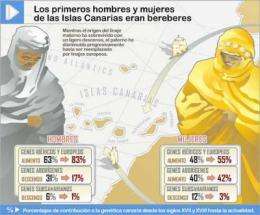
Iberian and European contribution to male genetic patrimony in the Canary Islands increased from 63% during the 17th and 18th centuries to 83% in the present day. At the same time, male aboriginal genes decreased from 31% to 17%, and Sub-Saharan genes, from 6% to 1%.
As for women, European contribution is more constant, having moved from 48% to 55%, and aboriginal contribution, from 40% to 42%. The only decline observed in genetic contribution, from 12% to 3% in the last three centuries, has been in the case of Sub-Saharans.
Despite these advances, there are still mysteries to solve, such as how to determine whether the first inhabitants of the Canary Islands arrived by their own means or whether they were brought by force, "as there are no signs to ascertain whether they were aware of the navigation or if they came in one or several waves", Fregal concludes.
More information: Fregel, Rosa; Gomes, Verónica; Gusmao, Leonor; González, Ana M.; Cabrera, Vicente M.; Amorim, Antonio; Larruga, José M. "Demographic history of Canary Islands male gene-pool: replacement of native lineages by European" BMC Evolutionary Biology 9: 181, 3 Aug 2009.
Source: FECYT - Spanish Foundation for Science and Technology


010.jpg)


