Robotic Hand That Senses Touch (w/ Video)
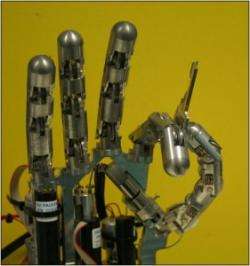
October 21, 2009 by John Messina Smart Hand Project

The Smart Hand allows its user to feel what it senses, allowing for precise control.

(PhysOrg.com) -- Developed by researchers at Lund University in Sweden and Scuola Superiore Sant'Anna in Italy, the Smart Hand project has given patient, Robin af Ekenstam (see video) the sense of touch in his new prosthesis hand.

The Smart Hand is an intricate prosthesis that incorporates four motors and forty designed to provide practical motion and senses to the person using it. This is the first device of its kind that sends signals back to the brain, allowing the user to have feelings in their and hand.

The Smart Hand takes advantage of the phantom limb syndrome which is the sensation amputees have that their missing body part is still attached.

You need Flash installed to watch this ideo


(Video Credit: BBC News)

By using the impulses from the brain that travel down the neurons to the site of amputation, scientists can use these signals and direct them to a mechanical device. This makes Smart Hand unique because it takes advantage of the phantom limb pathways that are available. By connecting sensors in the hand to the nerve endings in the stump of the arm, patients can feel and control the Smart Hand.

The Smart Hand project is far from creating a limb that functions as a normal hand since there are millions of nerves in a biological hand. The Smart Hand prototype represents more than 10 years of dedication and team work. Contributors from other countries include researchers in Denmark, Israel, Ireland, and Iceland.

Considering it has taken 10 years of hard work to come this far, it will take much less time to make large improvements. Whether improvements are made in the Smart Hand Project or other projects, we can expect to see substantial improvement in prosthetic work within a short amount of time.

One day those suffering from missing limbs may be able to recover at a rate beyond their expectation. Within the next decade, prostheses may be able to feel as natural as our biological part.

© 2009 PhysOrg.com


Rate this story - 4.7 /5 (28 votes)

Rank Filter

Move the slider to adjust rank threshold, so that you can hide some of the comments.


Display comments: newest first

  • Birthmark - Oct 21, 2009
    • Rank: not rated yet
    This is amazing that we can do this. They said it took 10 years to get to the hand they have in the video, imagine another 10 years with it already developed and made!
  • WithOneT - Oct 21, 2009
    • Rank: not rated yet
    We can rebuild him, we have the technology...
  • weirmeir - Oct 21, 2009
    • Rank: 5 / 5 (1)
    but 8 million bucks seems a bit steep.
  • weirmeir - Oct 21, 2009
    • Rank: 1 / 5 (1)
    time was you could get a whole bionic man for around 6.
  • Arikin - Oct 21, 2009
    • Rank: 1 / 5 (1)
    Nice work on the feedback being sent back to the user. I wonder how long it takes for each user to learn to manipulate it. Assumed much faster with the feedback. It is not like corresponding nerve endings are conveniently tagged. :-)
  • diva4d - Oct 22, 2009
    • Rank: not rated yet
    Wonderful indeed! In 20 years then, people wil voluntarily be amputating limbs to replace them with massively superior prosthetics... Lets see - I'll only be 53 then... Good timing!
  • Diotrephes - Oct 22, 2009
    • Rank: not rated yet
    No, in 10 years time - the smart-cock. (I mean the bird of course)
  • CreepyD - Oct 22, 2009
    • Rank: not rated yet
    Amazing to see.
    There's no reason they can't make it much stronger than a real hand too, though would there be moral implications in doing so?
    I wonder how close to a real hand it will get with time and practise under his belt!
  • Buyck - Oct 22, 2009
    • Rank: not rated yet
    Humans and robots coming closer to each other every year. In 2020-2025 many people will living with robots or many of them will be the two. Just like the example above. Its likely that the advancing technology will be integrated into our body or brain by the time. And its likely that we can improve ourselves with updates and other technology's. That is not so far away as we think.
  • richie - Oct 24, 2009
    • Rank: not rated yet
    hehe,something someone jus said (buyck)has got me laughing..never realised it before.Updates...really...like u know most people will probably have to implant the same hardware architecture coz repeated invasive procedures are a risk and 100 percent unpopular..and to upgrade,they'l probably have to really on O.S. systems that improve on former control algorithms to better enhance the 'cyborg' reality..and that's why am laughing..O.S. systems..ur new terrorist won't worry about the ammonium nitrate his hiding in the back of his truck..he'l jus learn how to program..and script a program that kills (harsh,i know but somthing to that effect)..and it would'n be so far fetched considering seamless information channels and data-transfer protocols will probably be intergrated into ur brain..that's if u want the internet at the palm of ur...tips?brain?....Its scary and funny..definately a future am not amused to indulge in..be a human,not ur multi-tasking coffee machine.

October 21, 2009 all stories

Comments: 10

4.7 /5 (28 votes)

  • hide
  • Related Stories


  • hide
  • Relevant PhysicsForums posts

  • how to welding thin SS foil (0.002")?
    created Feb 08, 2010
  • Civil Engineering is hazardous to your career prospects
    created Feb 06, 2010
  • hot water circulator, kitchen faucet, ? mixing
    created Feb 06, 2010
  • Static or dynamic pressures in duct
    created Feb 06, 2010
  • More from Physics Forums - General Engineering

Other News

Millimeter-scale, energy-harvesting sensor system developed

Millimeter-scale, energy-harvesting sensor system developed

Electronics / Hardware

created 21 hours ago | popularity 4.8 / 5 (11) | comments 5 | with audio podcast

(PhysOrg.com) -- A 9-cubic millimeter solar-powered sensor system developed at the University of Michigan is the smallest that can harvest energy from its surroundings to operate nearly perpetually.


US technology titans IBM and Intel have rolled out powerful new computer chips designed for business networks

Intel, IBM roll out new computer network chips

Electronics / Hardware

created 10 hours ago | popularity 5 / 5 (4) | comments 1

US technology titans IBM and Intel have rolled out powerful new computer chips designed for businesses continually demanding more from networks and data centers.


Intel Itanium 9300 Processor Raises Bar for Scalable, Resilient Mission-Critical Computing

Electronics / Hardware

created 20 hours ago | popularity not rated yet | comments 0

Intel Corporation today introduced the Itanium processor 9300 series, previously codenamed "Tukwila," which delivers more than double the performance of its predecessor, boosts scalability and adds reliability features to ...


Robonaut 2: NASA, GM Create Cutting Edge Robotic Technology

Robonaut 2: NASA, GM Create Cutting Edge Robotic Technology

Electronics / Robotics

created Feb 04, 2010 | popularity 4.5 / 5 (13) | comments 7 | with audio podcast

(PhysOrg.com) -- Robonaut is evolving. NASA and General Motors are working together to accelerate development of the next generation of robots and related technologies for use in the automotive and aerospace ...


JooJoo

Disputed Joojoo tablet to ship at end of February

Electronics / Consumer & Gadgets

created Feb 04, 2010 | popularity 4 / 5 (5) | comments 3

(AP) -- The Joojoo, a Web-browsing tablet device that's the subject of a high-profile Silicon Valley legal dispute, appears on track to reach early buyers at the end of February.