Grudgingly, young people finally flock to Twitter
(AP) -- They think it's pointless, narcissistic. Some don't even know what it is. Even so, more young adults and teens - normally at the cutting edge of technology - are finally coming around to Twitter, using it for class or work, monitoring the minutiae of celebrities' lives.
It's not always love at first tweet, though. Many of them are doing it grudgingly, perhaps because a friend pressures them or a teacher or boss makes them try the 140-character microblogging site.
"I still find no point to using it. I'm the type of person who likes to talk to someone," says Austyn Gabig, a sophomore at the University of California, San Diego, who only joined Twitter this month because she heard Ellen DeGeneres was going to use tweets as a way to win tickets to her talk show.
DeGeneres set off a frenzy on the UCSD campus when she promised the tickets to those who, within 15 minutes of the tweet, e-mailed her cell phone photos of themselves wearing a red towel and standing with someone in a uniform.
Gabig got the tweet, found a towel - and won tickets.
She might think she won't tweet again, but social networking expert David Silver predicts she'll change her mind.
"Every semester, Twitter is the one technology that students are most resistant to," says Silver, a media studies professor at the University of San Francisco, where he regularly teaches a class on how to use various Internet applications. "But it's also the one they end up using the most."
It is a rare instance, he and others say, of young people adopting an Internet application after many of their older counterparts have already done so.
Their slowness to warm to Twitter comes in part from a fondness for the ease and directness of text messaging and other social networking services that most of their friends already use.
Many also are under the false impression that their Twitter pages have to be public, which is unappealing to a generation that's had privacy drilled into them.
Then there's the fact that their elders like it, and that's very uncool. But that's bound to change as tech-savvy Gen Xers reach middle age and baby boomers and even some senior citizens become more comfortable with social networking.
"In some ways, what we're seeing here is a kind of closing of that generational gap as it relates to technology," says Craig Watkins, a University of Texas professor and author of the book "The Young and the Digital."
Consider, for instance, that the median age of a Facebook user is now 33, despite the social-networking site's roots as a college hangout, according to the Pew Internet & American Life Project. The median age for Twitter is 31.
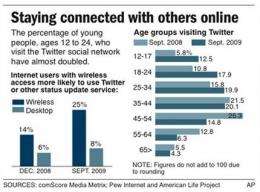
And while Facebook's audience is aging, Twitterers are getting younger. Internet tracker comScore Inc. found that 18- to 24-year-olds made up 18 percent of unique visitors to Twitter in September, compared with 11 percent a year earlier.
Meanwhile, kids ages 12 to 17 accounted for 12 percent of Twitter visitors last month, about double the proportion of a year earlier.
Pew researchers also found in a report released Wednesday that the number of people ages 18 to 24 who use some type of status-update service is growing quickly, too. They attribute much of the growth to Twitter.
"So much of this is driven by community. I'd even call it a tribe," says Susannah Fox, a Pew researcher who was the new report's lead author.
She said the survey also found that wireless devices are increasingly a factor in Twitter involvement, as in the more you have - laptop, mobile phone and so on - the more likely you are to tweet.
Alex Lifschitz, in his third year at the Rochester Institute of Technology in New York, uses Twitter as a tight-knit circle, keeping his contacts more limited than on Facebook.
Using his cell phone or laptop, he tweets to let professors know he can't make it to class or to ask questions about assignments. He also uses it for something as basic as organizing a food run with friends on campus.
"I can simply tweet and ask who wants to go somewhere with me, and I'll have a few takers at any given time," he says.
Mallory Wood, a recent graduate of Saint Michael's College in Vermont, is another Twitter convert - primarily for work. She's now an admissions counselor there, in charge of getting more people to follow her department on Twitter.
She uses the service to offer application fee waivers to prospective students and points them to links to student blogs, even some with complaints about campus life. "You have to be real with them," Wood says.
That's still not enough to persuade some young people to get on board.
"Quite frankly, I don't need to hear if someone stepped in dog poo on the way to class or how annoyed they are that they lost their favorite pen," says Carolyn Wald, a University of Chicago junior who has not joined Twitter and rarely posts status updates on Facebook because "I don't want to assume that people want to hear those things about me, either."
Even teen pop star Miley Cyrus stopped tweeting, griping in a rap song she posted on YouTube that, among other things, she'd grown weary of making constant, meaningless updates about what she was doing.
The key, USF professor Silver says, is showing his students how a simple status update can become a more sophisticated way to show their creative sides and, who knows, maybe land a job.
"It's just another tool in your tool kit," he says he tells his students. "The question is, 'How do you engage someone just long enough to get them to click on a link?'"
Scott Testa, a business administration professor who teaches marketing at Cabrini College in suburban Philadelphia, encourages his students to use Twitter to follow companies they would like to work for.
He also uses it to extend a conversation outside the classroom, in part because tweeting often draws comments "from those who might be a little more shy."
Renee Robinson, an associate professor of communication at Saint Xavier University in Chicago, says her students still feel overwhelmed by Twitter.
"They often see it as another level of information that they don't want," she says.
And sometimes she does, too. In one of her classes where she uses Twitter, she and her students had to cut back on people they were following because they were deluged with tweets.
So they all learned something: "Think carefully about what kind of information you want and how you want it delivered," she told them, "and then prioritize."
©2009 The Associated Press. All rights reserved. This material may not be published, broadcast, rewritten or redistributed.


