Algae may be secret weapon in climate change war
October 22, 2009 by Ruth Morris Algae is gaining ground as a potential renewable energy source

Enlarge

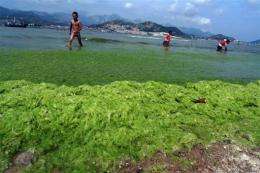
Children are seen playing on a beach covered with algae in Qingdao, China. It has turned out that algae -- slimy, fast-growing and full of fat -- is gaining ground as a potential renewable energy source.

Driven by fluctuations in oil prices, and seduced by the prospect of easing climate change, experts are ramping up efforts to squeeze fuel out of a promising new organism: pond scum.

As it turns out, -- slimy, fast-growing and full of fat -- is gaining ground as a potential .

Experts say it is intriguing for its ability to gobble up carbon dioxide, a , while living happily in places that aren't needed for .

Algae likes mosquito-infested swamps, for example, filthy pools, and even waste water. And while no one has found a way to mass produce cheap fuel from algae yet, the race is on.

University labs and start-up companies across the country are getting involved. Over the summer, the first mega-corporation joined in, when ExxonMobil said it would sink 600 million dollars into algae research in a partnership with a California biotechnology company.

If the research pans out, scientists say they will eventually find a cost-effective way to convert lipids from algae ponds into fuel, then pump it into cars, trucks and jets.

"I think it's very realistic. I don't think it's going to take 20 years. It's going to take a few years," said chemical engineer George Philippidis, director of applied research at Florida International University in Miami.

One of the factors fueling enthusiasm is algae's big appetite for carbon dioxide -- a by-product of burning fossil fuels.

"We could hook up to the exhaust of polluting industries," Philippidis said. "We could capture it and feed it to algae and prevent that CO2 from contributing to further ."

California company Sapphire Energy has already fueled a cross-country road trip with algae-tinged gasoline.

The trip, meant to raise awareness, prompted the headline, "Coast to Coast on Slime". Another California company is looking at fattening fish on algae and then processing the fish for oil.

"Where algae is very nice is, it's prolific. It's everywhere... and you don't have to do much. Mother Nature has kind of figured it out," said Roy Swiger, a molecular geneticist and director of the Florida division of the non-profit Midwest Research Institute.

MRI began studying algae as an energy source three years ago. Swiger warned that algal fuels are not ready for prime time yet. Even though algae grows like gangbusters, it currently costs up to 100 dollars to make a gallon of algal fuel-- hardly a savings.

The rub is bringing cost down, and production up. To do this, scientists must find cheap ways to dry algae and extract the lipids, where energy is stored.

Swiger noted that it would not make sense to spend five dollars of electricity to run a centrifuge to dry out algae, that in turn would only produce one dollar of fuel.

If research goes well, Swiger thinks it will take five years to bring down production costs to 40 dollars per gallon.

But taking even a tiny chunk out of the energy market -- ethanol has eked out a 4.0 percent share, for example -- can shift the energy mix.

"Four percent is not a lot, and yet everywhere you look there's a pump," Swiger said. "So four percent of a gigantic number is a lot."

Some start-ups are more optimistic. Paul Woods, chief executive of Florida-based Algenol Biofuels, says his company will beat others to market.

He has patented a technology for "sweating" ethanol from algae, without drying it first.

"We see ourselves as a very cheap way to supplement (energy supply)," said Woods, "and the more cheap ethanol we have, the more we're winning in efforts to have independence from foreign fuel."

Woods announced a partnership with Dow Chemical in July to build a demonstration plant, and expects to launch commercial production by 2011.

Experts don't see algal fuel replacing fossil fuels completely, and some have become leery of hype.

The idea of harnessing algae for fuel has been around for decades, they say. Still, no one has been able to make it financially feasible.

"Any fantastic claims will eventually discredit the field if given much credence," said algae expert John Benemann.

Instead, he sees algae as a good source for animal feeds, chemicals and fertilizer.

Back at FIU, Philippidis agreed "there is no silver bullet" to reduce dependency on fossil fuels.

But he saw promise on the horizon, especially as larger companies become involved in algae research. "We are still at an early stage... but as we scale up (production) I think costs will come down very, very quickly," he said.

And if that works, he added, "there is a small Greek island I would like to buy."

(c) 2009 AFP


print this article email this article download pdf blog this article bookmark this article     Stumble it Digg this share on Facebook retweet share on Reddit add to delicious
Rate this story - 4.5 /5 (8 votes)

Rank Filter

Move the slider to adjust rank threshold, so that you can hide some of the comments.


Display comments: newest first

  • Sean_W - Oct 22, 2009
    • Rank: 4 / 5 (1)
    It is true that there has been much hype regarding algae but there are also many more breakthroughs being made than can be touched on in one small article. From innovative drying methods to systems which increase the amount of light getting into the water.

    Algae is one of the few petroleum alternatives which can produce substances that are currently supplied by the petrochemical industry. And it can do this without shipping the initial feedstock across the planet from hostile states.
  • zevkirsh - Oct 22, 2009
    • Rank: 2 / 5 (1)
    i love that only a few days ago, research was published that run-away algea may have been responsible for the massive global extinction of the dinosaurs by driving a tremendous change in climate and toxicity. if not for fear of 'global warming' why would governments fund all this climate research?
  • dmcl - Oct 22, 2009
    • Rank: 5 / 5 (1)
    hybrid cycle production approaches are quite intriguing, such as coupling an algae facility with a wind or solar farm. In one case the algae facility would use the electicity produced by the wind facility during off-peak demand hours (maybe at night)to run its centrifuges or other process equipment, power that otherwise would have been lost or dumped.
  • Arikin - Oct 23, 2009
    • Rank: not rated yet
    Yet Another Algae article. Yes it is great that they are "currently considering" this type of research. But this research was started back in the 1970s during that period's oil crises.

    The Physorg site itself has featured 3-4 other stories just like this. Stop trying to hype the "look what we can think about" and start doing. Please...

October 22, 2009 all stories

Comments: 4

4.5 /5 (8 votes)
  • Stumble this up

  • Digg this

  • share this

  • hide
  • Related Stories

  • Exxon to make alternative fuel from algae: report
    created Jul 14, 2009 | popularity not rated yet | comments 0
  • Algae-Based Biofuel From Fish
    created Sep 01, 2009 | popularity not rated yet | comments 0
  • Algae jet fuel makes splash at international air show
    created Aug 11, 2008 | popularity not rated yet | comments 0
  • Montana researchers to study algae as a source of biofuel
    created Nov 13, 2008 | popularity not rated yet | comments 0
  • Beaming solar energy to algae
    created May 04, 2009 | popularity not rated yet | comments 0


  • hide
  • Relevant PhysicsForums posts

  • Breeding program
    created 23 hours ago
  • How does a concentration gradient provide energy?
    created Nov 20, 2009
  • Eyesight and Neural Damage from Electronics
    created Nov 19, 2009
  • Quick question about the Golgi Apparatus?
    created Nov 19, 2009
  • The beginning of humans
    created Nov 18, 2009
  • Omega 3 questions
    created Nov 18, 2009
  • More from Physics Forums - Biology

Other News

Atomic-level Snapshot Catches Protein Motor in Action (w/ Video)

Atomic-level Snapshot Catches Protein Motor in Action (w/ Video)

Biology / Cell & Microbiology

created 23 hours ago | popularity 4.5 / 5 (2) | comments 1

(PhysOrg.com) -- The atomic-level action of a remarkable class of ring-shaped protein motors has been uncovered by researchers with the Lawrence Berkeley National Laboratory using a state-of-the-art protein ...


Termite creates sustainable monoculture fungus-farming

Termite creates sustainable monoculture fungus-farming

Biology / Plants & Animals

created 23 hours ago | popularity 5 / 5 (1) | comments 0

(PhysOrg.com) -- Food production of modern human societies is mostly based on large-scale monoculture crops, but it now appears that advanced insect societies have the same practice. Our societies took just ...


Extinct goat Myotragus balearicus

Extinct goat was cold-blooded

Biology / Plants & Animals

created Nov 18, 2009 | popularity 4.9 / 5 (29) | comments 10

(PhysOrg.com) -- An extinct goat that lived on a barren Mediterranean island survived for millions of years by reducing in size and by becoming cold-blooded, which has never before been discovered in mammals.


Bigger not necessarily better, when it comes to brains

Bigger not necessarily better, when it comes to brains

Biology / Plants & Animals

created Nov 17, 2009 | popularity 4.4 / 5 (14) | comments 10

(PhysOrg.com) -- Tiny insects could be as intelligent as much bigger animals, despite only having a brain the size of a pinhead, say scientists at Queen Mary, University of London.


Right-handed chimpanzees provide clues to the origin of human language

Biology / Plants & Animals

created Nov 16, 2009 | popularity 3 / 5 (1) | comments 7

Most of the linguistic functions in humans are controlled by the left cerebral hemisphere. A study of captive chimpanzees at the Yerkes National Primate Research Center (Atlanta, Georgia), reported in the January 2010 issue ...