Protein is linked to lung cancer development
October 22, 2009 by Anne Trafton
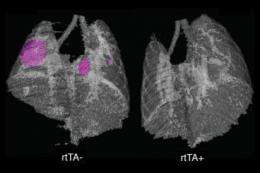
Left: Tumors are visible in the lungs of a mouse in which the NF-kappaB protein is not inhibited. Right: In the lungs of a mouse in which NF-kappaB is inhibited, tumor growth is significantly slowed. Images were taken at the Koch Institute Microscopy and Imaging Core Facility. Images: Etienne Meylan, courtesy Nature
(PhysOrg.com) -- A protein that normally helps defend cells from infection can play a critical role in the development of lung cancer, according to MIT cancer biologists.
Their findings suggest that the protein, NF-kappaB, could be a promising target for new drugs against lung cancer, which kills more than one million people each year.
NF-kappaB is a transcription factor protein that is normally activated when a cell is under attack from a virus or bacterium. Previous studies have suggested that constant activation of NF-kappaB enhances survival of tumor cells.
In the new study, reported in the Oct. 22 issue of Nature, the MIT team found that a particular pair of genetic circumstances is required to activate NF-kappaB in mouse lung tumors: expression of the cancer gene ras, and loss of the tumor suppressor gene p53. They also showed that inhibition of NF-kappaB in mice with that genetic profile can slow tumor growth.
In human lung cancer patients, the ras gene is active in 30 percent of patients, and p53 is lost in about 50 percent of tumors, meaning that about 15 percent overall have this combination. Drugs that inhibit NF-kappaB could potentially help treat such tumors, says Etienne Meylan, lead author of the paper and a postdoctoral associate in the laboratory of Tyler Jacks, director of the David H. Koch Institute for Integrative Cancer Research at MIT.
The researchers found that when they inhibited NF-kappaB in lung tumors of mice with this genetic profile, tumor growth slowed dramatically. During the three-week period following NF-kappaB inhibition, tumors in treated mice grew, on average, half as much as tumors in untreated mice. In some treated mice, tumors shrank.
Cancer biologists have been pursuing possible treatments based on NF-kappaB inhibition over the past decade or so, but during the past few years, a handful of studies have shown that inhibiting NF-kappaB can have adverse side effects. Because of that, "some people began to re-evaluate the potential of NF-kappaB as a target," says cancer researcher Sankar Ghosh of Columbia University Medical Center, who was not involved in the research. However, he says the new findings should jump start new efforts to target NF-kappaB in tumors with this specific genetic profile. "This paper shows the effects in such a dramatic and striking way, I think it will re-energize people who are interested in NF-kappaB as a potential target," says Ghosh.
The mouse model used in this study could be useful in those efforts, says Meylan. Additionally, "we could use this model to find better compounds — those that are more selective or more powerful," he says.
Provided by Massachusetts Institute of Technology (news : web)
-
Blocking the effect of inflammation-causing cells lowered prostate cancer cells invasion
Apr 08, 2008 |
not rated yet |
0
-
Research team discovers brain pathway responsible for obesity
Oct 02, 2008 |
not rated yet |
0
-
Too many calories send the brain off kilter
Oct 02, 2008 |
not rated yet |
0
-
An herbal extract inhibits the development of pancreatic cancer
Apr 19, 2009 |
not rated yet |
0
-
Duke/Singapore scientists find new way to classify gastric cancers
Oct 02, 2009 |
not rated yet |
0
-
Fast photon control brings quantum photonic technologies closer
8 hours ago |
5 / 5 (4) |
0
-
Engineers build first sub-10-nm carbon nanotube transistor
Feb 01, 2012 |
4.9 / 5 (33) |
30
-
Something old, something new: Evolution and the structural divergence of duplicate genes
Jan 31, 2012 |
4.6 / 5 (7) |
1
-
The hidden nanoworld of ice crystals: Revealing the dynamic behavior of quasi-liquid layers
Jan 30, 2012 |
5 / 5 (5) |
1
-
Stock market network reveals investor clustering
Jan 27, 2012 |
3.9 / 5 (23) |
8
-
Is Everyday Technology Killing Us?
Feb 08, 2012
-
Exercise and weight loss
Feb 08, 2012
-
Why do we have head aches? Our brains can't feel anything.
Feb 07, 2012
-
"The end of diseases" by David Agus, interview from Daily Show with Jon Stewart
Feb 04, 2012
-
Oncolytic adenovirus
Feb 04, 2012
-
Nutrition label stuffs and diets
Feb 02, 2012
- More from Physics Forums - Medical Sciences
More news stories
Researchers illuminate link between sodium, calcium and heartbeat
Using the Canadian Light Source synchrotron, researchers from the University of British Columbia have revealed, for the first time, one of the molecular mechanisms that regulates the beating of heart cells by controlling ...
56 minutes ago |
4.5 / 5 (2) |
0
|
Oxygen-deprived baby rats fare worse if kept warm
New study suggests that baby rats deprived of oxygen, but kept warm, had bigger swings in glucose and insulin, metabolic and physiologic effects that could increase the chances of brain damage. Findings could have implications ...
58 minutes ago |
not rated yet |
0
Fetal exposure to radiation increases risk of testicular cancer
Male fetuses of mothers that are exposed to radiation during early pregnancy may have an increased chance of developing testicular cancer, according to a study in mice at The University of Texas MD Anderson Cancer Center. ...
17 minutes ago |
not rated yet |
0
Prolonged fructose intake not linked to rise in blood pressure
Eating fructose over an extended period of time does not lead to an increase in blood pressure, according to researchers at St. Michael's Hospital.
47 minutes ago |
not rated yet |
0
Challenges of identifying cognitive abilities in severely brain-injured patients
Only by employing complex machine-learning techniques to decipher repeated advanced brain scans were researchers at NewYork-Presbyterian/Weill Cornell able to provide evidence that a patient with a severe brain injury could, ...
Medicine & Health / Neuroscience
37 minutes ago |
not rated yet |
0
Music service gives Myspace second wind
Faded online social network Myspace said Monday it was getting a second wind due to the popularity of a freshly launched online music player.
Computer programs that think like humans
Intelligence what does it really mean? In the 1800s, it meant that you were good at memorising things, and today intelligence is measured through IQ tests where the average score for humans is 100. ...
Study shows children with IBD have difficulty in school, mostly due to absences
Children with inflammatory bowel disease (IBD) may have difficulty functioning in school, particularly because their tendency to internalize problems can impact attendance. These are the findings from a Nationwide Children's ...
Fast photon control brings quantum photonic technologies closer
(PhysOrg.com) -- Using photons instead of electrons to transmit information could lead to faster and more secure ways to communicate, among other advantages. Now a team of physicists has taken another step toward realizing ...
Brain-imaging technique predicts who will suffer cognitive decline over time
Cognitive loss and brain degeneration currently affect millions of adults, and the number will increase, given the population of aging baby boomers. Today, nearly 20 percent of people age 65 or older suffer ...
Neuron memory key to taming chronic pain
For some, the pain is so great that they can't even bear to have clothes touch their skin. For others, it means that every step is a deliberate and agonizing choice. Whether the pain is caused by arthritic joints, an injury ...