Ancient 'Lucy' Species Ate A Different Diet Than Previously Thought
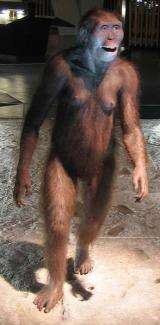
(PhysOrg.com) -- Research examining microscopic marks on the teeth of the "Lucy" species Australopithecus afarensis suggests that the ancient hominid ate a different diet than the tooth enamel, size and shape suggest, say a University of Arkansas researcher and his colleagues.
Peter Ungar, professor of anthropology, will present their findings on Oct. 20 during a presentation at the Royal Society in London, England, as part of a discussion meeting about the first 4 million years of human evolution.
“The Lucy species is among the first hominids to show thickened enamel and flattened teeth,” an indication that hard, or abrasive foods such as nuts, seeds and tubers, might be on the menu, Ungar said. However, the microwear texture analysis indicates that tough objects, such as grass and leaves, dominated Lucy’s diet.
“This challenges long-held assumptions and leads us to questions that must be addressed using other techniques,” Ungar said. Researchers thought that with the development of thick enamel, robust skulls and large chewing muscles, these species had evolved to eat hard, brittle foods. However, the microwear texture analysis shows that these individuals were not eating such foods toward the end of their lives.
The researchers used a combination of a scanning confocal microscope, and scale-sensitive fractal analysis to create a microwear texture analysis of the molars from 19 specimens of A. afarensis, the Lucy species, which lived between 3.9 and 2.9 million years ago, and three specimens from A. anamensis, which lived between 4.1 and 3.9 million years ago. They looked at complexity and directionality of wear textures in the teeth they examined. Since food interacts with teeth, it leaves behind telltale signs that can be measured. Hard, brittle foods like nuts and seeds tend to lead to more complex tooth profiles, while tough foods like leaves generally lead to more parallel scratches, which corresponds with directionality.
“The long-held assumption was that with the development of thick enamel, robust skulls and larger chewing muscles marked the beginning of a shift towards hard, brittle foods, such as nuts, seeds and tubers,” Ungar said. “The Lucy species and the species that came before it did not show the predicted trajectory.”
Next they compared the microwear profiles of these two species with microwear profiles from Paranthropus boisei, known as Nutcracker Man that lived between 2.3 and 1.2 million years ago, P. robustus, which lived between 2 million and 1.5 million years ago, and Australopithecus africanus, which lived between about 3 million and 2.3 million years ago. They also compared the microwear profiles of the ancient hominids to those of modern-day primates that eat different types of diets.
The researchers discovered that microwear profiles of the three east African species, A. afarensis, A. anamensis and P. boisei, differed substantially from the two south African species, P. robustus and A. africanus, both of which showed evidence of diets consisting of hard and brittle food.
“There are huge differences in size of skull and shape of teeth between the species in eastern Africa, but not in their microwear,” Ungar said. “This opens a whole new set of questions.”
Ungar’s colleagues include Robert S. Scott, assistant professor of anthropology at Rutgers University; Frederick E. Grine, professor of anthropology at Stony Brook University; and Mark F. Teaford, professor of anthropology at Johns Hopkins University.
• Join PhysOrg.com on Facebook!
• Follow PhysOrg.com on Twitter!
Provided by University of Arkansas (news : web)


