Eyes to the skies for the 'Galilean Nights'
October 22, 2009
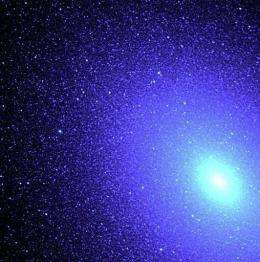
NASA image shows hot blue stars deep inside an elliptical galaxy. Astronomers around the world are gearing up for three days of intense sky-watching in honour of Galileo, whose observations 400 years ago revolutionised our understanding of the cosmos.
Astronomers around the world are gearing up for three days of intense sky-watching in honour of Galileo, whose observations 400 years ago revolutionised our understanding of the cosmos.
The "Galilean Nights" promoted by the International Astronomical Union (IAU) aim at giving hundreds of thousands of people the thrill of looking through a space telescope for the first time.
More than 1,000 public events in over 70 countries are being staged on Thursday, Friday and Saturday nights, according to the website www.galileannights.org.
In October 1609 Galileo Galilei began observations with a two-lens telescope that eventually led him to discover the four main satellites of Jupiter and realise that Earth's Moon was pitted with craters and not a perfect sphere.
These and other discoveries led Galileo to conclude, like Nicolaus Copernicus, that Earth revolved around the Sun and not the other way around.
He was persecuted for heresy by the Vatican and forced to recant. The last ten years of his life were spent under house arrest.
(c) 2009 AFP
-
World event hopes to lure 1 mln to astronomy
Apr 02, 2009 |
not rated yet |
0
-
What did Galileo actually do?
Feb 19, 2009 |
not rated yet |
0
-
Looking through Galileo's eyes
Jan 08, 2009 |
not rated yet |
0
-
Galileo's telescope on historic visit to Philly
Apr 02, 2009 |
not rated yet |
0
-
Galileo's notebooks may reveal secrets of new planet
Jul 09, 2009 |
not rated yet |
0
-
Engineers build first sub-10-nm carbon nanotube transistor
Feb 01, 2012 |
4.9 / 5 (29) |
30
-
Something old, something new: Evolution and the structural divergence of duplicate genes
Jan 31, 2012 |
4.6 / 5 (7) |
1
-
The hidden nanoworld of ice crystals: Revealing the dynamic behavior of quasi-liquid layers
Jan 30, 2012 |
5 / 5 (3) |
1
-
Stock market network reveals investor clustering
Jan 27, 2012 |
4 / 5 (22) |
8
-
Of microchemistry and molecules: Electronic microfluidic device synthesizes biocompatible probes
Jan 26, 2012 |
5 / 5 (1) |
0
-
Hypothetical way to travel faster than light, but not technically exceed lightspeed
Feb 06, 2012
-
How do scientists monitor the Sun's activity?
Feb 05, 2012
-
Search patterns in observational studies
Feb 05, 2012
-
Derivation of Pogson's law
Feb 03, 2012
-
Landing on comet by Rosetta probe in 2014 (YouTube)
Feb 02, 2012
-
Star whose pressure support is degenerate electrons.
Feb 01, 2012
- More from Physics Forums - General Astronomy
More news stories
Mars-bound NASA rover carries coin for camera checkup
(PhysOrg.com) -- The camera at the end of the robotic arm on NASA's Mars rover Curiosity has its own calibration target, a smartphone-size plaque that looks like an eye chart supplemented with color chips ...
Space & Earth / Space Exploration
9 hours ago |
4 / 5 (4) |
5
|
When worlds collide: Researchers harness supercomputers to understand solar storm, magnetosphere
If the sun is anything, it is reassuring. It rises, sets, and rises again, allowing us to grow crops, get tan, and power homes, just to name a few of humanity's most important life-sustaining functions. No ...
Space & Earth / Space Exploration
20 hours ago |
3 / 5 (1) |
6
|
Mars Express radar gives strong evidence for former Mars ocean
(PhysOrg.com) -- ESA's Mars Express has returned strong evidence for an ocean once covering part of Mars. Using radar, it has detected sediments reminiscent of an ocean floor within the boundaries of previously ...
Space & Earth / Space Exploration
19 hours ago |
4.4 / 5 (5) |
3
|
Man who warned of Challenger disaster dies at 73
The man who warned his employer of the equipment quirk that led to the deadly explosion of the space shuttle Challenger has died. Roger Boisjoly was 73.
Space & Earth / Space Exploration
10 hours ago |
5 / 5 (2) |
3
Russia sets its sights on the moon for 2020
Looks like Republican Presidential hopeful Newt Gingrich might have some competition if he wants to be the first to build a base on the Moon. Last week, the Russian Space Agency Roscosmos announced plans to ...
Space & Earth / Space Exploration
18 hours ago |
5 / 5 (4) |
5
Scientists develop biological computer to encrypt and decipher images
Scientists at The Scripps Research Institute in California and the TechnionIsrael Institute of Technology have developed a "biological computer" made entirely from biomolecules that is capable of deciphering ...
Entire genome of extinct human decoded from fossil
(PhysOrg.com) -- In 2010, Svante Pääbo and his colleagues presented a draft version of the genome from a small fragment of a human finger bone discovered in Denisova Cave in southern Siberia. The ...
Physicists 'record' magnetic breakthrough
An international team of scientists has demonstrated a revolutionary new way of magnetic recording which will allow information to be processed hundreds of times faster than by current hard drive technology.
Haptic cube lets you feel tomorrow's temps
(PhysOrg.com) -- Will it be an invention joining a storage room of other inventions? Or kicked further up to gadget boutiques for the very rich? Or a popular gadget for many worldwide? Whatever its destiny, ...
Computer security firm Symantec extorted by hackers
Computer security firm Symantec on Tuesday confirmed it tried to turn the tables on hackers who threatened to release stolen source code if a demand for $50,000 was not met.
California hits wind energy milestone: About 5 percent of power from wind
California now gets about 5 percent of its electricity from wind power, according to data released Tuesday by the California Wind Energy Association.
Oct 25, 2009
Rank: 1 / 5 (1)
This is a great way to celebrate the discoveries of Galileo.
Unfortunately the IAU has not paid attention to observational findings of the last four decades that indicate stars act as plasma diffusers that selectively move lightweight elements like H and He into the stellar atmospheres that we call the photosphere.
With kind regards,
Oliver K. Manuel