Mummy's tooth yields DNA

October 22, 2009 by Lin Edwards mummy

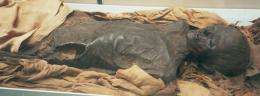
A mummy in the British Museum. Image: Wikimedia Commons

(PhysOrg.com) -- A four thousand year old Egyptian mummy's tooth has yielded its DNA to probing scientists.

A team of doctors from Massachusetts General Hospital and scientists from Boston's Museum of Fine Arts first tried unsuccessfully to extract genetic material from a piece of neck skin and a finger, recovered from the mummy's tomb in Deir el-Bersha near Cairo. They next tried to obtain from the pulp of a tooth, and after a delicate three-hour operation successfully extracted the tooth and obtained the genetic material.

Dr. Paul Chapman, a from the Massachusetts General Hospital, who was part of the operating team, was concerned not to disturb the fragile head because of its importance as an . Simply yanking the tooth was not possible, so the doctors approached it via the open neck, inserting a scope fitted with a camera. The first tooth they tried could not be moved, but the second yielded after patient work without damage to the rest of the head.

The tomb, belonging to Governor and Lady Djehutynakht, rulers of the Hermopolis district around 186 miles from Cairo, was first excavated in 1915. Dating from around 2000 BC, the tomb had been disturbed, but the disembodied head, a torso, examples of Egyptian art, other artifacts and scattered mummy wrappings remained.

The DNA should enable the scientists to identify the ancient Egyptian owner's gender, and perhaps learn about its ancestry. The genetic material was deemed so precious that one of the hospital team, Dr. Fabio Nunes, drove the to the New York medical examiner's office himself. The medical examiner's office which was chosen to do the analysis because of its experience with degraded DNA.

Rita E. Freed, from the Museum of Fine Arts, said the 19th century saw the unwrapping of mummies, and the 20th saw the ability to X-ray mummies develop. Now scientists realize you can also examine them for .

The mummy's head and other artifacts are currently on show at The Secrets of Tomb 10: Egypt 2000 BC in the Museum of Fine Arts, which gives visitors an insight into the lives of people in Deir el-Bersha between 2040 to 1640 BC, during the 11th and 12th dynasty.

© 2009 PhysOrg.com


print this article email this article download pdf blog this article bookmark this article     Stumble it Digg this share on Facebook retweet share on Reddit add to delicious
Rate this story - 4.6 /5 (14 votes)

Rank Filter

Move the slider to adjust rank threshold, so that you can hide some of the comments.


Display comments: newest first


October 22, 2009 all stories

Comments: 1

4.6 /5 (14 votes)
  • Stumble this up

  • Digg this

  • share this

  • hide
  • Related Stories

  • Stanford scientists scan 2,500-year-old mummy
    created Aug 20, 2009 | popularity not rated yet | comments 0
  • Radiologists attempt to solve mystery of Tut's demise
    created Nov 27, 2006 | popularity not rated yet | comments 0
  • Study: King Tut liked red wine best
    created Oct 27, 2005 | popularity not rated yet | comments 0
  • Egypt unveils pharaonic 'brain drain' bed
    created Mar 19, 2009 | popularity not rated yet | comments 0
  • Briefs: Egyptian pharaoh's tomb is not a tomb
    created Mar 15, 2006 | popularity not rated yet | comments 0


  • hide
  • Relevant PhysicsForums posts

  • Questions about diffusion
    created 4 hours ago
  • Human Leukocyte Antigen (HLA) typing
    created 11 hours ago
  • Breeding program
    created Nov 20, 2009
  • How does a concentration gradient provide energy?
    created Nov 20, 2009
  • More from Physics Forums - Biology

Other News

Museum: Galileo's fingers, tooth are found (AP)

Museum: Galileo's fingers, tooth are found

Other Sciences / Archaeology & Fossils

created 22 hours ago | popularity 4 / 5 (1) | comments 5

(AP) -- Two fingers and a tooth removed from Galileo Galilei's corpse in a Florentine basilica in the 18th century and given up for lost have been found again and will soon be put on display, an Italian museum ...


Measure to change U. of Neb. stem-cell rule fails (AP)

Measure to change U. of Neb. stem-cell rule fails (Update 2)

Other Sciences / Other

created 22 hours ago | popularity 5 / 5 (1) | comments 0

(AP) -- The University of Nebraska's governing board on Friday voted not to place tighter restrictions on embryonic stem cell research than those outlined under federal guidelines, which were expanded after ...


Researcher: Faint writing seen on Shroud of Turin (AP)

Researcher: Faint writing seen on Shroud of Turin (Update)

Other Sciences / Archaeology & Fossils

created Nov 20, 2009 | popularity 2 / 5 (24) | comments 23

(AP) -- A Vatican researcher has rekindled the age-old debate over the Shroud of Turin, saying that faint writing on the linen proves it was the burial cloth of Jesus. Experts say the historian may be reading ...


Three of a kind

Three of a kind: Revealing language’s universal essence

Other Sciences / Social Sciences

created Nov 20, 2009 | popularity 3.9 / 5 (11) | comments 6

(PhysOrg.com) -- On the surface, English, Japanese, and Kinande, a member of the Bantu family of languages spoken in the Democratic Republic of Congo, have little in common. It is not just that the vocabularies ...


Maya

New insights into the life of the Maya

Other Sciences / Archaeology & Fossils

created Nov 16, 2009 | popularity 4.6 / 5 (15) | comments 7

(PhysOrg.com) -- Ancient artifacts are almost always concerned with rich and powerful religious and political leaders, but new excavations of an ancient Maya site have unearthed a pyramid decorated with murals ...