You can control your Marilyn Monroe neuron
October 22, 2009 by Lin Edwards neuron

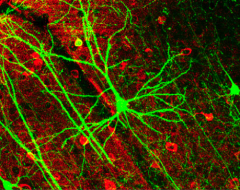
Image of pyramidal neurons in mouse cerebral cortex expressing green fluorescent protein. The red staining indicates GABAergic interneurons. (Source PLoS Biology). Image via Wikimedia Commons.

(PhysOrg.com) -- In a scientific first, researchers have been able to demonstrate the ability of humans to control the activity of individual brain cells.

Scientists examining single in the human brain have successfully identified individual responding to particular stimuli such as pictures of individual people and objects. They have also found that people can control the firing of the neurons.

The research studied volunteers with who had electrodes implanted in their brains to track where their originated. The electrodes were used by the researchers to "eavesdrop" on single cells in the medial temporal lobe, an area important for attention, and memory.

Dr. Moran Cerf of the California Institute of Technology in Pasadena and colleagues conducted their experiment by showing the subjects images of people, places or objects that were familiar to them, including pictures of celebrities such as Michael Jackson, Marilyn Monroe, and Bill Clinton. They then looked for the neurons that fired when the subject was shown each image.

In each of the subjects they found individual neurons fired when the person looked at a specific image. So there was a "Michael Jackson neuron", a "Marilyn Monroe neuron", and others that fired when the person was shown an image of the Eiffel tower, a spider, or other familiar objects or places.

When the neurons corresponding to particular images had been identified, the researchers hooked the electrodes up to a computer that displayed the image corresponding to the neuron that fired. The subject was then asked to think about one of the images. So, for example, a subject was asked to think about Marilyn Monroe. The Marilyn Monroe neuron in the subject's brain fired, and the information was relayed to the computer, which then displayed Monroe's image.

Another experiment designed to test how well the subjects could control the single neurons was a fade experiment in which the subject was shown a combined image of two faces: Josh Brolin (star of Goonies) and Marilyn Monroe, and told to think of Josh Brolin. The electrodes sent data on the Josh Brolin and Marilyn Monroe neurons to the computer, which brightened the image of the one causing most neuron firing. As the subject thought of Brolin, the image of Monroe faded out.

A total of ten patients took part in the fade experiment and were able to successfully control the fading 60-90 percent of the time, but they improved with practice.

The findings may help scientists understand the cognitive processes and how individual brain cells respond to particular stimuli. This information may find application in building machines that can be controlled by human thoughts, which could help people who cannot move, such as those suffering from quadriplegia.

Dr. Cerf presented the findings at the annual meeting of the Society for Neuroscience on 19 October.

© 2009 PhysOrg.com


print this article email this article download pdf blog this article bookmark this article     Stumble it Digg this share on Facebook retweet share on Reddit add to delicious
Rate this story - 4.7 /5 (26 votes)

Rank Filter

Move the slider to adjust rank threshold, so that you can hide some of the comments.


Display comments: newest first

  • danman5000 - Oct 22, 2009
    • Rank: not rated yet
    Sweet, this plus the robotic hand that senses touch and we are well on our way to Surrogates. I would have loved to participate in this experiment - imagine how creepy it must be to think of an image and have it appear on a screen.
  • NotAsleep - Oct 22, 2009
    • Rank: not rated yet
    A common statement: Mind Over Matter. I'd be curious how far we could push that statement, considering the subjects "got better with practice", although I suppose it would be pretty uncomfortable to have brain probes inside you all day every day.

    And when the cards stop falling your way, the future is dark and there's no way out, just remember: Goonies Never Say Die!
  • DaffyDuck - Oct 22, 2009
    • Rank: not rated yet
    danman, don't forget about 2-way communication to the brain with fiber optics. (http://www.wired....enetics)
  • Mr_Man - Oct 22, 2009
    • Rank: not rated yet
    This is amazing. Hopefully soon we will find out how exactly a neuron "encodes" a memory of an image. Perhaps at some point in the future we could "mold" the neurons with drugs or some kind of stimuli that will greatly speed up learning a skill. Maybe it could literally be like "Matrix" style learning (not quite that fast), but in knowing how the neuron retains information is the first step in manipulating it.
  • danman5000 - Oct 22, 2009
    • Rank: not rated yet
    danman, don't forget about 2-way communication to the brain with fiber optics. (http://www.wired....enetics)

    Dang that's pretty cool, I hadn't heard about that. Now my neural interface will even glow like the ones in Surrogates do!
  • ler177 - Oct 22, 2009
    • Rank: not rated yet
    How about dream recording?

    How about telling what animals are thinking (you know how R2D2 talks to Luke in SW via read-out? maybe it could work like that)?
  • fixer - Oct 22, 2009
    • Rank: not rated yet
    More important, a quadroplegic thinks forward and away he goes in his wheelie!
    Or, a person with no vocal chords holds up a PDA to the window and orders burger & fries etc.
  • kasen - Oct 23, 2009
    • Rank: 5 / 5 (3)
    I might be wrong, but how could a single neuron hold all the information regarding a complex visual stimuli like a picture? If anything, that particular neuron would be like a status checker(transistor-like), firing up when specific areas of memory are "accessed", or maybe just be part of said areas. I doubt they actually went cell by cell till they found the specific neuron related to some famous person.
  • vantomic - Oct 23, 2009
    • Rank: not rated yet
    i agree kasen. if I put a pistol in front of me do i use my "pistol neuron" to recognize it? Then what if I take apart the pistol and put the parts in front of me. Do I have a separate neuron for each part of the pistol? Therefore, if i look out into a city, would each object have a separate neuron associated with it?

    maybe there could be a separate neuron for each object in the city if I associated other information with that object (such as a name or other memory). Otherwise the buildings merge into a single pattern and are stored as a group memory of "city" in my "city neuron"...well hell, don't listen to me, just rambling and having fun thinking about stuff.
  • visual - Oct 23, 2009
    • Rank: not rated yet
    But how did they do it? Single-neuron precision seems very hard to achieve... how do they locate a Marilyn Monroe neuron among the millions that are in that area of the brain?

    You can not just poke an electrode around at random until you find the correct one. How were they probing the neurons, over how large an area and with what density?

    I know the "BrainGate" implant that was connected to motor cortex neurons in other experiments (namely the famous Matt Nagle case) had about 100 electrodes (of which only a dozen could be read at one time) that were each connected to a single neuron, or very few anyway. Were they using something similar?

    This is very interesting, but the article does not explain it well.
  • jldb - Oct 23, 2009
    • Rank: not rated yet
    I dont think they went searching for the MM neuron. instead they put in the electrodes then showed a series of pictures. Then used statistical analysis of the measured firing rates from the neurons that happened to be near where the electrodes were to find sets of semi orthogonal images -- i.e. images that on average only resulted in increased firing for a single neuron. Once these 'orthogonal' images were identified they carried out the rest of the study.
  • visual - Oct 28, 2009
    • Rank: not rated yet
    that explanation seems quite likely, and with the rather big difference in the images it shouldn't be too hard to find "orthogonal" sets of neurons. it is still curious for me though, did they use just a few electrodes wired independently and poked completely different areas of the studied brain area? how many, did they need to relocate them and how much? or did they use something like the braingate electrode grid chips.

    and even after finding such orthogonal sets of neurons, i am pretty sure that what they call the MM neuron might get triggered also by very different experiences, like maybe just the image of any woman, or even something completely random and unexpected.

    it is also very curious if the subjects would be able to learn to control the firing of that neuron in the reverse direction - willfully prevent it from firing even when viewing pictures of MM and especially if being made to not ignore them completely, for example by having to answer some questions about them.

October 22, 2009 all stories

Comments: 12

4.7 /5 (26 votes)
  • Stumble this up

  • Digg this

  • share this

  • hide
  • Related Stories

  • Oprah, Luke Skywalker and Maradona -- new study investigates how our brains respond to them
    created Jul 23, 2009 | popularity not rated yet | comments 0
  • How memories are made, and recalled
    created Sep 08, 2008 | popularity not rated yet | comments 0
  • Researchers can read thoughts to decipher what a person is actually seeing
    created Dec 06, 2007 | popularity not rated yet | comments 0
  • Single-Cell Recognition Research Finds a Halle Berry Neuron
    created Jun 23, 2005 | popularity not rated yet | comments 0
  • Unlocking the mysteries of memory
    created Dec 04, 2008 | popularity not rated yet | comments 0


  • hide
  • Relevant PhysicsForums posts

  • Has the H1N1 vaccine been scientifically proven to work?
    created 16 hours ago
  • nesfatin
    created Nov 22, 2009
  • Obsessive Compulsive Disorder
    created Nov 20, 2009
  • West's zone 2 starling resistor respiratory physiology
    created Nov 18, 2009
  • More from Physics Forums - Medical Sciences

Other News

Eye floaters and flashes of light linked to retinal tear, detachment

Eye floaters and flashes of light linked to retinal tear, detachment

Medicine & Health / Research

created 1hour ago | popularity not rated yet | comments 0

Suddenly seeing floaters or flashes of light may indicate a serious eye problem that - if untreated - could lead to blindness, a new study shows.


High salt intake directly linked to stroke and cardiovascular disease

Medicine & Health / Health

created 1hour ago | popularity 4.5 / 5 (2) | comments 0

High salt intake is associated with significantly greater risk of both stroke and cardiovascular disease, concludes a study published in the BMJ today.


Autism treatment: Risky alternative therapies have little basis in science

Medicine & Health / Diseases

created 1hour ago | popularity not rated yet | comments 0

James Coman's son has an unusual skill. The 7-year-old, his father says, can swallow six pills at once. Diagnosed with autism as a toddler, the Chicago boy had been placed on an intense regimen of supplements and medications ...


Early protein processes crucial to formation and layering of myelin membrane

Medicine & Health / Research

created 7 hours ago | popularity not rated yet | comments 0

New findings from an international team of researchers probing the nerve-insulating myelin sheath were bolstered by the work of Boston College biologists, who used x-rays to uncover how mutations affect the structure of myelin, ...


Chronic pain found to increase risk of falls in older adults

Medicine & Health / Health

created 4 hours ago | popularity not rated yet | comments 0

Chronic pain is experienced by as many as two out of three older adults. Now, a new study finds that pain may be more hazardous than previously thought, contributing to an increased risk of falls in adults over age 70. The ...