Scholar helps classify clicks in African languages
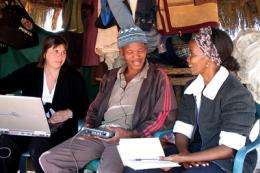
(PhysOrg.com) -- Linguistics scholar Amanda Miller is doing research with high-speed ultrasound technology to help her and fellow researchers successfully record and classify clicks in an endangered African language.
Miller, a visiting scholar in linguistics who was an assistant professor of linguistics at Cornell from 2001 to 2008, researches the phonetics of Khoesan languages, many of which are extinct or endangered -- including N|uu, the subject of a study she recently published in the Journal of the International Phonetic Association.
"N|uu was about to be an extinct language, and around 2002, some speakers were identified as still speaking the language in South Africa, and we thought it was important to study the language before they died," Miller said. "There are less than 10 people, and they're all in their 60s."
Miller and her collaborators -- Johanna Brugman, Ph.D. '09; Cornell graduate student Jonathan Howell; Levi Namaseb of the University of Namibia; Bonny Sands of Northern Arizona University; German graduate student Mats Exter of Universität zu Köln; and former Cornell graduate student Chris Collins -- conducted field research on the N|uu language in Upington, South Africa, between 2002 and 2005, funded by the National Science Foundation. Brugman's dissertation is on Khoesan language, and she was a recent Fulbright scholar in Namibia, Miller said.
Miller first heard about the N|uu speakers from Namaseb, then a Ph.D. student at the University of Toronto. "He was working with the speakers and trying to help them write the language down," she said. "He needed help with the phonetics because it's a very complex language."
Namaseb came to Cornell for a year, taking a phonetics course with Miller and serving as a consultant in a field methods class in linguistics.
Miller said that click consonants "don't fit into the classifications that are used for European languages. We documented all of the sounds of N|uu, and we were able also to come up with a [system] to classify all of the sounds, which has been a problem for 100 years."
In Africa, the researchers used portable, high-speed ultrasound imaging equipment to record the N|uu speakers' tongue movements at 124 frames per second.
"Ultrasound has been used since the 1960s for speech, but the equipment was very expensive [then]," Miller said. "With the help of an engineer, I was able to develop a method which allowed us to get high-speed ultrasound data out of the machine, and synchronize it with the audio signal. This is necessary for clicks, because when we study speech, we want to make sure what we're measuring is repeatable, not just that the tongue happened to move a funny way one time. Speech is imperfect -- we don't speak the same way every time."
Namaseb is developing a writing system for N|uu, informed by the speech research; the researchers are also working on a N|uu dictionary.
"These older speakers are starting to teach others," Miller said. "One of them teaches at a school now; she is teaching the language and the culture to descendants of this group."
Miller's recent collaborative research on Mangetti Dune !Xung, spoken in northern Namibia by about 500 people, will use some of the same methodology.
"My interest in clicks was that some clicks don't occur with front vowels as in the vowel in 'tea,' and some do," she said. "In the previous classifications there was no way to group sounds together that behave in a certain way. So my phonetic work has been able to show the similarity of the sounds that don't occur with front vowels."
Miller said the research "helps with understanding universal systems for languages so it helps us to be able to classify all languages in the world under one system. It's important for historical understanding of how people originated. In order to explain that, we need to have a system to show how each language changed form one to another. It's also important for speech recognition and speech synthesis."
Provided by Cornell University (news : web)


