A new technique identifies versions of the same song
October 22, 2009 A new technique identifies versions of the same song

Enlarge

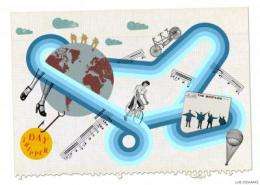
A new technique identifies versions of the same song. Credit: SINC

A team of researchers from Pompeu Fabra University (UPF, Spain) has developed a system to identify common patterns in versions of songs, which will help to quantify the similarity of musical pieces. The technique, which appears in the New Journal of Physics, could be applied to analyse time series of data in other fields, such as economy, biology or astronomy.

"What we propose is a measure to quantify cross recurrences between two songs, that is, to be able to analyse repetitions of different musical patterns that have previously been identified from the tonal or harmonic content of the audio recording" Joan Serrą, co-author of the technique and researcher of the Musical Technology Group (MTG) of UPF in Barcelona, explains to SINC.

Serrą and his team have developed this method, based on mathematical equations, which makes it possible to identify the concurrent presence of tonal events on two song tracks (taken from a CD or other device). The results can be visualised using Cross Recurrence Plots (CRPs).

For example, therefore, the researchers have taken the tonal profile from the song Day Tripper by the Beatles and have compared it with the version performed by the group Ocean Colour Scene, as well as with a different song, I've Got a Crush on You by Frank Sinatra. In the first case, the CRP shows oblique lines that reveal matches between the two versions, but in the second this pattern does not appear.

Serrą indicates that "The identification of versions of the same song (whether or not it is by the original artist, with the same instruments, with the same or different lyrics or language, in the studio or live) may be very interesting for scientific, commercial and intellectual property reasons, or simply for the interest of the end user".

The researcher points out that the cross recurrence plots and their quantification measures are "powerful tools for analysing and comparing time series of any type of data", which means they can be used in disciplines such as astrophysics, biology, engineering or the economy. For example, it would be possible with this technique to analyse over a period of time the correlations between the Ibex and the Dow Jones or with other stock exchange indexes.

The possible applications of this study in different fields have led to its publication in the , a journal of generalist and multidisciplinary physics.

More information: J. Serrą, X. Serra y R. G. Andrzejak. "Cross recurrence quantification for cover song identification". New Journal of Physics 11: 093017, 2009.

Source: FECYT - Spanish Foundation for Science and Technology


print this article email this article download pdf blog this article bookmark this article     Stumble it Digg this share on Facebook retweet share on Reddit add to delicious
Rate this story - 4 /5 (3 votes)

Rank Filter

Move the slider to adjust rank threshold, so that you can hide some of the comments.


Display comments: newest first

  • NotAsleep - Oct 22, 2009
    • Rank: not rated yet
    I hope musicians don't get sued for accidentally recreating music that they've never heard before
  • kasen - Oct 22, 2009
    • Rank: not rated yet
    Well, as a musician friend of mine always says, all music has already been written, so it's impossible be 100% original. Barring the very experimental stuff, most music can be reduced to a small number of basic rhythm and melody combinations that people would find acoustically pleasing. Originality comes from interpretation.

    Besides, this musical analysis was used just as a test for the technique, if I understand correctly. I'm sure there are better uses for it besides tormenting would-be composers.
  • frajo - Oct 22, 2009
    • Rank: not rated yet
    Most interesting.
    Did they test the new method with the Haydn Variations by Brahms? Or with the dozens of versions of "La Folia"? Did it find the cross recurrences within BWV 1080? Or the originals of Bernd Alois Zimmermann's "Musique pour les Soupers du Roi Ubu" which consists of recurrences only?
    I doubt it.
  • RayCherry - Oct 23, 2009
    • Rank: not rated yet
    If this tool does its job, each new peice of music can be tested with the tool (by the musicians who are attempting to create something new) which should provide a legal basis for originality

    Further, where the music is discovered to be accidentally similar to existing music (which will happen the majority of the time) the musicians can consult a database for the terms and conditions of reusing the music they have incorporated in their new work

    I have never met a (real) musician who did not want the ability to do just these things. Nothing worse than believing you are being original, breaking new groud, and then having some bubble-bursting music agent tapping you on the shoulder

    Congratulations to the UPF team. I hope that you have, or will discover, the right commercial, judicial and governmental support to make your tool widely available

October 22, 2009 all stories

Comments: 4

4 /5 (3 votes)
  • Stumble this up

  • Digg this

  • share this

  • hide
  • Related Stories

  • Semantic descriptors to help the hunt for music
    created Jan 04, 2006 | popularity not rated yet | comments 0
  • Researchers find where musical memories are stored in the brain
    created Mar 09, 2005 | popularity not rated yet | comments 0
  • Probing Question: What makes a song catchy?
    created Jun 08, 2006 | popularity not rated yet | comments 0
  • It don't mean a thing if it ain't got that (modern) swing
    created Jul 09, 2007 | popularity not rated yet | comments 0
  • Physicists Help Police with New 3D Hologram Technique
    created Aug 10, 2004 | popularity not rated yet | comments 0


  • hide
  • Relevant PhysicsForums posts

  • tonometer experiment
    created 4 hours ago
  • Radiation heat transfer between air or wall
    created 5 hours ago
  • Hi ,new here and have a question! :)
    created 5 hours ago
  • Hydrostatic pressure in a submerged pipe
    created 7 hours ago
  • More from Physics Forums - General Physics

Other News

First Neutrino Events Observed at T2K Near Detector

First Neutrino Events Observed at T2K Near Detector

Physics / General Physics

created 18 hours ago | popularity 4.8 / 5 (20) | comments 1

(PhysOrg.com) -- Physicists from the Japanese-led multi-national T2K neutrino collaboration announced today that over the weekend they detected the first events generated by their newly built neutrino beam ...


Researchers develop virtual streams to help restore real ones

Physics / General Physics

created 14 hours ago | popularity not rated yet | comments 0

Researchers at the University of Minnesota have developed a unique new computer model called the Virtual StreamLab, designed to help restore real streams to a healthier state. The Virtual StreamLab, which demonstrates the ...


Scientists react as they stand in front of a screen at CERN

First atoms reported smashed in Large Hadron Collider (Update)

Physics / General Physics

created Nov 23, 2009 | popularity 4.7 / 5 (27) | comments 21

Two circulating beams on Monday produced the first particle collisions in the world's biggest atom smasher, the Large Hadron Collider (LHC), three days after its restart, scientists announced.


Restored machine to explore mysteries of Big Bang (AP)

Restored machine to explore mysteries of Big Bang

Physics / General Physics

created Nov 21, 2009 | popularity 4.6 / 5 (18) | comments 26

(AP) -- Scientists are preparing the world's largest atom smasher to explore the depths of matter after successfully restarting the $10 billion machine following more than a year of repairs.


In the Brain, Seven Is A Magic Number

In the Brain, Seven Is A Magic Number

Physics / General Physics

created Nov 23, 2009 | popularity 4.5 / 5 (31) | comments 8

Having a tough time recalling a phone number someone spoke a few minutes ago or forgetting items from a mental grocery list is not a sign of mental decline; in fact, it's natural.