The CoRoT space mission: Early results
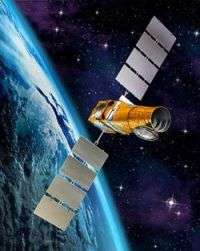
Astronomy & Astrophysics is publishing a special issue this week dedicated to the early results of the CoRoT space mission. The CoRoT (Convection, Rotation & planetary Transits) satellite is a 30 centimeter space telescope, launched on 27 December 2006 from Baikonour. Since then, CoRoT has been orbiting at about 900 km from the Earth, monitoring the changes in brightness of a huge amount of stars with unprecedented accuracy. This aims at both detecting exoplanets by the transit method and studying seismology of a wide variety of stars.
Up to now, seven exoplanets have been discovered in the CoRoT data and confirmed by ground-based follow-up campaigns. The difficulty with this exoplanet hunting is nicely illustrated by some papers (Moutou et al., Almenara et al.) that describe the long process of deciphering the candidates and finally characterizing a few stars hosting planets among tens of thousands. In this issue, two papers are devoted to the most exciting, and now famous, planet-hosting star: CoRoT-7. Léger et al. report the discovery of CoRoT-7b, the smallest exoplanet ever found, as was announced in February 2009 during the first CoRoT international symposium. In a second article, Queloz et al. measured the mass of the planet (5 Earth masses), using additional, ground-based measurements. They calculated its density (about 5,6 g/cm3), showing that CoRoT-7b is a rocky planet, just like the Earth. This is the first rocky exoplanet confirmed to date. Queloz et al. also discovered a second planet in the CoRoT-7 system. Now known as CoRoT-7c, it is another super-Earth exoplanet of about 8 Earth masses.
The accuracy of the CoRoT data is exemplified by detection of the secondary transit of CoRoT-1b, when the planet passes behind its star. This is a real challenge because the amplitude of such an event is about one hundred parts per million. Comparing the depths of both transits provides information on the albedo of the planet, hence on the nature of its atmosphere (Alonso et al.).
CoRoT's primary goal is not only to hunt exoplanets, but also to study the seismology of stars. This part of the mission is also a major step forward as illustrated by several papers that deal with the detection and measurements of solar-like oscillations in distant stars. CoRoT shows that the oscillations are generally more complicated than those of the Sun, which poses new problems of interpretation (e.g., Garcia et al., Barban et al.). Such oscillations have also been detected and quantified for the first time in many red giants, using data from the exoplanet search program (Hekker et al.). The physical processes responsible for these oscillations are now understood (Dupret et al.).
CoRoT observing hot stars also gave astonishing results. The satellite observed a Be star [2] during an outburst phase and measured the change in the oscillation spectrum during this rare event. These observations gave insight into the nature of the explosion. It will help in solving a question that has been pending for years: are oscillations the cause of the outburst? (Huat et al., Floquet et al.)
Although primarily devoted to asteroseismology and exoplanet search, CoRoT also addresses many important topics in stellar physics. Several papers deal with stellar activity and report the detection of spots in the stars' photospheres (Mosser et al.), giving access to the stars' rotation rate. In some cases, it is even possible to detect the latitude dependence of the rotation rate (Lanza et al.). Significant progress in the modeling of fast-rotating stars will help in understanding these new data (Reese et al.).
The CoRoT satellite has been orbiting the Earth for nearly three years and will be operated until 2013. This A&A special issue nicely shows that it has already been a pioneering mission and has led to major insights in both exoplanetary and asteroseismic domains. CoRoT's successors are already on their way: the NASA Kepler mission, a super CoRoT devoted to finding Earth-size and smaller exoplanets, was launched in March 2009. Even more ambitious, the ESA project PLATO is still under assessment as a part of the ESA Cosmic Vision program for 2015-2025. PLATO will be able to combine the detailed study of the stellar interior and of the planetary environment of tens of thousands of bright stars.
More information: www.aanda.org/index.php?option … ntents/contents.html
Source: Astronomy & Astrophysics


