Galaxy cluster smashes distance record
October 22, 2009 Galaxy cluster smashes distance record

Enlarge

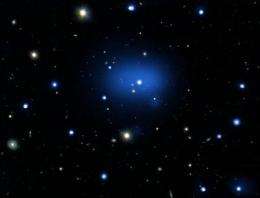
This is a composite image of the most distant galaxy cluster yet detected. This image contains X-rays from NASA's Chandra X-ray Observatory, optical data from the Very Large Telescope (VLT), and optical and infrared data from the Digitized Sky Survey. This record-breaking object, known as JKCS041, is observed as it was when the Universe was just one quarter of its current age. X-rays from Chandra are displayed here as the diffuse blue region, while the individual galaxies in the cluster are seen in white in the VLT's optical data, embedded in the X-ray emission. Credit: X-ray: NASA/CXC/INAF/S.Andreon et al Optical: DSS; ESO/VLT

The most distant galaxy cluster yet has been discovered by combining data from NASA's Chandra X-ray Observatory and optical and infrared telescopes. The cluster is located about 10.2 billion light years away, and is observed as it was when the Universe was only about a quarter of its present age.

The , known as JKCS041, beats the previous record holder by about a billion light years. Galaxy clusters are the largest gravitationally bound objects in the . Finding such a large structure at this very early epoch can reveal important information about how the Universe evolved at this crucial stage.

JKCS041 is found at the cusp of when scientists think galaxy clusters can exist in the early Universe based on how long it should take for them to assemble. Therefore, studying its characteristics - such as composition, mass, and temperature - will reveal more about how the Universe took shape.

"This object is close to the distance limit expected for a galaxy cluster," said Stefano Andreon of the National Institute for Astrophysics (INAF) in Milan, Italy. "We don't think gravity can work fast enough to make galaxy clusters much earlier."

Distant galaxy clusters are often detected first with optical and infrared observations that reveal their component galaxies dominated by old, red stars. JKCS041 was originally detected in 2006 in a survey from the United Kingdom (UKIRT). The distance to the cluster was then determined from optical and infrared observations from UKIRT, the Canada-France-Hawaii telescope in Hawaii and NASA's . Infrared observations are important because the optical light from the galaxies at large distances is shifted into infrared wavelengths because of the expansion of the universe.

The Chandra data were the final - but crucial - piece of evidence as they showed that JKCS041 was, indeed, a genuine galaxy cluster. The extended X-ray emission seen by Chandra shows that hot gas has been detected between the galaxies, as expected for a true galaxy cluster rather than one that has been caught in the act of forming.

Also, without the X-ray observations, the possibility remained that this object could have been a blend of different groups of galaxies along the line of sight, or a filament, a long stream of galaxies and gas, viewed front on. The mass and temperature of the hot gas detected estimated from the Chandra observations rule out both of those alternatives.

The extent and shape of the X-ray emission, along with the lack of a central radio source argue against the possibility that the X-ray emission is caused by scattering of cosmic microwave background light by particles emitting radio waves.

It is not yet possible, with the detection of just one extremely distant galaxy cluster, to test cosmological models, but searches are underway to find other galaxy clusters at extreme distances.

"This discovery is exciting because it is like finding a Tyrannosaurus Rex fossil that is much older than any other known," said co-author Ben Maughan, from the University of Bristol in the United Kingdom. "One fossil might just fit in with our understanding of dinosaurs, but if you found many more, you would have to start rethinking how dinosaurs evolved. The same is true for galaxy clusters and our understanding of cosmology."

The previous record holder for a galaxy cluster was 9.2 billion light years away, XMMXCS J2215.9-1738, discovered by ESA's XMM-Newton in 2006. This broke the previous distance record by only about 0.1 billion light years, while JKCS041 surpasses XMMXCS J2215.9 by about ten times that.

"What's exciting about this discovery is the astrophysics that can be done with detailed follow-up studies," said Andreon.

Among the questions scientists hope to address by further studying JKCS041 are: What is the build-up of elements (such as iron) like in such a young object? Are there signs that the cluster is still forming? Do the temperature and X-ray brightness of such a distant cluster relate to its mass in the same simple way as they do for nearby clusters?

The paper describing the results on JKCS041 from Andreon and his colleagues will appear in an upcoming issue of the journal Astronomy and Astrophysics.

Source: Chandra X-ray Center (news : web)


print this article email this article download pdf blog this article bookmark this article     Stumble it Digg this share on Facebook retweet share on Reddit add to delicious
Rate this story - 4.2 /5 (10 votes)

Rank Filter

Move the slider to adjust rank threshold, so that you can hide some of the comments.


Display comments: newest first

  • frajo - Oct 22, 2009
    • Rank: 5 / 5 (1)
    if you found many more, you would have to start rethinking how dinosaurs evolved.

    I'm prepared for a paradigm change. Maybe the long distance calibrators have to be readjusted, maybe Hubble's constant turns out not to be too constant.
  • Thecis - Oct 23, 2009
    • Rank: 5 / 5 (1)
    Well, Hubbles constant can be constant but the trouble is the equation which also holds the distant. I have seen many arguments that the measured distant might be off (ergo, galaxy is smaller than expected, etc).
    When the total distance is off, or the measured speed, this would automatically mean that Hubbles constant is off.

    Another scenario is that this law is accurate but not for very extreme distances (comparible with temperature and the movement of matter, its linear until reaching 0K).

    Im curious what they will find out.

October 22, 2009 all stories

Comments: 2

4.2 /5 (10 votes)
  • Stumble this up

  • Digg this

  • share this

  • hide
  • Related Stories

  • Spitzer Sees 9 Billion Years Back in Time
    created Mar 21, 2006 | popularity not rated yet | comments 0
  • Massive galaxy cluster found 10 billion light years away
    created Jun 06, 2006 | popularity not rated yet | comments 0
  • XMM-Newton's massive discovery
    created Aug 25, 2008 | popularity not rated yet | comments 0
  • Chandra catches 'piranha' black holes
    created Jul 24, 2007 | popularity not rated yet | comments 0
  • Survey Reveals Building Block Process For Biggest Galaxies
    created Apr 12, 2006 | popularity not rated yet | comments 0


  • hide
  • Relevant PhysicsForums posts

  • Primary Mirror grinding
    created 3 hours ago
  • dark energy can escape black holes.
    created 11 hours ago
  • Are there green, purple and pink stars?
    created 23 hours ago
  • Sideral question
    created Nov 21, 2009
  • Doppler shifted blackbody spectrum
    created Nov 21, 2009
  • Earth v. Moon
    created Nov 21, 2009
  • More from Physics Forums - General Astronomy

Other News

Free Spirit: Third Extrication Drive Ends With Wheel Stall

Free Spirit: Third Extrication Drive Ends With Wheel Stall

Space & Earth / Space Exploration

created 55 minutes ago | popularity not rated yet | comments 0

(PhysOrg.com) -- Spirit experienced a wheel stall with the right-rear wheel during the second step of a two-step drive on Sol 2092 (Saturday, Nov. 21). This is not the same wheel that stalled on Sol 1899 (May ...


Cassini Sends Back Images of Enceladus as Winter Nears

Cassini Sends Back Images of Enceladus as Winter Nears

Space & Earth / Space Exploration

created 15 minutes ago | popularity 5 / 5 (1) | comments 0

(PhysOrg.com) -- NASA's Cassini spacecraft has sailed seamlessly through the Nov. 21 flyby of Saturn's moon Enceladus and started transmitting uncalibrated temperature data and images of the rippling terrain. ...


3 Questions: Sara Seager on searching for Earth-like planets

3 Questions: Sara Seager on searching for Earth-like planets

Space & Earth / Astronomy

created 55 minutes ago | popularity 1 / 5 (1) | comments 0

(PhysOrg.com) -- MIT planetary scientist Sara Seager has been studying exoplanets — planets circling stars other than the sun — for many years.


Spitzer Telescope Observes Baby Brown Dwarf

Spitzer Telescope Observes Baby Brown Dwarf

Space & Earth / Astronomy

created 1hour ago | popularity 5 / 5 (4) | comments 0

(PhysOrg.com) -- NASA's Spitzer Space Telescope has contributed to the discovery of the youngest brown dwarf ever observed -- a finding that, if confirmed, may solve an astronomical mystery about how these ...


New computer-developed map shows more extensive valley network on Mars

New computer-developed map shows more extensive valley network on Mars

Space & Earth / Space Exploration

created 2 hours ago | popularity 4.7 / 5 (3) | comments 0

New research adds to the growing body of evidence suggesting the Red Planet once had an ocean.