CDC: 1 in 5 kids had flu-like illness this month
October 22, 2009 By MIKE STOBBE , AP Medical Writer CDC: 1 in 5 kids had flu-like illness this month (AP)

Enlarge

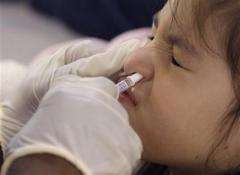
Marisol Rangeo receives the swine flu nasal spray vaccine in Indianapolis, Thursday, Oct. 22, 2009. The Marion County Health Department had about 3,000 shots and nasal sprays on hand Thursday for the free clinic. (AP Photo/Darron Cummings)

(AP) -- About 1 in 5 U.S. children had a flu-like illness earlier this month - and most of those cases likely were swine flu, according to a new government health survey. About 7 percent of surveyed adults said they'd had a flu-like illness, the survey found.

The information comes from a household survey of more than 14,000 adults done in the first 11 days of October. The adults were asked if they had a fever or other flu-like symptoms in the past week; a smaller number were asked about their children.

The survey was done by telephone and there was no medical confirmation of their reports. The Centers for Disease Control and Prevention announced the results Wednesday at a medical meeting in Atlanta.

Swine flu is widespread throughout the country, and the virus is causing more illness now that it has at any time since it was first identified in April. In people ages 5 to 64, there have been as many flu-related hospitalizations in the last six weeks as there usually are in an entire flu season, said Lyn Finelli, a CDC flu surveillance official.

Also, the number of swine flu deaths in children since the start of September roughly equals the number in the first four months of the pandemic, Finelli said.

For most people, swine flu has been a mild illness, perhaps very mild, CDC officials believe. There are cases without symptoms, "and maybe quite a few of those," said Nancy Cox, a CDC flu expert.

Millions of Americans have been infected, CDC officials estimate.

---

On the Net:

CDC swine flu update: http://www.cdc.gov/h1n1flu/update.htm

©2009 The Associated Press. All rights reserved. This material may not be published, broadcast, rewritten or redistributed.


print this article email this article download pdf blog this article bookmark this article     Stumble it Digg this share on Facebook retweet share on Reddit add to delicious
Rate this story - not rated yet


October 22, 2009 all stories

Comments: 0

not rated yet
  • Stumble this up

  • Digg this

  • share this

  • hide
  • Related Stories

  • Near half of swine flu patients otherwise healthy
    created Oct 13, 2009 | popularity not rated yet | comments 0
  • CDC: 76 children dead of swine flu as cases rise
    created Oct 09, 2009 | popularity not rated yet | comments 0
  • US swine flu deaths rise to 263
    created Jul 17, 2009 | popularity not rated yet | comments 0
  • Rapid tests often wrong about swine flu
    created Aug 06, 2009 | popularity not rated yet | comments 0
  • Harvard survey: Swine flu in, affection out
    created May 08, 2009 | popularity not rated yet | comments 0


  • hide
  • Relevant PhysicsForums posts

Other News

Two molecules affecting brain plasticity

Medicine & Health / Neuroscience

created 29 minutes ago | popularity 5 / 5 (1) | comments 0

(PhysOrg.com) -- You wouldn't want a car with no brakes. It turns out that the developing brain needs them, too.


Study sheds light on brain's fear processing center

Medicine & Health / Research

created 26 minutes ago | popularity not rated yet | comments 0

Breathing carbon dioxide can trigger panic attacks, but the biological reason for this effect has not been understood. A new study by University of Iowa researchers shows that carbon dioxide increases brain acidity, which ...


Auditory illusion: How our brains can fill in the gaps to create continuous sound

Medicine & Health / Neuroscience

created 1minute ago | popularity not rated yet | comments 0

It is relatively common for listeners to "hear" sounds that are not really there. In fact, it is the brain's ability to reconstruct fragmented sounds that allows us to successfully carry on a conversation in a noisy room. ...


Startled flies may provide insight into ADHD

Medicine & Health / Neuroscience

created 3 minutes ago | popularity not rated yet | comments 0

It seems obvious that naturally waking up from sleep and being startled by something in the environment are two very different emotional states. However, the neuroscience that underlies these different forms of arousal has, ...


Feeding the clock

Feeding the clock: Cycles of feeding and fasting drive circadian gene expression in the liver

Medicine & Health / Research

created 1hour ago | popularity not rated yet | comments 0

When you eat may be just as vital to your health as what you eat, found researchers at the Salk Institute for Biological Studies. Their experiments in mice revealed that the daily waxing and waning of thousands ...