Sharp Develops Solar Cell with World's Highest Conversion Efficiency of 35.8%
October 22, 2009
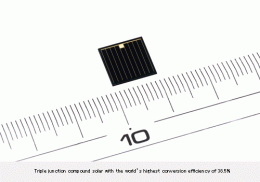
Sharp Corporation has achieved the world's highest solar cell conversion efficiency (for non-concentrator solar cells) of 35.8% using a triple-junction compound solar cell.
Unlike silicon-based solar cells, the most common type of solar cell in use today, the compound solar cell utilizes photo-absorption layers made from compounds consisting of two or more elements such as indium and gallium.
Due to their high conversion efficiency, compound solar cells are used mainly on space satellites. Since 2000, Sharp has been advancing research and development on a triple-junction compound solar cell that achieves high conversion efficiency by stacking three photo-absorption layers.
To boost the efficiency of triple-junction compound solar cells, it is important to improve the crystallinity (the regularity of the atomic arrangement) in each photo-absorption layer (the top, middle, and bottom layer). It is also crucial that the solar cell be composed of materials that can maximize the effective use of solar energy.
Conventionally, Ge (germanium) is used as the bottom layer due to its ease of manufacturing. However, in terms of performance, although Ge generates a large amount of current, the majority of the current is wasted, without being used effectively for electrical energy. The key to solving this problem was to form the bottom layer from InGaAs (indium gallium arsenide), a material with high light utilization efficiency. However, the process to make high-quality InGaAs with high crystallinity was difficult.
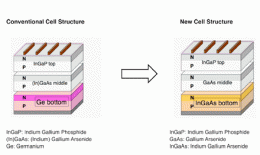
Sharp has now succeeded in forming an InGaAs layer with high crystallinity by using its proprietary technology for forming layers. As a result, the amount of wasted current has been minimized, and the conversion efficiency, which had been 31.5% in Sharp’s previous cells, has been successfully increased to 35.8%.
Provided by Sharp


NREL Solar Cell Sets World Efficiency Record at 40.8 Percent
http://www.physor...843.html
???
A bank of cells on the roof and boot lid should allow the average commuter a free ride if the sun is shining, topping up the battery while the car is parked.
This is for a concentrated PV cell- that one had the power of 326 suns hitting it at at once to achieve 40.8% eff
According to a joint venture study by the USGS and DOE under ideal atmospheric conditions (death valley) and with only single axis sun tracking, a black painted sheet of steel is hit for up to 16kwh/m2 per hour of sunlight. Which is enough to run a 20 hp engine full throttle per hour- but nobody is driving around with their pedal to the floor for 60/60 minutes, even if you hit 30/60 you would still have 30 minutes of 40hp full throttle, 10/60 minutes and you have you guessed it 120hp and what are the distances you drive- this may actually be more then enough energy to expediently get you where you are going. Especially if you have good energy storage systems since you get to add all the hours of sunlight you are not driving, but parked in the light. Actually in a day a square meter can be hit by enough energy to drive a 300HP motor full throttle for an hour fairly easy. A car roof is usually not a square meter though, but with hood and trunk
Interesting, as in space with no atmosphere, solar flux is only 1365 watts/m2. Your quoted value is the maximum daily total, not hourly. For a tracking system, in Death Valley, on a summer day.
It doesn't matter which way you go you can't achieve more than those 1.4kW times the amount of square meters on your car.
A sizeable car (Mercedes CL) is 5m by 2m. So you'll get 14kW (about 19hp) MAXIMUM at midday in death valley. You aren't going anywhere with 20hp and a car that size (especially not in normal weather conditions, during commuter times (morning/evening)).
For a small car (like a VW rabbit) you get about 10hp. Again: this is MAXIMUM at 100% efficiency. With real efficiency ratings of solar panels (50%) and weather conditions? Most lawn mowers/golf carts will outperform you.
Lugging around additional batteries with an underpowered vehicle is not an option here.