Feds designate polar bear habitat in Alaska
October 22, 2009 By MATTHEW DALY , Associated Press Writer
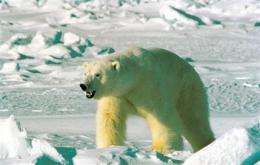
FILE - This undated file photo from the U.S. Fish and Wildlife Service's Alaska Image Library shows a polar bear. The Obama administration is setting aside 200,000 square miles in Alaska and off its coast as "critical habitat" for polar bears, an action that could add restrictions to future offshore drilling for oil and gas. (AP Photo/U.S. Fish and Wildlife Service, FILE)
(AP) -- The Obama administration said Thursday it is designating more than 200,000 square miles in Alaska and off its coast as "critical habitat" for polar bears, an action that could add restrictions to future offshore drilling for oil and gas.
Federal law prohibits agencies from taking actions that may adversely affect critical habitat and interfere with polar bear recovery.
Assistant Interior Secretary Tom Strickland called the habitat designation a step in the right direction to help polar bears stave off extinction, while recognizing that the greatest threat to the bear is the melting of Arctic sea ice caused by climate change.
"As we move forward with a comprehensive energy and climate strategy, we will continue to work to protect the polar bear and its fragile environment," Strickland said at a news conference.
The total area proposed for critical habitat designation would cover about 200,541 square miles - about half in the rugged Chukchi Sea off Alaska's northwest coast. About 93 percent of the area proposed for the polar bear is sea ice, with the remaining 7 percent made up of barrier islands or land-based dens of snow and ice.
Designation as critical habitat would not, in itself, bar oil or gas development, but would make consideration of the effect on polar bears and their habitat an explicit part of any government-approved activity.
Thursday's announcement starts a 60-day public comment period, with a final rule expected next year. Interior faces a June 30 deadline for critical habitat designation under terms of a settlement agreement between the government and three environmental groups.
The Bush administration last year declared polar bears "threatened," or likely to become endangered. The May 2008 order by then-Interior Secretary Dirk Kempthorne cited the bear's need for sea ice, the dramatic loss of such ice in recent decades and computer models that suggest sea ice is likely to recede further in the future.
Environmental groups hailed the habitat announcement, but noted that it came in the same week that the Interior Department approved a plan by a subsidiary of Royal Dutch Shell to drill exploratory wells on two leases in the Beaufort Sea off Alaska's north coast. The proposed drilling sites are within the area proposed for critical habitat designation.
"If polar bears are to survive in a rapidly melting Arctic, we need to protect their critical habitat, not turn it into a polluted industrial zone," said Brendan Cummings, a lawyer with the Arizona-based Center for Biological Diversity, which filed a lawsuit in the polar bear case.
Cummings called the Interior Department "schizophrenic" - on the one hand declaring its intent to protect polar bear habitat in the Arctic, yet at the same time "sacrificing that habitat to feed our unsustainable addiction to oil."
The announcement comes one day after the state of Alaska filed a new complaint in its effort to overturn the listing of the polar bear as threatened under the Endangered Species Act.
Former Gov. Sarah Palin filed suit last year, saying that Interior did not respond to the state's concerns in a timely manner before listing the polar bears as threatened. State officials say the listing could cripple offshore oil and gas development in the Chukchi and Beaufort seas, which provide prime habitat for the polar bears.
Gov. Sean Parnell, who succeeded Palin upon her resignation last summer, said the Endangered Species Act was being used as a way to shut down resource development along Alaska's northern coast. Parnell said he does not intend to let that happen.
Environmental groups monitoring the Arctic have long complained that federal regulators routinely grant permits for petroleum exploration without adequately considering consequences for whales, polar bears, walrus and other marine mammals. They say boats, drilling platforms and aircraft will add to bears' stress by causing them to flee and expend more energy.
Conservation groups also say oil companies have not demonstrated they can clean up an oil spill in broken ice. Cleanup off Alaska's coast could be slowed by extreme cold, moving ice, high wind and low visibility.
Andrew Wetzler of the Natural Resources Defense Council said designation of critical habitat is a powerful tool to protect threatened species, but said more must be done to save the polar bear from extinction.
On the Net: U.S. Fish and Wildlife Service: http://www.fws.gov/
©2009 The Associated Press. All rights reserved. This material may not be published, broadcast, rewritten or redistributed.
-
Polar bears at risk from ice loss
Oct 14, 2005 |
not rated yet |
0
-
Polar bears face extinction in 100 years
Jul 05, 2005 |
not rated yet |
0
-
Next 50 years may be last for polar bears
Sep 09, 2007 |
not rated yet |
0
-
Scientists want polar bear protection
Jun 20, 2006 |
not rated yet |
0
-
Governor opposes polar bear protection
Nov 02, 2007 |
not rated yet |
0
-
Fast photon control brings quantum photonic technologies closer
10 hours ago |
5 / 5 (4) |
0
-
Engineers build first sub-10-nm carbon nanotube transistor
Feb 01, 2012 |
4.9 / 5 (33) |
30
-
Something old, something new: Evolution and the structural divergence of duplicate genes
Jan 31, 2012 |
4.6 / 5 (7) |
1
-
The hidden nanoworld of ice crystals: Revealing the dynamic behavior of quasi-liquid layers
Jan 30, 2012 |
5 / 5 (5) |
1
-
Stock market network reveals investor clustering
Jan 27, 2012 |
3.9 / 5 (23) |
8
-
Looking for website on Molecular Neuroscience
46 minutes ago
-
Factors affecting beet root cell membrane
Feb 12, 2012
-
Stem cell question.
Feb 10, 2012
-
Protease cleavage
Feb 10, 2012
-
Pertubance in a model
Feb 10, 2012
-
Cancer drugs and Alzheimer's, Oh my!
Feb 09, 2012
- More from Physics Forums - Biology
More news stories
Plants use circadian rhythms to prepare for battle with insects
In a study of the molecular underpinnings of plants' pest resistance, Rice University biologists have shown that plants both anticipate daytime raids by hungry insects and make sophisticated preparations to ...
2 hours ago |
5 / 5 (2) |
0
|
Study finds fish of Antarctica threatened by climate change
A Yale-led study of the evolutionary history of Antarctic fish and their "anti-freeze" proteins illustrates how tens of millions of years ago a lineage of fish adapted to newly formed polar conditions ...
4 hours ago |
3.7 / 5 (3) |
0
|
Explosive evolution need not follow mass extinctions, says study of ancient zooplankton
Following one of Earth's five greatest mass extinctions, tiny marine organisms called graptoloids did not begin to rapidly develop new physical traits until about 2 million years after competing species became ...
4 hours ago |
5 / 5 (1) |
1
|
Writing a new code for life?
On "Star Trek, the aliens often look so human that crew members fall in love with them. But in real life, scientists in the field known as astrobiology can't be sure alien life would even be carbon-based like us, or use DNA ...
7 hours ago |
5 / 5 (5) |
1
Lens produces hours of scientific work in seconds
A new form of microscope which can produce results in seconds rather than hours dramatically speeding up the process of drug development - is being developed by researchers at the University of Strathclyde ...
8 hours ago |
4.4 / 5 (7) |
1
|
First-of-its-kind stem cell study re-grows healthy heart muscle in heart attack patients
Results from a Cedars-Sinai Heart Institute clinical trial show that treating heart attack patients with an infusion of their own heart-derived cells helps damaged hearts re-grow healthy muscle.
Discovery paves way for salmonella vaccine
(Medical Xpress) -- An international research team led by a University of California, Davis, immunologist has taken an important step toward an effective vaccine against salmonella, a group of increasingly antibiotic-resistant ...
Time of year important in projections of climate change effects on ecosystems
(PhysOrg.com) -- Does it matter whether long periods of hot weather, such as last year's heat wave that gripped the U.S. Midwest, happen in June or July, August or September?
Smoking bans lead to less, not more, smoking at home: study
Smoking bans in public/workplaces don't drive smokers to light up more at home, suggests a study of four European countries with smoke free legislation, published online in Tobacco Control.
Ovarian cancer arises in fallopian tube of knockout mice
(Medical Xpress) -- The most deadly form of "ovarian" cancer arises in the fallopian tubes not the ovaries of knockout mice that lack two genes associated with the disease, said researchers led by Baylor College ...
UK cases of progressive sight loss condition set to rise a third by 2020
New cases of the progressive sight loss condition, known as age-related macular degeneration, or AMD for short, are set to rise by a third in the UK over the next decade, reveals research published online in the British Jo ...
Oct 23, 2009
Rank: 3 / 5 (2)
More rubbish from, "the cap, trade and let's see what else we can steal", crowd.