What Comes After Hard Drives?
October 23, 2009 By Lisa Zyga
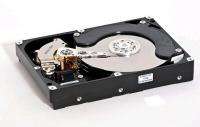
An opened Samsung HD753LJ hard disk drive. Researchers predict that, in 2020, hard disk drives will likely be less expensive on a cost per terabyte basis than any of the competing technologies. Image credit: Christian Jansky.
(PhysOrg.com) -- The ability to store and retrieve data is an important component of today's computers, as well as other modern electronic devices such as cell phones, video game consoles, and camcorders. Since their invention in the 1950s, magnetic-based hard disk drives (HDDs) have been the primary method of nonvolatile storage. However, researchers are currently developing several new and promising nonvolatile memory (NVM) technologies, but for one of them to replace HDDs within the next decade, it will be a challenge.
According to a new study, if HDDs continue to progress at their current pace, then in 2020 a two-disk, 2.5-inch disk drive will be capable of storing more than 14 TB and will cost about $40 (today, a typical 500 GB hard drive costs about $100). Although flash memories have also become popular - with advantages such as lower power consumption, faster read access time, and better mechanical reliability than HDDs - the cost per GB for flash memories is nearly 10 times that of HDDs. In addition, flash memory technology will reach technical limits that will prevent its continued scaling before 2020, keeping them from replacing HDDs.
In a study published in a recent issue of IEEE Transactions on Magnetics, Professor Mark Kryder and PhD student Chang Soo Kim of Carnegie Mellon University have investigated 13 up-and-coming NVM technologies to see whether one of them might outperform HDDs on a cost-per-TB basis in 2020. Their results showed that most technologies will probably not be competitive with HDDs or flash memories at that time, except for two potential candidates: phase change random access memory (PCRAM) and spin transfer torque random access memory (STTRAM).
As Kryder and Kim explained, PCRAM is based on the phase change properties of chalcogenide glass. With the application of heat, the glass can switch between two different states (amorphous and crystalline) to be used as a memory. With their small cell size and ability to store multiple bits per cell, PCRAMs have the potential to offer high densities and be cost-competitive with HDDs, but their biggest drawback is that they require somewhat higher power than most other technologies. PCRAMs are already beginning to be marketed by Numonyx Inc., an Intel-ST Microelectronics joint venture, and so are closer to practical realization than STTRAM.
STTRAM, which is similar to magnetic RAM, uses a spin polarized current to write data by reorienting the states of a magnetic tunnel junction between parallel and anti-parallel orientations. In their evaluation, Kryder and Kim found that STTRAMs appear to potentially offer superior power efficiency, among other advantages. If STTRAMs could be improved to store multiple bits per cell, the researchers predict that STTRAMs’ density could make them candidates for replacing flash memory and possibly HDDs.
“We were surprised to find that the study indicated that, even in 2020, hard drives were likely to be considerably less expensive on a cost per terabyte basis than any of the competing technologies,” Kryder told PhysOrg.com. “It was also somewhat surprising to find that the technical potential of a technology was not necessarily well-correlated with where the industry was investing the most dollars; rather, industrial firms are tending to invest where they have the most know-how. This is not necessarily the wisest decision, but is quite understandable.”
The other NVM technologies that Kryder and Kim evaluated were ferroelectric RAM, magnetic RAM, carbon nanotube RAM, probe memory, holographic memory, copper bridge RAM, resistive RAM, racetrack memory, single electron memory, molecular memory, and polymer memory. Although these technologies offer potential, each of them still faces significant performance challenges over the next decade. Holographic memory, for example, offers high density and is inexpensive, but it currently only offers “write once, read many times” (WORM) functionality, and with its 50-year storage lifetime it may be better suited to the archival market. The researchers also pointed out the intriguing concept behind single electron memory, where information could be stored in something as small as a single electron, but they predicted that this technology likely won’t be practical until beyond 2020.
Kryder, who has previously been CTO for Seagate Technology, the world's largest hard drive maker, explained that he had been continually asked to review new technologies that were often touted as potentially replacing hard drives.
“Feedback from industrial associates has indicated that having a structured set of criteria to evaluate technologies was very useful and that the study has helped them to prioritize the technologies that they look at,” he said. “This study allowed us to identify the most promising technologies on which to work, and we are now attempting develop multi-level cell STTRAM.”
More information: Mark H. Kryder and Chang Soo Kim. “After Hard Drives - What Comes Next?” IEEE Transactions on Magnetics, Vol. 45, No. 10, October 2009.
Copyright 2009 PhysOrg.com.
All rights reserved. This material may not be published, broadcast, rewritten or redistributed in whole or part without the express written permission of PhysOrg.com.
-
16 Gb Samsung's Flash Solid State Disk to Replace Hard Drives
May 23, 2005 |
not rated yet |
0
-
Toshiba develops new MRAM device which opens the way to giga-bits capacity
Nov 06, 2007 |
not rated yet |
0
-
Epson and Fujitsu Announce Joint Development of Next-Generation Technology for FRAM Non-Volatile Memory
Jun 15, 2005 |
not rated yet |
0
-
Samsung unveils world's first 16-gigabit NAND flash memory chip
Sep 12, 2005 |
not rated yet |
0
-
New Computer Revolution is Around the Corner - the World's First 16-Mbit Magnetic RAM Prototype
Jun 22, 2004 |
not rated yet |
0
-
Engineers build first sub-10-nm carbon nanotube transistor
Feb 01, 2012 |
5 / 5 (21) |
19
-
Something old, something new: Evolution and the structural divergence of duplicate genes
Jan 31, 2012 |
4.6 / 5 (7) |
1
-
The hidden nanoworld of ice crystals: Revealing the dynamic behavior of quasi-liquid layers
Jan 30, 2012 |
5 / 5 (2) |
1
-
Stock market network reveals investor clustering
Jan 27, 2012 |
4.1 / 5 (21) |
8
-
Of microchemistry and molecules: Electronic microfluidic device synthesizes biocompatible probes
Jan 26, 2012 |
not rated yet |
0
-
Tennis Court Speed Measurement
11 hours ago
-
Fastest way to cool water
19 hours ago
-
Counter-weights
Feb 02, 2012
-
Composite electric glass heating elements
Feb 02, 2012
-
pipe stress analysis
Feb 02, 2012
-
Interested in average household energy consumption in 2011...
Feb 01, 2012
- More from Physics Forums - General Engineering
More news stories
Researchers find social robots require astute tuning to improve acceptability by the human mind
After years of existing only in fiction, social robots are finally being designed that can more closely emulate how people express themselves, interact and learn and doing so while performing jobs like teaching social ...
7 hours ago |
not rated yet |
0
GPS shoe lets families keep track of elderly relatives
A Teaneck, N.J., shoe maker has joined with a California technology company to create a shoe that uses GPS technology that records where a wearer walks - and can send alerts to caregivers if someone suffering from Alzheimer's ...
Electronics / Consumer & Gadgets
8 hours ago |
not rated yet |
0
New Nokia phone no standout, but worth a look
The first of Nokia's new generation of smartphones isn't flashy and certainly isn't an iPhone killer. But it's a nice device, and at $40 with a two-year contract, a bargain.
Electronics / Consumer & Gadgets
9 hours ago |
1 / 5 (2) |
2
Motorola: Some refurbished tablets weren't wiped
Motorola Mobility says about 100 Xoom tablet computers that it refurbished for sale on Woot.com may not have been properly wiped of the previous owners' data.
Electronics / Consumer & Gadgets
8 hours ago |
not rated yet |
1
A boom in smarter baby monitors
The cry has been heard: After 20 years with little change to baby monitoring devices, new designs premiered in January at the Consumer Electronics Show promising Wi-Fi connectivity and high-definition video that streams live ...
Electronics / Consumer & Gadgets
7 hours ago |
not rated yet |
0
Whole exome sequencing identifies cause of metabolic disease
Sequencing a patient's entire genome to discover the source of his or her disease is not routine yet. But geneticists are getting close.
Amazon fungi found that eat polyurethane, even without oxygen
(PhysOrg.com) -- Until now polyurethane has been considered non-biodegradable, but a group of students from Yale University in the US has found fungi that will not only eat and digest it, they will do so even in the absence ...
Scientists chart high-precision map of Milky Way's magnetic fields
(PhysOrg.com) -- Scientists at the Naval Research Laboratory (NRL) are part of an international team that has pooled their radio observations into a database, producing the highest precision map to date of ...
Hearing metaphors activates brain regions involved in sensory experience
When a friend tells you she had a rough day, do you feel sandpaper under your fingers? The brain may be replaying sensory experiences to help understand common metaphors, new research suggests.
Renowned physicist invents microscope that can peer at living brain cells
(PhysOrg.com) -- Ever since scientists began studying the brain, theyve wanted to get a better look at what was going on. Researchers have poked and prodded and looked at dead cells under electron microscopes, ...
New kind of high-temperature photonic crystal could someday power everything from smartphones to spacecraft
A team of MIT researchers has developed a way of making a high-temperature version of a kind of materials called photonic crystals, using metals such as tungsten or tantalum. The new materials which ...
Oct 23, 2009
Rank: 2.7 / 5 (9)
But I'm not sure what type of data we'll need multi-terabyte drives for (except for specialized scientific stuff like medical data from 3D scanners)
Maybe if we move to fully volumetrically saved 3D movies*. But that's about all I can think of that would require that type of storage space on a home PC.
(*or the next Windows version, of course)
Oct 23, 2009
Rank: 4.5 / 5 (4)
We are still moving towards ubiqitous computing -- and with devices like the iPhone and the android phones a personal repository of information at home and a portable computer/phone for your necessities is the way the market seems to be moving.
Oct 23, 2009
Rank: 3 / 5 (4)
The Ultra High Definition format will require at least a couple terabytes per movie, unless we invent an absurdly efficient form of compression. New games are more and more storage dependant, and are continuing to use as much harddrive space as they can get away with. Remember that as 3D models (and their textures and such) become more realistic, the amount of storage required (not to mention processing power:P) will grow as well (and it has been).
So I don't foresee us having an excess of storage space at any time in the near future.
Oct 23, 2009
Rank: 4.3 / 5 (7)
What's the point of moving to 'Ultra HD'? It seems to me like the audiophiles' argument against MP3. I'm all for good quality but I'm not shelling out big bucks to buy the same movies (again) just for a teenzy weenzy bit more of visual quality. Doubling the resolution does not double subjective quality.
(Good) movies happen mostly in your own head, anyways - the stuff on the screen is just a framework for your own interpretation of it.
Got a complete collection of my all-time favorites (well over 100) moved to a 500 gig HDD with plenty of space to spare.
Including all the not-so-great movies I could conceivably fill a terabyte (but for what purpose? Those not-so-great movies aren't worth watching more than once anyways. Leave them on the DVD or stream them once from a provider)
Just hoarding dreck on your HDD that you're never going to watch is pointless.
Oct 23, 2009
Rank: 5 / 5 (4)
Clearly you have no idea how quickly a 1TB drive can be filled with media. People I know with media centers are not having any trouble filling up a TB including myself. Any decent size IT dept. can go through a TB over night dealing with SQL backups and crap. There are also quite a lot of at-home hobbyist who study and work on all kinds of art and science projects which can make a notable dent in a 1TB drive pretty quick. A lot of people also maybe like to run servers or build their own system images and store them, even maybe play with entire virtualized networks as VM software becomes more common and memory/cpu becomes cheaper.
Right now, I need about one more TB drive, and a year or so from now I'll probably need another. Then I'll need three more to deal with backups/raid just to protect the knowledge and media I've collected.
Yes, we need a hell of a lot more HDD space, because quite a lot of us enjoy saving, collecting, creating and exploring art/info/knowledge.
Oct 23, 2009
Rank: not rated yet
Oct 23, 2009
Rank: 5 / 5 (2)
Oct 23, 2009
Rank: 4 / 5 (2)
Enough said :)
Anthony
Oct 23, 2009
Rank: 5 / 5 (2)
Personal HDD = independence.You can store anything you want
Oct 23, 2009
Rank: not rated yet
Oct 23, 2009
Rank: not rated yet
I remember when people were asking "Do we really need Gigabyte drives for home use?". I also remember some saying these Gigabyte drives would never be filled.
The answer to your question is yes of course. Some people can fill them now as detailed above.
Others maybe not, but as the software and media industries progress so to will the need for storage capacity.
Oct 23, 2009
Rank: not rated yet
Parallelism is the way around the speed problem. If you were to RAID 64 PCRAM chips into a RAID0 you would achieve 0.3 times 64 or 19.2 megabytes/second. It would only require 14 1/2 hours to fill a 1 TByte array. That is not unreasonably fast.
Oct 23, 2009
Rank: 4 / 5 (1)
Oct 23, 2009
Rank: 5 / 5 (2)
What I'm getting at is that I'd rather they'd research ways to make the HDDs (or for preference SDDs) last longer than making ever bigger ones that still croak after a few years of usage.
I'm in the medical tech sector and we create HUGE datasets on a daily basis, so it's not like I don't see the use for big harddrives. But after we use the datasets we are obligated to archive them for 15 years. Guess who just found out that some of our older backups (HDDs and burned CDs/DVDs) aren't readable anymore?
Oct 23, 2009
Rank: 2 / 5 (2)
Oct 23, 2009
Rank: 4.5 / 5 (2)
Remember in the early fifties when experts thought that there would be a need for maybe three computers in the entire world? When ever someone says we don't need a particular technology, it usually only takes a decade or so for them to have to eat their words. The needs of the future will far surpass anything we might imagine today.
Oct 23, 2009
Rank: not rated yet
Oct 23, 2009
Rank: 2 / 5 (2)
Oct 23, 2009
Rank: 3.5 / 5 (4)
Allow me to share a personal anecdotal example:
I have over 2000 DVDs and I am transferring all of them to a NAS so that they can be watched on my computers, televisions. I have - so far - used over 14 T-bytes of HDD storage and I am not done yet. And this is for my home.
Maybe we should archive your statement to sit beside Bill Gates comment about only needing 56K of RAM...
In the market, it isn't about need - it is about "want". Never underestimate the "needs" of convenience of the consumer.
Oct 23, 2009
Rank: 5 / 5 (1)
But most of all we could get rid of the Registry and all it's problems and just have all the files required for a program stored in it's own folder!
Oct 24, 2009
Rank: 1 / 5 (2)
Oct 24, 2009
Rank: 5 / 5 (2)
Oct 24, 2009
Rank: not rated yet
Oct 24, 2009
Rank: 5 / 5 (1)
So, home users may need terabytes of storage one day (we can always be surprised), but I don't think it will be caused by oridinary video clips. (Perhaps interactive realistic 3D game scenes?)
Oct 24, 2009
Rank: 4 / 5 (2)
Most of the hard drive space on my main machine is taken up with graphics files (both vector and raster) and software. The poor mac I own has a 250 GB HDD that has 4 GB left on it. I use that for programming. 14 TB would come in very handy at this rate.
Oct 24, 2009
Rank: 1.5 / 5 (4)
Oct 24, 2009
Rank: 2 / 5 (2)
I will stick to 160GB drives until cheaper forms of semicondutor storage become avaiable.
Oct 24, 2009
Rank: 5 / 5 (3)
That is why you have *BACKUPS*.
And with any high tech media, you have to engage in a 'rolling upgrade' where you migrate old data to new media on a ongoing basis.
Otherwise you will find yourself in a technological trap as the media you stored your data on becomes obsolete and impossible to read. No matter *what* high tech media you use, eventually you will find that you lack the technology needed to read it.
A classic example are the laserdiscs I have. I can only read them right now because I have stashed a couple of 12 year old laserdisc players. And I will have to 'rip' them fairly soon or they will become unreadable even with them as analog video compatible devices to display them move onto the trash heap of history.
Oct 24, 2009
Rank: 5 / 5 (3)
Here are some quotes from some computer "experts" of the past.
"Computers in the future may weigh no more than 1.5 tons."
Popular Mechanics, forecasting the relentless march of science, 1949
"I think there is a world market for maybe five computers."
Thomas Watson, chairman of IBM, 1943
"I have traveled the length and breadth of this country and talked with the best people, and I can assure you that data processing is a fad that won't last out the year."
The editor in charge of business books for Prentice Hall, 1957
"But what ... is it good for?"
Engineer at the Advanced Computing Systems Division of IBM, 1968, commenting on the microchip.
"There is no reason anyone would want a computer in their home."
Ken Olson, president, chairman and founder of Digital Equipment Corp., 1977
I also believe that Bill Gates was quoted as saying that 640k would be more memory than anyone would ever need..
Good day all..
Oct 24, 2009
Rank: 3 / 5 (2)
Assuming that you have 2000 movies on your HDD and watch one of those movies every night (which is erring on the safe side) - and that you never watch the same movie again - you'll be watching stuff for about 6 years.
When's the last time anyone had a harddrive that lasted for 5 years?
What is the point of having the movies on the HDD if you watch them only once? (if you watch your movies multiple times then the calculation just gets much worse). If there are some movies you don't watch anymore then there's no point in keeping them on a drive.
I can see where we needed ever greater HDDs because the TYPEs of data we were storing grew ever more storage intensive. I just don't see which TYPE of new data will need storage on that order of magnitude.
Oct 24, 2009
Rank: 5 / 5 (2)
I have dozens that are that old and in use. If you RAID them (and you'd better if you have that much data), a normal drive failure doesn't cause data loss.
I'm cycling my old drives out of use not because they have failed en mass, but because they are reaching the point where I can't buy replacement drives for the RAIDs if one does die because their technology is too old and because the new drives are much bigger at a much lower price. I can replace a half dozen old drives with a single new one for less than I paid for just one of the old ones.
Oct 24, 2009
Rank: 4.3 / 5 (3)
Many people have a movie-list, a list of movies they plan to watch. Well I have a movie list of actually downloaded movies I plan to watch. I have entire TV-series and documentaries I plan to watch also. I could've easily filled 3TB if I had the storage. This excludes any apps, OS, work-related files etc.
Oct 24, 2009
Rank: not rated yet
I don't know about you, but now that 1TB hard drives have become so cheap I can finally store my ever expanding CD & DVD collections - not as lossy compressed, inferior quality data - but in their original form. Mind you, after archiving half of it I am already running out of space, yet again, so there's some way to go still. I hope the expanding size of HDDs + ever faster broadband will finally mean the death of inferior quality MP3s and MPGEG-video.
Oct 25, 2009
Rank: not rated yet
It's helpful to remember what Bill Gates said: "It (640K memory limit) was ten times what we had before. But to my surprise, we ran out of that address base for applications within—oh five or six years people were complaining."
If you use the Time Machine back-up system on a Macintosh, you can run through 1TB pretty quick if you want daily/hourly recovery going back a year or more. BTW try TM at an Apple Store sometime - it will blow you away. Plus you can boot Windows/Linux on all Intel Macs.
I have a 1TB and 1.5TB drive for backups and I now need to decide another 1TB, a 2-4TB drive or try to re-use a drive.
Also if you work out how much free time you _really_ have, buying TV/Movies on iTunes is far cheaper (and no commercials) than either BC, Cable or Satellite TV service (up to 10x cheaper). That takes disk quickly also.
Oct 26, 2009
Rank: not rated yet
7 years of intensive materials study with the
help of University of Berkeley and others.
They are looking at exabits/in. !!
Heard they are building testbed proof of concept
in their lab.