Transforming nanowires into nano-tools using cation exchange reactions
October 23, 2009
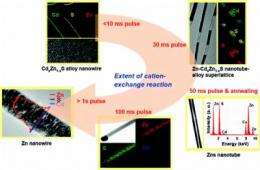
Using only chemical reactants, engineers transformed semiconducting nanowires into a variety of useful, nanoscale materials. Credit: Ritesh Agarwal, the University of Pennsylvania
A team of engineers from the University of Pennsylvania has transformed simple nanowires into reconfigurable materials and circuits, demonstrating a novel, self-assembling method for chemically creating nanoscale structures that are not possible to grow or obtain otherwise.
The research team, using only chemical reactants, transformed semiconducting nanowires into a variety of useful, nanoscale materials including nanoscale metal strips with periodic stripes and semiconducting patterns, purely metallic nanowires, radial heterostructures and hollow semiconducting nanotubes in addition to other morphologies and compositions.
Researchers used ion exchange, one of the two most common techniques for solid phase transformation of nanostructures. Ion (cation/anion) exchange reactions exchange positive or negative ions and have been used to modify the chemical composition of inorganic nanocrystals, as well as create semiconductor superlattice structures. It is the chemical process, for example, that turns hard water soft in many American households.
Future applications of nanomaterials in electronics, catalysis, photonics and bionanotechnology are driving the exploration of synthetic approaches to control and manipulate the chemical composition, structure and morphology of these materials. To realize their full potential, it is desirable to develop techniques that can transform nanowires into tunable but precisely controlled morphologies, especially in the gas-phase, to be compatible with nanowire growth schemes. The assembly, however, is an expensive and labor-intensive process that prohibits cost-effective production of these materials.
Recent research in the field has enabled the transformation of nanomaterials via solid-phase chemical reactions into nonequilibrium, or functional structures that cannot be obtained otherwise.
In this study, researchers transformed single-crystalline cadmium sulfide nanowires into composition-controlled nanowires, core−shell heterostructures, metal-semiconductor superlattices, single-crystalline nanotubes and metallic nanowires by utilizing size-dependent cation-exchange reactions along with temperature and gas-phase reactant delivery control. This versatile, synthetic ability to transform nanowires offers new opportunities to study size-dependent phenomena at the nanoscale and tune their chemical/physical properties to design reconfigurable circuits.
Researchers also found that the speed of the cation exchange process was determined by the size of the starting nanowire and that the process temperature affected the final product, adding new information to the conditions that affect reaction rates and assembly.
"This is almost like magic that a single-component semiconductor nanostructure gets converted into metal-semiconductor binary superlattice, a completely hollow but single crystalline nanotube and even a purely metallic material," said Ritesh Agarwal, assistant professor in the Department of Materials Science and Engineering at Penn. "The important thing here is that these transformations cannot take place in bulk materials where the reaction rates are incredibly slow or in very small nanocrystals where the rates are too fast to be precisely controlled. These unique transformations take place at 5-200 nanometer-length scales where the rates can be controlled very accurately to enable such intriguing products. Now we are working with theoreticians and designing new experiments to unravel this 'magic' at the nanoscale."
The fundamental revelation in this study is a further clarification of nanoscale chemical phenomena. The study also provides new data on how manufacturers can assemble these tiny circuits, electrically connecting nanoscale structures through chemical self-assembly.
It also opens up new possibilities for the transformation of nanoscale materials into the tools and circuits of the future, for example, self-assembling nanoscale electrical contacts to individual nanoscale components, smaller electronic and photonic devices such as a series of electrically connected quantum dots for LEDs or transistors, as well as improved storage capacities for batteries.
More information: The study has been published in the current issue of the journal Nano Letters.
-
Nanosys Announces Issued Patent Covering Fundamental Nanowire Heterostructures
May 06, 2005 |
not rated yet |
0
-
Scientists demonstrate method for integrating nanowire devices directly onto silicon
May 08, 2008 |
not rated yet |
0
-
Electric field can align silver nanowires
May 17, 2006 |
not rated yet |
0
-
Integration of semiconductor and superconductor electronics on the nanoscale
Jul 08, 2005 |
not rated yet |
0
-
New Nanowire-Based Memory Could Beef Up Information Storage
Jul 02, 2008 |
not rated yet |
0
-
Engineers build first sub-10-nm carbon nanotube transistor
Feb 01, 2012 |
4.9 / 5 (33) |
30
-
Something old, something new: Evolution and the structural divergence of duplicate genes
Jan 31, 2012 |
4.6 / 5 (7) |
1
-
The hidden nanoworld of ice crystals: Revealing the dynamic behavior of quasi-liquid layers
Jan 30, 2012 |
5 / 5 (4) |
1
-
Stock market network reveals investor clustering
Jan 27, 2012 |
3.9 / 5 (23) |
8
-
Of microchemistry and molecules: Electronic microfluidic device synthesizes biocompatible probes
Jan 26, 2012 |
5 / 5 (2) |
0
-
Can Plasma Be Solid
4 hours ago
-
What is delta Δ ?
4 hours ago
-
Need some help understanding HertzĀKnudsen formula
5 hours ago
-
Anatomy of Fat man: implosion-critical bomb
7 hours ago
-
what makes two sounds similar???
7 hours ago
-
What would happen when a jet travelling at Mach 10 experiences engine failure
14 hours ago
- More from Physics Forums - General Physics
More news stories
Lab study raises questions over nano-particle impact
Tests involving chickens have raised questions about the impact on health from engineered nano-particles, the ultra-fine grains commonly used in drugs and processed foods, scientists said on Sunday.
Nanotechnology / Bio & Medicine
9 hours ago |
5 / 5 (5) |
0
New kind of solar cell could capture significantly more energy than current cells
New solar cells could increase the maximum efficiency of solar panels by over 25%, according to scientists from the University of Cambridge.
Feb 08, 2012 |
4.5 / 5 (13) |
14
|
Nanoshell whispering galleries improve thin solar panels
Visitors to Statuary Hall in the U.S. Capitol Building may have experienced a curious acoustic feature that allows a person to whisper softly at one side of the cavernous, half-domed room and for another on ...
Nanotechnology / Nanomaterials
Feb 07, 2012 |
4.4 / 5 (7) |
6
|
'Dark plasmons' transmit energy
Microscopic channels of gold nanoparticles have the ability to transmit electromagnetic energy that starts as light and propagates via "dark plasmons," according to researchers at Rice University.
Feb 09, 2012 |
4.8 / 5 (10) |
1
|
Revealing how a battery material works
Since its discovery 15 years ago, lithium iron phosphate (LiFePO4) has become one of the most promising materials for rechargeable batteries because of its stability, durability, safety and ability to deliver ...
Nanotechnology / Nanomaterials
Feb 08, 2012 |
5 / 5 (6) |
0
|
Scientists discover molecular secrets of 2,000-year-old Chinese herbal remedy
For roughly two thousand years, Chinese herbalists have treated Malaria using a root extract, commonly known as Chang Shan, from a type of hydrangea that grows in Tibet and Nepal. More recent studies suggest that halofuginone, ...
New method to examine batteries -- MRI from the inside
There is an ever-increasing need for advanced batteries for portable electronics, such as phones, cameras, and music players, but also to power electric vehicles and to facilitate the distribution and storage of energy derived ...
Google might launch Drive for cloud storage soon
(PhysOrg.com) -- Google's next big move, according to the Wall Street Journal, is a cloud storage service called Drive. Hardly first to the plate, Google is simply catching up to introducing its cloud reposi ...
A mitosis mystery solved: How chromosomes align perfectly in a dividing cell
Although the process of mitotic cell division has been studied intensely for more than 50 years, Whitehead Institute researchers have only now solved the mystery of how cells correctly align their chromosomes during symmetric ...
Starve a virus, feed a cure? Findings show how some cells protect themselves against HIV
A protein that protects some of our immune cells from the most common and virulent form of HIV works by starving the virus of the molecular building blocks that it needs to replicate, according to research published online ...
Researchers find extensive RNA editing in human transcriptome
In a new study published online in Nature Biotechnology, researchers from BGI, the world's largest genomics organization, reported the evidence of extensive RNA editing in a human cell line by analysis of RNA-seq data, demons ...