EphA4 -- the molecular transformer
October 23, 2009 EphA4 -- the molecular transformer

Enlarge

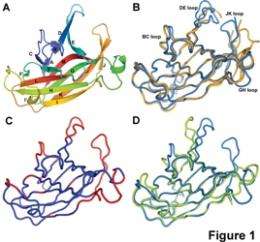
The structure of EphA4

(PhysOrg.com) -- EphA4 is a protein which is attached to the surfaces of many types of human cells and plays a role in a wide range of biological processes. EphA4 functions by binding to ephrin ligands, cell surface proteins which sit on opposing cells. The signalling cascades which result from this contact direct cells to move in a particular direction, to the right place in the body. This is critical in the development of the nervous system, and has also been linked with the suppression of melanoma tumours.

There are fourteen Eph and eight ephrin ligands in the human . These are divided into two classes, A and B. Generally receptors and ligands can only bind strongly to others in the same class, i.e. a class A receptor will bind to a class A ligand. However, this is not always the case, and one receptor in particular, Eph4A, has been known to bind to both class A and B ephrins.

Researchers from the University of Oxford have been studying the EphA4 receptor because it has the potential to be a target in the treatment of cancer. To realise this potential it is necessary to understand the mechanisms by which EphA4 binds to both class A and B ephrins on the molecular scale. They looked at the structure of EphA4 alone, and when bound to both class A and class B ephrins.

They found that when EphA4 is bound to a class A ephrin, it has a shape similar to other class A receptors, but when binding to a class B ephrin it actually changes its shape to resemble other class B receptors. This research has been published in the journal Structure.

“Our results show that EphA4 is a molecular transformer, able to change its shape depending on the that it wants to bind. This explains how, at an , it is able to bind to both classes of ephrins. This is important in understanding how the nervous system develops, and also has potential as a future target for cancer treatments,” said Dr Thomas Bowden, University of Oxford.

More information: Structural Plasticity of Eph Receptor A4 Facilitates Cross-Class Ephrin Signaling Thomas A. Bowden, A. Radu Aricescu, Joanne E. Nettleship, Christian Siebold, Nahid Rahman-Huq, Raymond J. Owens, David I. Stuart and E. Yvonne Jones, Structure, 17 (10), 1386-1397, October 2009, doi:10.1016/j.str.2009.07.018

Provided by Diamond Light Source


print this article email this article download pdf blog this article bookmark this article     Stumble it Digg this share on Facebook retweet share on Reddit add to delicious
Rate this story - not rated yet


October 23, 2009 all stories

Comments: 0

not rated yet
  • Stumble this up

  • Digg this

  • share this

  • hide
  • Related Stories

  • Sharing the road
    created Apr 10, 2008 | popularity not rated yet | comments 0
  • Star-shaped cells in the brain aid with learning
    created Sep 07, 2009 | popularity not rated yet | comments 0
  • Odd protein interaction guides development of olfactory system
    created Oct 29, 2007 | popularity not rated yet | comments 0
  • A molecule keeps anxiety down
    created Aug 19, 2008 | popularity not rated yet | comments 0
  • Scientists find mechanism that constructs key brain structure
    created Sep 16, 2009 | popularity not rated yet | comments 0


  • hide
  • Relevant PhysicsForums posts

  • Goddard
    created 11 hours ago
  • Rate Laws
    created 13 hours ago
  • why oxygen, cannot act as a pi-donor while NO can?
    created Nov 20, 2009
  • Aspirin
    created Nov 19, 2009
  • More from Physics Forums - Chemistry

Other News

Accidental discovery produces durable new blue pigment for multiple applications

Accidental discovery produces durable new blue pigment for multiple applications

Chemistry / Biochemistry

created Nov 16, 2009 | popularity 4.5 / 5 (30) | comments 6

An accidental discovery in a laboratory at Oregon State University has apparently solved a quest that over thousands of years has absorbed the energies of ancient Egyptians, the Han dynasty in China, Mayan ...


One word: bioplastics

One word: bioplastics

Chemistry / Materials Science

created Nov 17, 2009 | popularity 4.6 / 5 (12) | comments 4

(PhysOrg.com) -- Every year, more than 250 billion pounds of plastic are produced worldwide. Much of it ends up in the world's oceans, a fact that troubles MIT biology professor Anthony Sinskey.


New on-off 'switch' triggers and reverses paralysis in animals with a beam of light

New on-off 'switch' triggers and reverses paralysis in animals with a beam of light (w/ Video)

Chemistry / Biochemistry

created Nov 18, 2009 | popularity 4.8 / 5 (5) | comments 3

In an advance with overtones of Star Trek phasers and other sci-fi ray guns, scientists in Canada are reporting development of an internal on-off "switch" that paralyzes animals when exposed to a beam of ultraviolet ...


New research provides blueprint for molecular basis of global warming

New research provides blueprint for molecular basis of global warming

Chemistry / Materials Science

created Nov 17, 2009 | popularity 4 / 5 (4) | comments 3

A new study indicates that major chemicals most often cited as leading causes of climate change, such as carbon dioxide and methane, are outclassed in their warming potential by compounds receiving less attention.


Ethanol

Microbes to Take Over Ethanol Production?

Chemistry / Biochemistry

created Nov 20, 2009 | popularity 3.5 / 5 (6) | comments 0

(PhysOrg.com) -- Not too long ago, it seemed that ethanol production was the wave of the future. The use of trash, wood chips or different types of plants -- usually grass or corn -- to make ethanol was considered ...