Navy Researchers Apply Science to Fire Fighting
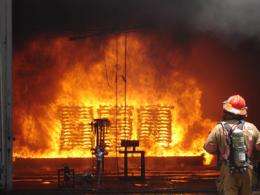
A fire aboard a Navy ship can quickly become a deadly cauldron. The grim reminders of this would be the deadly fires that took place aboard the USS Forrestal in 1967 or the USS Enterprise in 1969.
Today's Navy scientists are conducting research to insure that sailors and their ships can be protected from the deadly effects of fire. The Navy Technology Center for Safety & Survivability, located at the Naval Research Laboratory in Washington, DC, carries out research aimed to solve current and future Navy problems regarding combustion, fire extinguishment, fire modeling and scaling, damage control, and atmosphere hazards. Dr. Frederick Williams, Director of the Center explains that, "The Center's mission is to assure that the sailors have the best tools possible to combat the ravages of shipboard fires."
The Center has unique fire research facilities that include pressurable chambers up to a 10,000 cubic foot capacity at the Centers test site at NRL's Chesapeake Bay Detachment in Calvert County, Maryland. The Center also has custody of the world's unique fire test ship, ex-USS Shadwell (LSD-15) located in Mobile Alabama, where full-scale fire and damage control tests are conducted using the reality conformations of active duty sailors. Using the ex-USS Shadwell, NRL scientists are able to enhance their technology base for introducing advanced damage control concepts to the fleet. The ship provides a unique opportunity to realistically experience a true damage control environment, to create a partnership between the technical and fleet communities, and to take advantage of new insights gleaned during full-scale experimentation.
Today's Navy scientists and engineers are seeing success in several areas of fire fighting research. Two areas that are of particular note involve the use of high expansion foam and halon alternatives.
High Expansion Foam
Scientists at NRL have successfully tested high expansion foam aboard the U.S. Navy fire test vessel, ex-USS Shadwell. The Navy is interested in the use of high expansion foam to protect large volume, mission critical spaces, such as hangar bays, well decks, vehicle stowage areas and magazines in future ships. In highly obstructed spaces, fires collect behind obstructions or underneath machinery and are difficult to reach by traditional water or low expansion foam spray systems. High expansion foam can quickly fill a compartment and get water to fire threats in amounts sufficient to extinguish the fires but substantially less than amounts than typically delivered by deluge sprinkler water systems.
In the tests conducted aboard the ex-USS Shadwell, test engineers compared high flow rate Aqueous Film Forming Foam (AFFF) overhead deluge sprinklers and two high expansion foam systems against a triple threat fire (Class A, Class B pool and Class B running fuel fires). The high expansion foam systems included a fan-type system using outside air to generate expanded foam, or an inside-air system using ceiling-mounted generators within the protected space. Navy researchers found the high expansion foam to be the system of choice for fighting fires in those areas where there is a potential for multiple obstructed fire threats.
As far as long-term goals, Navy researchers will work to establish compatibility between different manufacturers' agents and common proportioning systems. They will also work to develop dual AFFF/high expansion agents and multi-use proportioning systems that would significantly increase installation flexibility for shipboard applications.
SSC Halon Alternative
The Navy is currently developing and building the Ship-to-Shore Connector (SSC), which will replace the existing Landing Craft Air Cushion (LCAC). Fire protection for the SSC must be "Halon-free," which requires identifying suitable firefighting agents to replace the Halon 1301 and Halon 1211 systems, which currently protect the turbine engine enclosures, auxiliary power units, fuel bays, and the cargo deck on the LCAC. Also, since the SSC will be minimally manned and weight will be a critical factor, firefighting agents and systems that offer low weight and low life cycle cost economies are essential. The alternative firefighting agents must also accommodate the SSC's operating temperature range of 10° to 200° F.
NRL researchers recently completed highly successful tests to demonstrate the effectiveness of propelled extinguishing agent technology (PEAT) to protect the SSC turbine engine enclosures, auxiliary power units, and fuel bay compartments. The class of PEAT generators chosen for the SSC application was solid particle aerosol-type generators. This particular type of PEAT generator was chosen because of its technology maturity, commercial availability and its environmental acceptability related Ozone Depletion Potential and Global Warming Potential. During NRL fire testing, the PEAT aerosol units were able to extinguish all of the Class B pool and Class B spray fire threats and meet the Naval Sea Systems Command established requirements for re-ignition mitigation. The successes of this fire test series offer a more than a 50% reduction in weight and maintenance-free fire protection option for the SSC program.
For a number of years, the Navy and Air Force have tried to find a suitable replacement for Halon 1211 for aviation applications and this research is still on-going. For the SSC, the Halon 1211 alternative options had to take into account the mixed fuel loads and extreme clutter that may be present, and to identify a firefighting agent that would provide effective standoff capability for a firefighter that will have minimal personal protection equipment. Navy fire tests engineers tested alternative fire extinguishing agents aboard the Navy's fire test ship, ex-USS Shadwell, in the spring of 2009 and identified that a 150 lb ABC extinguisher is the best alternative for the Halon 1211 replacement for the SSC Cargo Deck application.
NRL's successes with the SSC Halon Replacement program is significant because PEAT provides an effective technology remedy that provides:
• An environmentally friendly fire fighting agent
• A module approach with sealed units (no moving parts, no pressurized containers, no pumps, and self-monitoring electric release)
• Simple installation and minimal maintenance (no pipes to be installed)
• Long self-life (10 years minimum)
These advantages may soon be applied to other U.S. Navy ship applications, where a low cost and weight fire protection system is desired.
Provided by Naval Research Laboratory (news : web)


