Largest solar panel plant in US rises in Fla.
October 24, 2009 By CHRISTINE ARMARIO , Associated Press Writer Largest solar panel plant in US rises in Fla. (AP)

Enlarge

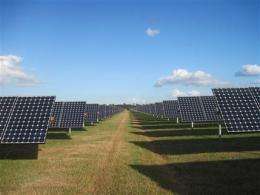
Acres of open land filled with solar panels is seen in a Wednesday, Oct. 21 2009 photo, at the DeSoto Next Generation Solar Energy Center in Ardacia, Fla., which will be the nation's largest solar photovoltaic plant in the country. The center is set for completion by the end of this month. (AP Photo/Christine Armario)

(AP) -- Greg Bove steps into his pickup truck and drives down a sandy path to where the future of Florida's renewable energy plans begin: Acres of open land filled with solar panels that will soon power thousands of homes and business.

For nearly a year, construction workers and engineers in this sleepy Florida town of citrus trees and cattle farms have been building the nation's largest solar panel energy plant. Testing will soon be complete, and the facility will begin directly converting sunlight into energy, giving Florida a momentary spot in the solar energy limelight.

The Desoto Next Generation Center will power a small fraction of Florida Power & Light's 4-million plus customer base; nevertheless, at 25 megawatts, it will generate nearly twice as much energy as the second-largest photovoltaic facility in the U.S.

The White House said President Barack Obama is scheduled to visit the facility Tuesday, when it officially goes online and begins producing power for the electric grid.

As demand grows and more states create mandates requiring a certain percentage of their energy come from renewable sources, the size of the plants is increasing. The southwest Florida facility will soon be eclipsed by larger projects announced in Nevada and California.

"We took a chance at it and it worked out," said Bove, construction manager at the project, set on about 180 acres of land 80 miles southeast of Tampa. "There's a lot of backyard projects, there's a lot of rooftop projects, post offices and stores. Really this is one of the first times where we've taken a technology and upsized it."

Despite its nickname, the Sunshine State hasn't been at the forefront of . Less than 4 percent of Florida's energy has come from renewable sources in recent years. And unlike California and many other states, Florida lawmakers haven't agreed to setting clean energy quotas for electric companies to reach in the years ahead.

California, New Jersey and Colorado have led the country in installing photovoltaic systems; now Florida is set to jump closer to the top with the nation's largest plant yet.

The Desoto facility and two other solar projects Florida Power & Light is spearheading will generate 110 megawatts of power, cutting greenhouse gas emissions by more than 3.5 million tons. Combined, that's the equivalent of taking 25,000 cars off the road each year, according to figures cited by the company.

The investment isn't cheap: The Desoto project cost $150 million to build and the power it supplies to some 3,000 homes and businesses will represent just a sliver of the 4 million-plus accounts served by the state's largest electric utility.

But there are some economic benefits: It created 400 jobs for draftsmen, carpenters and others whose work dried up as the southwest Florida housing boom came to a closure and the recession set in. Once running, it will require few full-time employees.

Mike Taylor, director of research and education at the nonprofit Solar Electric Power Association in Washington, said the project puts Florida "on the map."

"It's currently the largest," Taylor said of the Desoto photovoltaic plant. "But it certainly won't be the last."

There are two means of producing electricity from the sun: photovoltaic cells that directly convert ; and thermal power, which uses mirrors to heat fluid and produce steam to run a turbine power generator.

Taylor said a one- or two-megawatt project was considered large not long ago. The size has slowly increased each year.

Overall, the United States still trails other nations in building photovoltaic plants.

Spain and Germany have made larger per capita commitments to solar power because of aggressive government policies, said Stephen Smith, executive director of the Southern Alliance for Clean Energy. And China has announced plans to pay up to 50 percent of the price of solar power systems of more than 500 megawatts.

"If we don't get our market right and send the right market signals and really support growing this technology, we will be buying from other countries," Smith said.

In April, Arizona-based manufacturer First Solar Inc. announced plans to build a 48-megawatt plant in Nevada, producing power for about 30,000 homes. Even that pales compared to recently announced plans for a 2 gigawatt facility in China. First Solar has initial approval to build it.

©2009 The Associated Press. All rights reserved. This material may not be published, broadcast, rewritten or redistributed.


print this article email this article download pdf blog this article bookmark this article     Stumble it Digg this share on Facebook retweet share on Reddit add to delicious
Rate this story - 3.9 /5 (23 votes)

Rank Filter

Move the slider to adjust rank threshold, so that you can hide some of the comments.


Display comments: newest first

  • Buyck - Oct 24, 2009
    • Rank: 3 / 5 (3)
    Good good... we must have such initiatives on more places in the world. And spending more money in higher efficiency of solar panels to at least 35 to 50%.
  • 3432682 - Oct 24, 2009
    • Rank: 3.5 / 5 (6)
    $50,000 per home or business. Brilliant. How much money will we waste before we catch on?
  • mikejuly24 - Oct 24, 2009
    • Rank: 3.7 / 5 (3)
    I am a bit uneasy with the numbers here. The article claims that the Florida plant of 25MW will be able to supply 3,000 homes and businesses, where as, a 48MW plant in Nevada(less than double the size) will be able to power 30,000 homes. Either these numbers don't make sense or the businesses and homes in Florida use about 5 times more energy.
  • Sean_W - Oct 24, 2009
    • Rank: 3.7 / 5 (3)
    I have no axe to grind against alternative energies and I think R&D into them are important but 150 million dollars to supply energy to 3000 homes doesn't sound like a good investment. I don't know how long they expect the equipment to last or if some of that $150 million is budgeted for replaceing it over time but it just sounds like a bad idea. Forcing through huge projects before the technology is commercially viable using government funds is a sure way to turn people against the concept.
  • daqman - Oct 24, 2009
    • Rank: 5 / 5 (2)
    I pulled out my electricity bill and took a look. My home (five bedrooms with a family of four) uses on average about 40 kWh per day. So approximately an average of 1.7 kW continuous power. So a 25 MW plant should power 14,700 homes not 3000. That's still 10,000 per home but that's less than 10 years worth of power bills at the going rate and, presumably, the plant will last longer than that.
  • grgfraiser - Oct 24, 2009
    • Rank: 3 / 5 (2)
    it's all good till a hurricane hits
  • RealScience - Oct 24, 2009
    • Rank: 3.7 / 5 (3)
    Dagman - A photovoltaic solar plant only produces power when the sun is shining, whereas you divided your use by 24 hours per day.

    In Florida for flat panels on one-axis trackers this would be a factor of four difference, so it should be about 3700 homes like yours, or $40,000 per year.

    That is too expensive to be practical from a purely short-term economic viewpoint.

    In the long term, however, it does help bring solar costs down faster and bring forward the day that solar can stand on its own.

    I'm not fond of subsidies, but oil is subsidized, too (the Iraq war alone costs $2 per gallon, and yes, it is about oil), and nuclear power has been subsidized (governments paid for development, and still pay for insurance).

    But I have to agree with Sean_W that this particular project seems a bit too expensive, not even following the recent downward trend in costs.
  • GeToChKn - Oct 24, 2009
    • Rank: 3 / 5 (2)
    For the all people saying the math doesn't work, try your English a bit more first. "3000 homes and businesses" and "30,000 homes". Maybe the businesses use more electricity than a home, and therefore you won't get the same mW per house you're looking for.
  • GeToChKn - Oct 24, 2009
    • Rank: not rated yet
    Also, looking at per capita energy consumption by state shows that Florida uses more energy than Arizona, therefore again allowing more homes in Arizona than Florida off the same power amount.
  • RAL - Oct 25, 2009
    • Rank: 3 / 5 (2)
    I'm all for research on solar but throwing 150 million into an operating facility that will only supply 3000 homes is like taking money out and burning it. There are far cheaper and more efficient ways of producing electricity. It's not like we have money to spend this foolishly.
  • dirk_bruere - Oct 26, 2009
    • Rank: 4 / 5 (1)
    It is more cost effective to install on domestic premises. That way the cost is amortized against the retail cost of electricity from the mains.

October 24, 2009 all stories

Comments: 11

3.9 /5 (23 votes)
  • Stumble this up

  • Digg this

  • share this

  • hide
  • Related Stories

  • New Florida City To Run On Solar Power
    created Apr 13, 2009 | popularity not rated yet | comments 0
  • Can solar work help save jobs at space center
    created Jun 02, 2009 | popularity not rated yet | comments 0
  • Ground broken on Nevada solar plant
    created Feb 13, 2006 | popularity not rated yet | comments 0
  • Canada awards $1.1M for energy projects
    created Nov 21, 2007 | popularity not rated yet | comments 0
  • Desert power: A solar renaissance
    created Apr 01, 2008 | popularity not rated yet | comments 0


  • hide
  • Relevant PhysicsForums posts

  • Aspiring Engineering major looking for general answers
    created Nov 19, 2009
  • Calculating max load of square tube (steel)
    created Nov 19, 2009
  • Passive Chemical Heating
    created Nov 19, 2009
  • Shortening Boat Trailer
    created Nov 18, 2009
  • Strain Gage Test Advice
    created Nov 17, 2009
  • How Could I do This? Motor to open and close doors on a timer??
    created Nov 17, 2009
  • More from Physics Forums - General Engineering

Other News

Hackers leak e-mails, stoke climate debate

Technology / Internet

created 4 hours ago | popularity 4.6 / 5 (8) | comments 4

(AP) -- Computer hackers have broken into a server at a well-respected climate change research center in Britain and posted hundreds of private e-mails and documents online - stoking debate over whether some scientists have ...


plug-in hybrid electric vehicle

Pulling the plug on hybrid myths

Technology / Energy

created Nov 19, 2009 | popularity 3.8 / 5 (12) | comments 17

(PhysOrg.com) -- Whether you call them myths, urban legends, fables or old wives' tales, there's a lot of misinformation out there about plug-in electric hybrid vehicles. These vehicles, abbreviated PHEVs, ...


UK police make 2 Trojan computer virus arrests

Technology / Internet

created Nov 18, 2009 | popularity 5 / 5 (1) | comments 10

(AP) -- A couple suspected of helping spread some of the Internet's most aggressive computer viruses has been arrested in the English city of Manchester, police said Wednesday.


A sign marks the entrance to IBM Corporate Headquarters

IBM makes Big Blue cloud

Technology / Software

created Nov 16, 2009 | popularity 2.9 / 5 (8) | comments 8

IBM on Monday announced it has created the world's largest business computing "cloud" capable of holding an amount of digital data on a par with 250 billion iTunes songs.


Google SPDY

Google's SPDY will speed up downloads

Technology / Internet

created Nov 16, 2009 | popularity 4.4 / 5 (16) | comments 7

(PhysOrg.com) -- As part of its effort to speed up the Web, Google is experimenting with SPDY, a new application layer protocol, that it hopes will speed up the conversation between browsers and Web servers ...