NASA satellite still sees heavy rainfall in Tropical Storm Neki
October 24, 2009
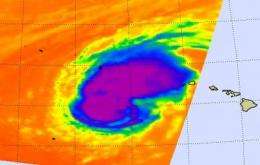
The Atmospheric Infrared Sounder instrument on NASA's Aqua satellite captured an infrared image of Hurricane Neki on October 22 at 2:59 a.m. local time. Infrared imagery revealed the deep convection in Neki's center and in the northeast quadrant of the storm. The coldest cloud tops are cold as or colder than 220K (Kelvin) or minus 63F. The blue areas are around 240K, or minus 27F. Credit: NASA/JPL, Ed Olsen
Tropical Storm Neki continues moving north and over the weekend it will be in open waters in the Central Atlantic. NASA's Tropical Rainfall Measuring Mission (TRMM) satellite passed over Neki early on October 23 and noticed some intense areas of rainfall, even though it is not a hurricane anymore.
On Friday afternoon, October 23, a Tropical Storm warning was still effect for The Papahanaumokuakea National Monument from Nihoa Island to French Frigate Shoals to Maro Reef.
On October 23 at 11 a.m. EDT (5 a.m. HST), Neki had maximum sustained winds near 70 mph. It was moving north-northeast near 7 mph, and had a minimum central pressure of 995 millibars. Its center was about 90 miles south-southeast of French Frigate Shoals and 400 miles west of Lihue, Hawaii near 22.8 North and 165.6 West.
This video is not supported by your browser at this time.
The French Frigate Shoals is the largest atoll in the northwestern Hawaiian Islands. It got its mane name from the French explorer Jean-François de La Pérouse, who almost lost two frigates when attempting to navigate the shoals.The Tropical Rainfall Measuring Mission (TRMM) satellite, managed by NASA and the Japanese Space Agency (JAXA) passed over Tropical Storm Neki on October 23 at 0124 UTC (9:24 a.m. EDT Oct. 22) and captured a look at Neki's rainfall. TRMM found that areas of heavy rainfall continued to fall in the northeast and the northern quadrants of the storm. Rainfall rates were very intense, around 2 inches (50 millimeters) per hour in those areas of Neki. Because rainfall is so intense, the Central Pacific Hurricane Center is calling for rainfall amounts between 8 and 12 inches in Neki's path over the weekend.
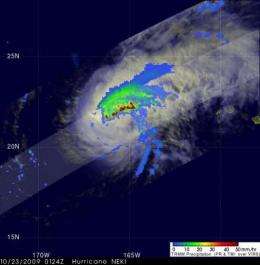
The Tropical Rainfall Measuring Mission analysis of rainfall within Neki on Oct. 23 at 0124 UTC showed areas of heavy rainfall, about 2 inches per hour (red). The yellow and green areas indicate moderate rainfall between .78 to 1.57 inches per hour. Neki was moving into the French Frigate Shoals (west-northwest of the Hawaiian Islands) at the time of this image. Credit: NASA/SSAI, Hal Pierce
Rain rates are created from different instruments aboard TRMM. The rain rates in the center of TRMM images are derived from the TRMM Precipitation Radar, the only spaceborne radar of its kind, while those in the outer portion are from the TRMM Microwave Imager. The rain rates are then overlaid on infrared data from the TRMM Visible Infrared Scanner to create the entire image. The images are created at NASA's Goddard Space Flight Center, in Greenbelt, Md.Hal Pierce of NASA's TRMM Team at NASA Goddard also created an animation of rainfall laid over cloud cover (see above).
High seas and large surf will continue to impact portions of the Papahanaumokuakea National Monument Friday and Friday night.
Neki and is expected to continue weakening while moving toward the north-northeast over the weekend.
-
TRMM sees some heavy rains in Neki as it heads toward Johnston Island
Oct 20, 2009 |
not rated yet |
0
-
Papahanaumokuakea National Monument facing Hurricane Neki
Oct 22, 2009 |
not rated yet |
0
-
NASA's TRMM satellite sees heavy rainfall in Choi-Wan
Sep 17, 2009 |
not rated yet |
0
-
NASA sees Carlos power back up to hurricane status in 3-D
Jul 14, 2009 |
not rated yet |
0
-
NASA eyes Hilda's Hawaiian hangout -- south of the islands
Aug 26, 2009 |
not rated yet |
0
-
Engineers build first sub-10-nm carbon nanotube transistor
Feb 01, 2012 |
4.9 / 5 (33) |
30
-
Something old, something new: Evolution and the structural divergence of duplicate genes
Jan 31, 2012 |
4.6 / 5 (7) |
1
-
The hidden nanoworld of ice crystals: Revealing the dynamic behavior of quasi-liquid layers
Jan 30, 2012 |
5 / 5 (4) |
1
-
Stock market network reveals investor clustering
Jan 27, 2012 |
3.9 / 5 (23) |
8
-
Of microchemistry and molecules: Electronic microfluidic device synthesizes biocompatible probes
Jan 26, 2012 |
5 / 5 (2) |
0
-
Do some geologists actually act a lot like Randy Marsh?
Feb 11, 2012
-
Discrepancy between oxygen and carbon-dioxide levels
Feb 09, 2012
-
where gems are found in the world
Feb 09, 2012
-
Wind Waves in Reservoir ~ Wind run-up and Wind set-up
Feb 08, 2012
-
Balance of oxygen in the atmosphere
Feb 01, 2012
-
The case for a methanol-based economy
Jan 30, 2012
- More from Physics Forums - Earth
More news stories
Salvage workers begin pumping fuel from Italian shipwreck
Salvage workers Sunday began pumping fuel from the shipwrecked Italian cruise liner Costa Concordia, a day ahead of schedule, officials said.
6 hours ago |
5 / 5 (1) |
0
Latin America mining boom clashes with conservation
Latin America is experiencing a mining boom as prices rise fuelled by a hike in global demand, but the region is also being hit by a wave of violent protests, strikes and rallies by environmentalists.
14 hours ago |
5 / 5 (1) |
1
Political leaders play key role in how worried Americans are by climate change: study
More than extreme weather events and the work of scientists, it is national political leaders who influence how much Americans worry about the threat of climate change, new research finds.
Feb 06, 2012 |
5 / 5 (7) |
73
NASA budget will axe Mars deal with Europe: scientists
US President Barack Obama's budget proposal to be submitted next week for 2013 will cut NASA's budget by 20 percent and eliminate a major partnership with Europe on Mars exploration, scientists said Thursday.
Space & Earth / Space Exploration
Feb 10, 2012 |
5 / 5 (3) |
58
Humans may have helped the decline of African rainforests 3000 years ago
(PhysOrg.com) -- Large areas of rainforests in Central Africa mysteriously disappeared over three thousand years ago, to be replaced by savannas. The prevailing theory has been that the cause was a change ...
Declining health-care productivity in England: Who says so?
Reports that the National Health Service in England has been declining in productivity in the last decade appear to have been accepted as fact. However, a Viewpoint published Online First by The Lancet disputes this. The Vi ...
Scientists discover molecular secrets of 2,000-year-old Chinese herbal remedy
For roughly two thousand years, Chinese herbalists have treated Malaria using a root extract, commonly known as Chang Shan, from a type of hydrangea that grows in Tibet and Nepal. More recent studies suggest that halofuginone, ...
New method to examine batteries -- MRI from the inside
There is an ever-increasing need for advanced batteries for portable electronics, such as phones, cameras, and music players, but also to power electric vehicles and to facilitate the distribution and storage of energy derived ...
Overeating may double risk of memory loss
New research suggests that consuming between 2,100 and 6,000 calories per day may double the risk of memory loss, or mild cognitive impairment (MCI), among people age 70 and older. The study was released today and will be ...
A mitosis mystery solved: How chromosomes align perfectly in a dividing cell
Although the process of mitotic cell division has been studied intensely for more than 50 years, Whitehead Institute researchers have only now solved the mystery of how cells correctly align their chromosomes during symmetric ...
Lab study raises questions over nano-particle impact
Tests involving chickens have raised questions about the impact on health from engineered nano-particles, the ultra-fine grains commonly used in drugs and processed foods, scientists said on Sunday.

Oct 26, 2009
Rank: not rated yet